Snowbird season in South Florida: a restaurant and café playbook for November to May
Every South Florida operator knows the curve. Part-year residents start coming back in the fall, the holiday weeks get busy, late winter and spring fill every table, and around mid-May, as schools let out, many part-year residents head north and the season winds down. From Miami-Dade through Broward and Palm Beach, and over on the Naples and Fort Myers side, November to May can decide how the whole year goes.
The season rewards the places that get ready in October. This guide covers each step, before, during and after, for one location or many, and ends with a printable checklist.
This is general information, not legal advice. Updated October 4, 2026: the FloridaCommerce, Florida Constitution, Florida Statutes, DBPR, Department of Labor, National Hurricane Center and Google pages cited here were reviewed for this post.
The shape of the season
Every area and concept has its own curve, so use this as a frame and fill it in from your own sales:
Phase | Roughly when | What usually changes |
|---|---|---|
Arrivals | October and November | Weekday traffic climbs week by week as part-year residents return |
Holiday weeks | Thanksgiving to New Year's | Visiting families, holiday travelers and private parties on top |
Peak | January to March | Your busiest stretch, with local events on top |
Spring | March and April | Still strong, with school and college spring breaks |
Season ends | Mid-May | Part-year residents head north as schools let out |
Off-season | Late May to October | Summer heat, rainy afternoons and hurricane season |
Start by pulling last season's weekly sales, and sales by hour for a few typical weeks, from your POS.
Before you start: the tail of hurricane season
The Atlantic hurricane season runs from June 1 to November 30, and storms sometimes form outside those dates (NOAA National Hurricane Center). Your ramp-up overlaps it: review who decides to close and how you reach the team, check the generator and supplies, and know what happens to the walk-in in an outage.
Step 1: Forecast the season from last season
For each week from November to mid-May, ask: compared with an ordinary October week, how much busier was it last season?
- Pick a baseline week from last October, with no holidays or events.
- Divide each season week's sales by the baseline. That ratio is your season curve, in your own numbers.
- Adjust for what's different this year: new menu or hours, a new competitor nearby, construction on your street, holidays on different dates.
- List the days that aren't normal: holidays, local events, spring breaks, private bookings. See our holiday and event staffing guide.
Check sales by hour too: the season can move the rush, not just grow it. Write the forecast down with your reasoning, to compare when the season ends.
Step 2: Turn the forecast into a labor budget and a weekly ramp
- Choose your labor target as a share of sales. Use your own number; there's no universal right one.
- Budget = forecast sales × target. Divide by your average hourly cost to get the hours you can schedule.
- Separate fixed and variable hours. The opening crew and the manager on duty don't double when sales do; the extra hours go to the rush. Our slow-season guide shows how to read sales per labor hour by daypart, and the method works in reverse.
Then ramp week by week instead of switching from summer to peak overnight:
When | What to do |
|---|---|
Early October | Budget the season by week; decide how many people and which positions |
Mid to late October | Hire, start training, build November from the forecast |
November | Add shifts in steps as sales arrive; compare each week with the forecast |
December | Publish the holiday weeks early; offer extra shifts as open shifts |
January to April | Hold the peak schedule; check overtime and burnout every week |
Mid-May | Trim at the edges first (Step 7) |
Overtime piles up in peak weeks. Under federal law, non-exempt employees get at least time and a half for hours over 40 in a workweek, and "Averaging of hours over two or more weeks is not permitted" (DOL Fact Sheet #23). Our Florida pay rules guide covers overtime and tipped pay in more detail.
Step 3: Hire early, and train before the rush
Hire in October: people hired in late November are still learning when the peak arrives. Ask your best people from last season first, then experienced seasonal workers, students and part-timers who want more hours. Our hiring guide covers job posts, interviews and paid trial shifts.
Pay at the new Florida rates. Florida's minimum wage rose to $15.00 an hour on September 30, 2026, and FloridaCommerce lists it as in effect through December 31, 2027 (FloridaCommerce). For tipped employees who meet the FLSA tip credit rules, the direct cash wage is $11.98 an hour (the $15.00 minimum minus the $3.02 tip credit) (FloridaCommerce 2026 announcement). The same announcement reminds employers to post the state minimum wage notice; put up the 2026–2027 poster.
The yearly date also changes. The Florida Constitution raised the wage each September 30 until it reached $15.00 in 2026; from September 30, 2027, the rate is adjusted for inflation each year and takes effect the following January 1 (Florida Constitution, Art. X, §24). So there's no increase in the middle of this season, and the next change is January 1, 2028.
Food safety training deadlines. Every food service employee must be trained by a DBPR-approved program within 60 days of employment, and you must show proof on request, including at an inspection (s. 509.049, F.S.). The training is required every three years (DBPR food service employee training). A new manager has 30 days after employment to pass the food manager certification test (s. 509.039, F.S.). With a wave of October hires, put each deadline on the calendar the day they start; our health inspection guide covers what inspectors ask for.
Train in a week: food safety, allergens and the menu on day one, shadowing in busy shifts, then the station alone with a manager check, and a short quiz. Our one-week training guide has the full plan.
Teens and spring break. Federal limits for 14- and 15-year-olds depend on school: no more than 3 hours on a school day and 18 in a school week, up to 8 hours on a non-school day and 40 in a week without school, and only between 7 a.m. and 7 p.m. (9 p.m. from June 1 through Labor Day; DOL Fact Sheet #43). Florida adds its own limits; the hiring guide has them.
Step 4: Set the rules for peak weeks
The busiest weeks are also the ones your team most wants off. Decide the rules in October and share them in writing:
- Blocked days: the few dates nobody can request off, announced now, not in December.
- Advance notice: how far ahead requests must come in during the season.
- Season availability: ask everyone what they can work from November to mid-May, including school breaks, second jobs and trips home.
- Open shifts and cover: offer extra shifts as open shifts, name a backup for each key role on the busiest days, and agree how call-outs work. Blocked days don't change sick leave rules; see our call-outs guide.
- A fair rotation for the biggest days, so the same people don't work every holiday.
Step 5: Raise pars and order ahead
A busy Saturday in February runs on what you ordered on Wednesday.
- Raise par levels in steps that follow your forecast, not all at once in November. Our inventory guide covers pars, counts and ordering.
- Ask every vendor about season lead times and cutoffs, and line up backups for items that run short.
- Check storage in the walk-in, freezer and dry storage before the deliveries grow.
- Raise prep targets with the forecast, and print a prep list for each shift.
- Log waste daily. Bigger batches mean more to throw away when a rainy week empties the patio; see our waste log guide.
- Tighten the menu if the crew can't keep up in peak weeks; see seasonal menu changes.
Step 6: Hours, guests and reviews
Hours. If you extend hours for the season, change them everywhere guests look: the door, your website, reservation and delivery apps, and your Google Business Profile. Google's special hours set different hours for specific dates, and Google suggests confirming your hours for official holidays even when they don't change. Special hours cover up to 6 days in a row; for a closure of 7 days or more, Google advises marking the business temporarily closed (Google Business Profile Help). See our Google Business Profile guide for the rest of your listing.
Reservations and waitlists. Before the season, decide how many tables you hold for walk-ins and who owns the list on each shift.
The guest mix. In season you serve year-round regulars, returning part-year residents and first-time tourists. Keep the regulars welcome when the room is full; they carry you through the summer.
Reviews. More guests means more reviews, and new visitors read them before they choose. Read and reply every few days, low ratings first. Our guide to replying to Google reviews has examples.
Step 7: When the season ends (around mid-May): step down without losing your core team
How you step down decides who comes back next season.
- Trim at the edges first: shorter shifts and fewer people in quiet hours before anyone's hours are cut. Our slow-season guide walks through it.
- Ask first. Many seasonal staff plan to leave when the season ends, and some of your year-round team want a break.
- Protect the core team you need from late May to October and again next November.
- Lower pars and prep targets the way you raised them, and update your hours everywhere, Google included.
- Keep the best seasonal staff for next year: thank them, ask whether they're coming back, keep their contact details and note what they did well. See our staff turnover guide.
- Write the season review: forecast against actual by week, staffing gaps, stock-outs and waste. It's next season's starting point.
Where Mays fits
Scheduling, training, inventory and reviews in one app:
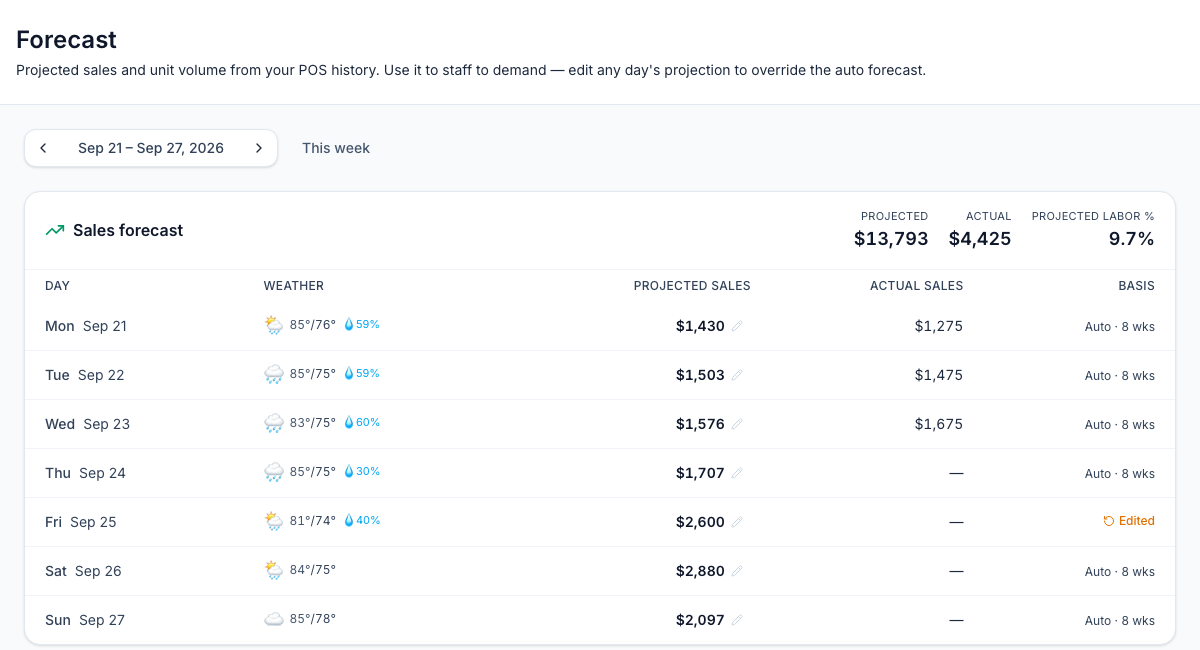
- Forecast and budget (the image at the top of this post). With Square or Union connected, Scheduling → Forecast projects each day's sales from the same weekday over the last 8 weeks, recent weeks counting more, next to the weather. It follows a ramp-up late and doesn't know holidays, so click a day and type your own projection; weeks more than about 8 weeks out have none, so plan those from last season's POS reports. Set a Weekly budget on the schedule, and compare projected with actual sales in Scheduling → Reports → Actuals.
- The ramp. Copy week gives you last week's shifts as drafts, the OT warnings card names everyone heading into overtime before you publish, and the Events row puts local events on the schedule.
- Wages. With Labor law compliance's Minimum wage on, Scheduling → Positions lists any wage below the legal minimum at the location.
- Peak-week rules. Blocked Days (Scheduling → Time Off) stops time-off requests in the app for the dates you pick, and admins can require advance notice. Staff can send Temporary availability for a season or school break, which you approve and see in Glance View.
- Open shifts and cover. Staff claim open shifts in the app and you approve them in Approvals. When someone can't make a shift, Find cover in the app shows who's free, puts the shift in the pool, or asks up to five of the best matches if they can cover.
- Training. Admins turn your SOPs into short modules with a quiz and assign them to a location or role, so seasonal hires who join later get them too. Pop quizzes go to people on shift who haven't passed yet.
- Food safety certificates. With Labor law compliance on, record each person's food handler card and manager certificate. The location shows who's missing a card against Florida's 60-day deadline after the hire date, and Mays reminds people before a card expires. Mays training isn't a DBPR-approved program, so keep using an approved one.
- Minors. With work rules for minors on, Mays warns you when a teen's shift breaks federal or Florida limits. Add your school district's calendar, breaks included, so spring break counts as no school.
- Inventory. Set pars on Inventory → Stock; Order to par builds orders and emails each vendor a PDF purchase order, with each vendor's delivery days, cutoff, lead time and minimum set per location. Prep sheets suggest how much to prep from your targets and what's on hand, and the Waste Log records what you throw away and why.
- Google reviews. The Reviews page lists your Google reviews for every location, filters the low-rated and unanswered ones, and posts your reply on Google. It shows the 50 newest, so check it often in season.
Mays doesn't change your Google hours or take reservations; update those where they live.
Your snowbird season checklist
Before the season (September and October)
- Storm plan, generator and supplies checked
- Last season's weekly and hourly sales pulled from your POS
- A forecast for every week to mid-May, with the reasoning written down
- A labor target, weekly budgets and a ramp plan
- Every wage checked against $15.00 and the $11.98 tipped cash wage; the 2026–2027 poster up
- Returning staff asked first; new hires started by late October
- Food handler and manager deadlines on the calendar for every hire
- A one-week training plan and a short quiz
- Blocked days, notice rules and season availability shared
- Vendors asked about lead times and backups; storage checked
- Season hours on the door, website, apps and Google
In season (November to mid-May)
- Forecast against actual every week, and the next weeks adjusted
- Schedules published early; extra shifts as open shifts
- Overtime checked before publishing
- Pars and prep targets raised with the forecast; counts current
- Waste logged daily, reviewed weekly
- Holiday hours confirmed on Google
- Reviews answered every few days
After the season (mid-May on)
- Shifts trimmed at the edges; volunteers asked first
- Pars and prep targets lowered; summer hours updated everywhere
- The best seasonal staff thanked, with contact details and notes kept
- A written season review
Sources
- FloridaCommerce, Florida minimum wage
- FloridaCommerce, Florida's minimum wage announcement (updated September 30, 2026)
- Florida Constitution, Article X, Section 24: Florida minimum wage
- Florida Statutes, s. 509.049: food service employee training
- Florida Statutes, s. 509.039: food service manager certification
- Florida DBPR, food service employee training
- US Department of Labor, Fact Sheet #23: overtime pay
- US Department of Labor, Fact Sheet #43: child labor in nonagricultural occupations
- NOAA National Hurricane Center, tropical cyclone climatology
- Google Business Profile Help, how to set special hours
Plan your season in Mays
Forecast the ramp, block the peak weeks, train new hires and raise your pars, in one app.
Start your free trial: 30 days, every module, no card needed. Or book a walkthrough and we'll set up your season schedule with you.