Training your first hires in one week
A new café's first hires usually learn the job the same way: they follow whoever is working, ask the same questions the last hire asked, and pick up three slightly different ways to steam milk. By the time you notice, the "standard" is whatever the busiest barista does.
A week is enough to get a new hire working safely and to your standard, if the week is planned. This guide gives you a day-by-day plan, how to keep your SOPs in one place, where short quizzes and shadow shifts fit, how to sign people off, and the Florida food-safety training deadlines to put on the calendar.
This is general information, not legal advice. Check the current rules with the Florida DBPR or your local health authority.
Before day one
Get these ready before the new hire walks in:
- The schedule for the week, with shadow shifts next to a named trainer, not "whoever's on."
- Your SOPs in one place: drink recipes, opening and closing steps, the cleaning schedule, the temperature checks, and what to do when something goes wrong.
- Their accounts: the scheduling and time clock app, the checklist app, the team chat.
- A trainer sign-off list for each station they'll learn.
Training time is paid time. Under federal rules, time spent in training counts as hours worked unless four conditions are all met: it's outside normal hours, it's voluntary, it isn't job related, and no other work is done at the same time (DOL Fact Sheet #22). A new barista's first week never meets those conditions, so schedule and pay it like any other shift.
Florida's food-safety training deadlines
Two deadlines start the day someone is hired, and inspectors check both.
Who | What | Deadline | Valid for | Source |
|---|---|---|---|---|
Every food service employee | Food handler training from a DBPR-approved program | Within 60 days of employment | 3 years | |
Every manager responsible for food storage, preparation or service | Pass an approved food protection manager certification exam | Within 30 days of employment | 5 years |
A few details that matter for a small café:
- Only division-approved training programs count for food handlers (DBPR food service employee training). Food manager certification comes from one of the accredited exam programs DBPR lists (DBPR food manager certification).
- Keep proof on site. You must show proof of employee training on request, including at an inspection, with the employee's name, date of birth, the training date and the approved program used (s. 509.049(5)). The same goes for manager certificates (s. 509.039).
- At least one certified food protection manager must be responsible for all periods of operation, and when four or more employees are storing, preparing or serving food at the same time, one must be present (Rule 61C-4.023(1)).
- Training also has to fit the job. Staff who prepare food must know safe thawing, cooking, cooling, handling, holding and storage; service staff must know safe serving; and whoever cleans must know proper cleaning and sanitizing (Rule 61C-4.023(4)(b)). That duty-specific training is your part, and your week-one plan is where it happens.
On DBPR's inspection list, "food manager certification" (53a) and "state approved food handler training; employee duty specific training/knowledge" (53b) are both intermediate violations (DBPR inspections page).
Put both deadlines on the calendar the day each person starts.
The one-week plan
For a new barista at a café open 7 am to 4 pm. Adjust the stations to your menu.
Day | Focus | What they do | Done when |
|---|---|---|---|
1 | Orientation and safety | Tour, paperwork, the app, handwashing, temperatures, allergens, what to do if they're sick. Read the week-one SOPs and take the first short quiz. | Quiz passed; food handler training booked |
2 | Shadow the opener | Follow the opening checklist next to the trainer: coolers, sanitizer, espresso dial-in, the pastry case. | Can explain every opening task |
3 | Bar, supervised | Make the core menu with the trainer watching. Milk steaming, the drink build order, cleaning between drinks. | Core drinks made to recipe |
4 | Register and floor | Register, handoffs, the tip policy, handling a complaint, restocking during the rush. | Runs the register through a rush |
5 | Close, supervised | Work the closing checklist: backflushing, grinders, labeling, the drawer count. | Trainer signs off on bar and close |
Days 6 and 7 are regular shifts, scheduled next to an experienced teammate. The first solo shift comes after the sign-offs, not on a fixed date.
SOPs in one place
The SOP binder in the back office doesn't get read. A good SOP library is:
- Short: one task per page. "Steaming oat milk" is an SOP; "Bar procedures" is a chapter nobody finishes.
- Visual: a photo of the finished drink, a 30-second video of the steam wand position.
- Specific: the numbers are in it (grams, seconds, degrees).
- Where the staff are: on their phones, searchable, not in a binder.
- Owned: one person updates it when the recipe changes, so there's one current version.
Short quizzes beat long tests
The point of a quiz in week one isn't to grade people. It's to catch the one rule someone misunderstood before it reaches a customer. Keep quizzes short (five questions on one topic is plenty), write questions straight from your SOPs, and explain the right answer when someone gets it wrong. Retakes are fine. The goal is that everyone ends up knowing it.
Good first topics: cold and hot holding temperatures, handwashing and glove use, allergens, date labeling, and when to tell the shift lead they're sick.
Shadow shifts that teach
A shadow shift works when the trainer knows they're training:
- Schedule it as a real shift with a label like "Training," so the trainer isn't also covered as a full pair of hands in the rush.
- Give the trainer the plan for that day and the sign-off list.
- Switch roles halfway: the new hire does, the trainer watches.
- End with five minutes of questions, and note anything the SOPs didn't cover.
Sign-offs
A sign-off is the trainer confirming, station by station, that the new hire can do the job to standard: "can open the bar alone," "can close the register and count the drawer." Keep it as a short list per station, signed and dated by the trainer, and keep it with the person's training record. It tells you who can work which station, and it's the evidence of duty-specific training if anyone asks.
Where Mays fits
- Knowledge base: folders of SOP articles with photos, tables and embedded YouTube videos, plus uploaded documents (PDF, Word, images). You decide who sees what by location, role or person. Staff read it in the app's Knowledge tab, and the AI Assistant in chat answers questions from your own articles.
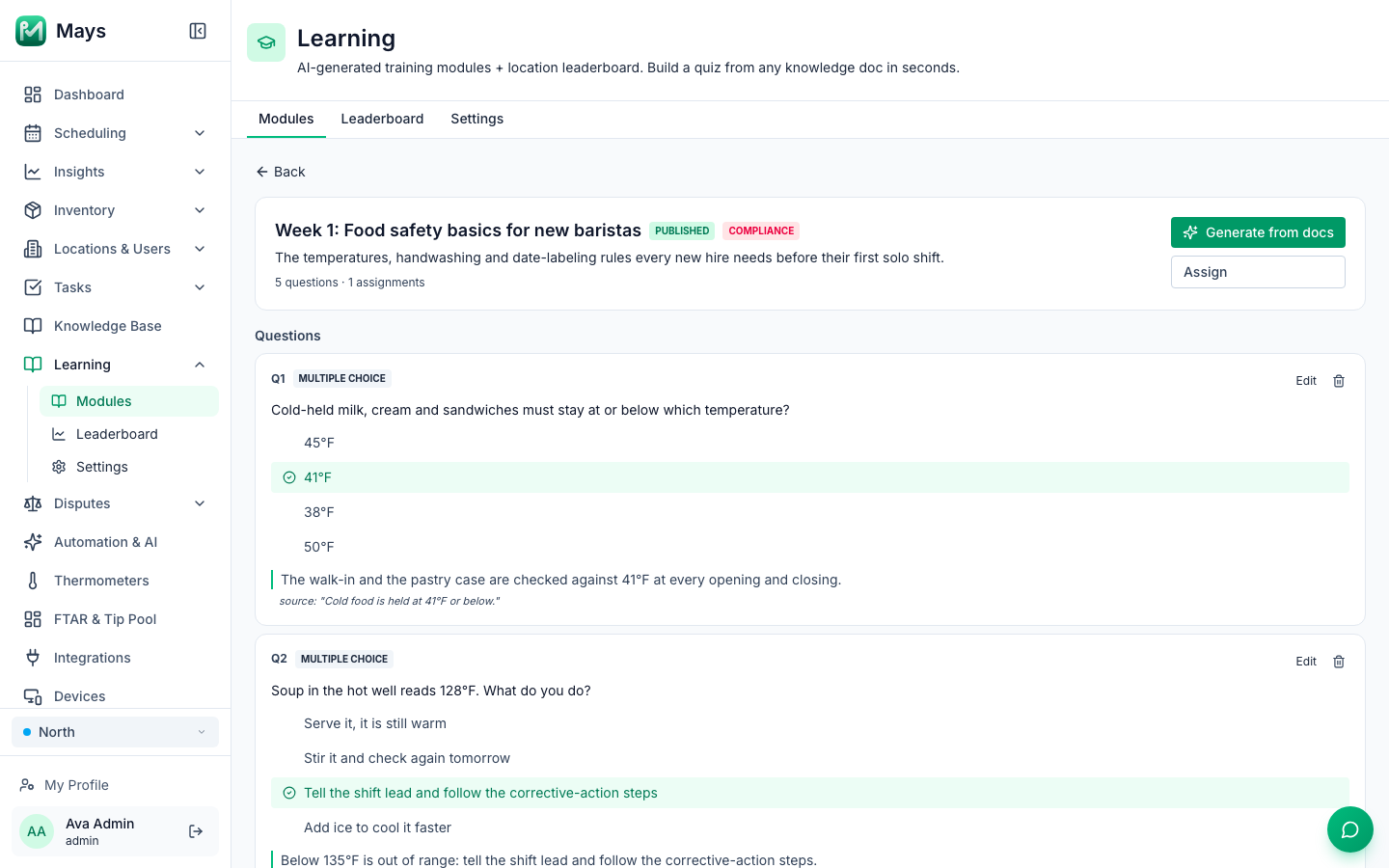
- Training modules: an admin builds a module from knowledge-base articles and documents, and the AI drafts a quiz of up to 15 multiple-choice or true/false questions, each with the quote it came from. You review and edit every question before publishing, and set the passing score (80% by default).
- Assign by location, role, department or person, with a due date. Anyone who later joins that role or location sees the module automatically.
- Staff take quizzes on their phone, one question at a time, and see the right answer and a short explanation for each question afterwards. Admins see each person's attempts, best score and answers.
- Certificates: a module marked compliance-critical issues a PDF certificate when someone passes.
- Sign-offs and training shifts: give a trainer a one-off task per station for each new hire, and label training shifts "Training" on the schedule.
Mays training is for your own SOPs and standards. It isn't a DBPR-approved food handler program, and Mays doesn't track outside certificates or their expiry dates, so keep those records and the 60- and 30-day deadlines in your own files.
The image at the top of this post shows a week-one food-safety module with its first two questions.
Your first-week checklist
- Food handler training booked on day one (60-day deadline), manager certification scheduled (30 days)
- Week one on the schedule, with named trainers and "Training" shifts
- SOPs written, one task per page, on staff phones
- A five-question quiz for each critical topic
- A sign-off list per station, signed by the trainer
- Proof of training kept where you can show it at an inspection
Train your next hire in Mays
Put your SOPs in the knowledge base, turn the critical ones into short quizzes, and assign them to every new hire's role.
Start your free trial: 30 days, every module, no card needed. Opening soon? The first 90 days playbook puts training in context with checklists, schedules and food-safety logs.