Health inspection prep for a new restaurant (Florida edition)
Your first routine inspection won't be scheduled. An inspector walks in during service, shows ID, and spends the next hour opening coolers, probing food, checking the handwashing sinks and asking for paperwork. Whether that hour goes well depends on the habits you built in the weeks before.
This guide covers how inspections work in Florida, what the three violation classes mean, what inspectors cite most often, a self-inspection checklist you can run every week, the records to keep, and what happens after a violation.
This is general information, not legal advice. Check the current rules with the Florida DBPR, and treat your inspector's word as final.
Who inspects, and how often
Restaurants and cafés in Florida are licensed and inspected by the Division of Hotels and Restaurants at the Department of Business and Professional Regulation (DBPR). The division enforces the 2017 FDA Food Code, adopted effective November 1, 2019 (DBPR inspections page). The temperature log guide covers the temperatures in detail.
Every licensed food service establishment gets 1 to 4 unannounced inspections a year, based on risk: the food you use, how you prepare it, and your inspection and compliance history. From DBPR's table:
Level | Who | Inspections a year |
|---|---|---|
1 | Places that don't cook raw animal food, or cook it but don't cool any cooked or heated food | 1 |
2 | Places that cook raw animal food and cool cooked food, run a special process, or serve raw or undercooked animal food that needs a consumer advisory | 2 |
3 | A history of non-compliance (three or more disciplinary actions in two years), or serving a highly susceptible population | 3 |
4 | Identified by the Florida Department of Health in a confirmed foodborne illness | 4 |
A café that bakes off pastries and cooks eggs for breakfast sandwiches, but never cools anything it cooked, is Level 1 on that table. DBPR can also inspect after a complaint or to check that violations were corrected.
Two more things to know. Inspection results are public: anyone can look up your reports in DBPR's online inspection search (DBPR FAQ). And establishments are not graded or rated. A report is described as a snapshot of the day.
Not open yet? DBPR publishes an opening/licensing inspection checklist (form HR 5024-017) for new establishments. It asks for things like a working three-compartment sink, thermometers in every hot and cold holding unit plus a 0–220°F stem thermometer, soap, paper towels and handwashing signs at every handwash sink, a chemical test kit if you sanitize by hand or keep wiping cloths in sanitizer, and a choking poster where employees can see it.
High priority, intermediate and basic violations
DBPR sorts every violation into one of three classes (definitions quoted from the inspections page):
Class | DBPR's definition | Examples from DBPR's lists |
|---|---|---|
High priority | "could contribute directly to a foodborne illness or injury" | Holding food cold (03a) or hot (03b), cooling (03d), date marking (02c), handwashing (12a), food-contact surfaces clean and sanitized (22) |
Intermediate | "if not addressed, could lead to risk factors that contribute to foodborne illness or injury" | Thermometers provided and accurate (05), handwash sinks accessible (31a), handwashing supplies and sign (31b), food manager certification (53a), food handler training (53b) |
Basic | "considered best practices to implement" | Non-food-contact surfaces clean (23), floors, walls and ceilings (36), wiping cloths (21), employee belongings (40) |
Some categories appear in more than one class, depending on what the inspector actually finds. Date marking (02c), for example, is on both the high priority and the intermediate list.
What inspectors cite most
DBPR's annual report for fiscal year 2024–25 (July 2024 to June 2025) lists the ten violations cited most often in public food service establishments (H&R Annual Report 2024–25, table 9 and figure 3):
# | Violation | Times cited |
|---|---|---|
1 | 14 – Food-contact and nonfood-contact surfaces designed, constructed, maintained, installed, located | 48,777 |
2 | 22 – Food-contact surfaces clean and sanitized | 45,655 |
3 | 36 – Floors, walls, ceilings and attached equipment properly constructed and clean; rooms and equipment properly vented | 43,907 |
4 | 08B – Food protection during preparation, storage and display | 29,143 |
5 | 31B – Handwashing supplies and handwash sign provided | 26,721 |
6 | 23 – Non-food contact surfaces clean | 25,100 |
7 | 08A – Separating raw animal foods from each other, ready-to-eat foods and unwashed produce | 21,572 |
8 | 03A – Receiving and holding PH/TCS foods cold | 19,916 |
9 | 10 – In-use food dispensing utensils properly stored | 19,695 |
10 | 31A – Handwash sinks installed, accessible, not used for other purposes | 18,775 |
Almost none of that is exotic. It's cleaning, repairs, storage order, handwashing sinks and cold holding: things a weekly walk-through catches. The same report says more than a third of all violations the division cited that year were corrected during the inspection.
A self-inspection checklist
Walk your store once a week the way an inspector would, with a probe thermometer and sanitizer test strips in your pocket. The last column is the DBPR category each line relates to.
Area | Check | DBPR |
|---|---|---|
Cold holding | Probe food in every cooler: 41°F or below | 03a |
Hot holding | Probe hot-held food: 135°F or above | 03b |
Thermometers | One in every cooler and hot-holding unit; a working probe thermometer | 05 |
Date marking | Ready-to-eat TCS food held over 24 hours is dated, and nothing is past 7 days, counting the prep day as day 1 (Food Code §3-501.17) | 02c |
Storage order | Raw animal food below ready-to-eat food and produce | 08a |
Food protection | Food covered, labeled and off the floor | 08b |
Utensils | In-use scoops and utensils stored properly, handles out of the food | 10 |
Handwash sinks | Accessible and used only for handwashing (§5-205.11) | 31a |
Hand supplies | Soap, towels and a handwash sign at every handwash sink (§6-301.11, §6-301.12, §6-301.14) | 31b |
Sanitizing | Sanitizer at the right strength, with a test kit on hand (§4-302.14) | 22, 16 |
Surfaces | Food-contact surfaces clean; gaskets, cutting boards and shelves in good repair | 22, 14 |
Cleaning | Non-food-contact surfaces, floors, walls and ceilings clean | 23, 36 |
Staff | No sick employees working with food; no eating or drinking at prep areas; hair restrained | 11, 12b, 13 |
Chemicals | Stored apart from food and never above it (§7-201.11) | 41 |
Paperwork | License displayed; manager certificate and food handler training proof on site | 50, 53a, 53b |
Fix what you can on the spot, and write down what you can't, with a name and a date next to it.
Records to keep
Record | The rule | Source |
|---|---|---|
Food manager certificate | Managers pass an approved exam within 30 days of employment. At least one certified food protection manager is responsible for all periods of operation, and one must be present when four or more employees are storing, preparing or serving food at the same time. | |
Food handler training proof | Every food service employee is trained within 60 days of employment. Proof (name, date of birth, training date, approved program) must be shown on request, including at an inspection. | |
Current license | Displayed properly (category 50) | |
Temperature logs | The Food Code makes the person in charge responsible for daily oversight of temperature monitoring. It doesn't prescribe a log form, but a log is the easiest way to show the monitoring happens. | |
Your last inspection report | Not a rule, just good practice: keep it with a note of what you corrected and when | — |
The training guide covers the 60- and 30-day deadlines in more detail.
What happens after a violation
Every inspection ends with a report and a result. The main outcomes, from DBPR's inspections page:
- Next routine inspection: the violations must be corrected by the next routine inspection. If a pattern of violations continues, the inspector can ask for enforcement action without a warning first.
- Warning: the violations must be corrected by a date, or within a set number of days. The inspector comes back for a callback inspection. They can give you a time extension if every high priority violation is corrected, you've made significant progress on the rest, and you don't have a history of repeated violations.
- Administrative complaint: legal action by the division. It can follow a warning that wasn't complied with, a pattern of repeat violations, or conditions serious enough to need immediate action. You have 21 days after receiving it to request a hearing, or you can accept the settlement offer (DBPR administrative complaints).
- Emergency closure: for an immediate threat to the public. The license is suspended, and DBPR performs a callback inspection within 24 hours (you can ask for it earlier). You can reopen once an inspection shows the violations that caused the closure are corrected.
Fines. The law caps fines at $1,000 per offense. For a violation of a "critical law or rule," each day can count as a separate offense (s. 509.261, F.S.). DBPR's standard penalties for first and second offenses (Rule 61C-1.005, F.A.C.):
Violation class | 1st offense | 2nd offense |
|---|---|---|
Basic | $150 to $300 | $250 to $500 |
Intermediate | $200 to $400 | $375 to $750 |
High priority | $250 to $500 | $500 to $1,000, license suspension, or both |
A "second offense" means one disciplinary final order against the same license in the 24 months before the complaint. Fines for multiple violations add up, and the division can go above or below these ranges for aggravating or mitigating circumstances. Fixing a violation still matters: DBPR notes that penalties can apply to violations corrected after the warning deadline.
Where Mays fits
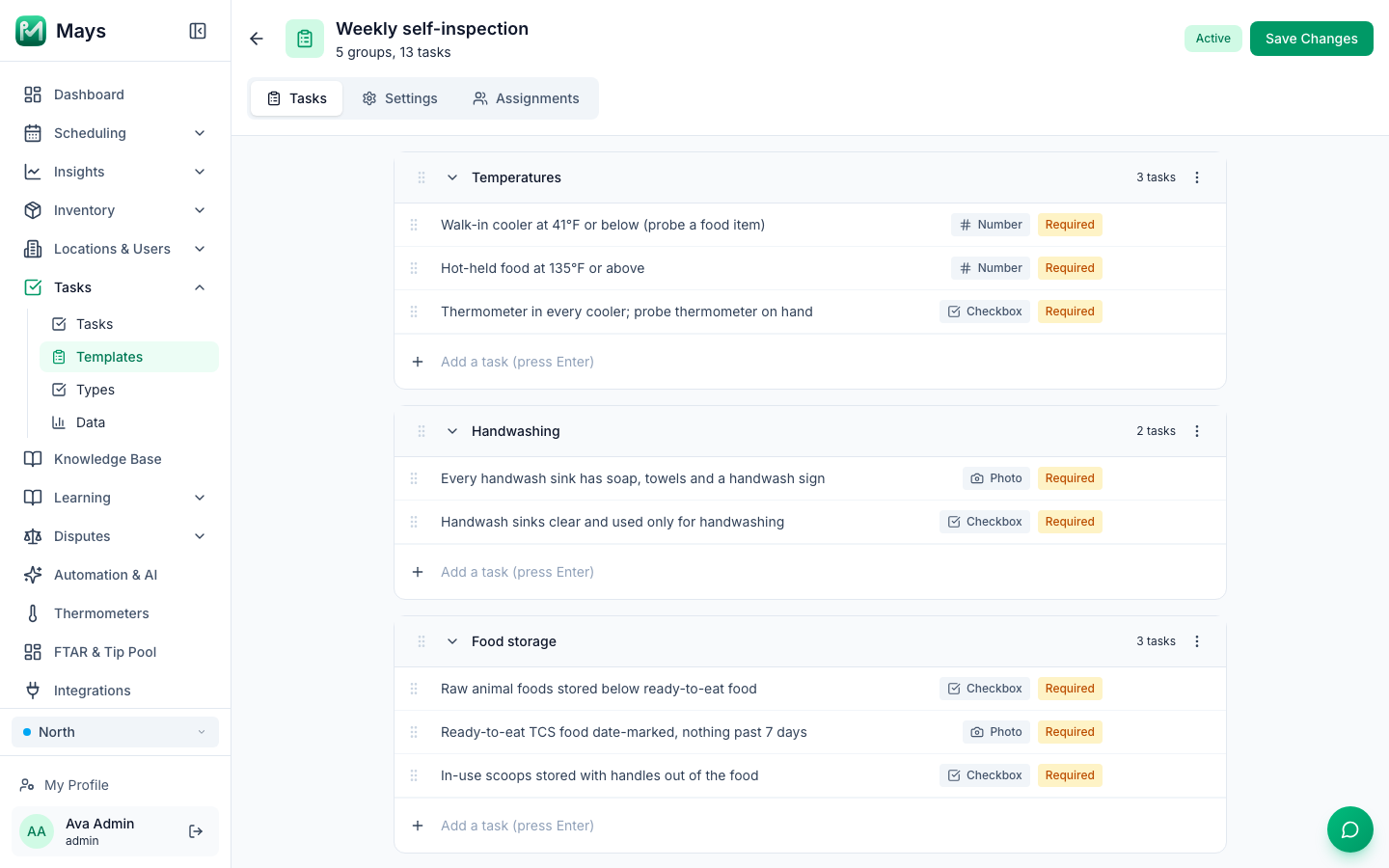
- The self-inspection as a checklist. Build the checklist above as a weekly template in Mays, grouped by area, with a number answer for each temperature, a photo for the handwash sinks and the date labels, and checkboxes for the rest. Assign it to your shift lead or manager. The image at the top of this post shows one. AI photo verification (an organization setting that uses AI credits) can flag a photo that doesn't show what the task asked for, and a manager can reject a task with a reason so it gets redone.
- Daily checks on the opening and closing lists. The weekly walk-through doesn't replace daily cooler, sanitizer and sink checks. The checklist guide has a sample to copy.
- Coolers watched overnight. With Govee sensors (bought separately), Mays records each unit's temperature every five minutes, alerts whoever's on shift when a unit stays out of range, and exports the sensor log as a PDF or CSV. Manual checks stay with the checklist, so keep both.
- SOPs and training in one place. Keep your cleaning steps, date-marking rules and employee health policy in the knowledge base, and turn the critical ones into short training modules with a quiz. A module marked compliance-critical issues a certificate when someone passes.
Mays training isn't a DBPR-approved food handler program, and Mays doesn't track outside certificates or their expiry dates. Keep manager certificates and food handler training proof where you can show them to an inspector.
Your inspection-ready checklist
- A weekly self-inspection, walked with a probe thermometer and test strips
- Daily temperature, sanitizer and handwash-sink checks on the opening and closing lists
- Everything ready-to-eat dated, 7 days at most, and raw food stored below ready-to-eat
- The license displayed; manager certificates and food handler training proof on site
- The 30- and 60-day training deadlines on the calendar for every new hire
- Your last inspection report, with what you corrected and when
Get inspection-ready in Mays
Turn the self-inspection into a weekly checklist, put the daily checks on your opening and closing lists, and let sensors watch the coolers overnight.
Start your free trial: 30 days, every module, no card needed. Or book a walkthrough and we'll build your self-inspection checklist with you.