Staff turnover in restaurants: keeping your first team
The first team you hire learns your menu, your regulars and your way of doing things. Every person who leaves takes that with them, and you start over: a job post, interviews, a first week of training, and a few weeks of someone else covering the gaps.
Some turnover is normal in restaurants, and some of it is healthy. But a small restaurant can keep far more of its first team than it expects, mostly through things that cost little: a first week that's planned, a schedule people can count on, recognition that's specific, a visible next step, and conversations before someone has already decided to go.
This is general information, not legal advice. Updated September 24, 2026: the Bureau of Labor Statistics and Department of Labor pages cited here were re-checked.
What the numbers say
The Bureau of Labor Statistics publishes quit rates by industry in its Job Openings and Labor Turnover Survey. The annual averages for 2025, from Table 22: annual average quits rates by industry and region (not seasonally adjusted, released March 13, 2026):
Industry | Average monthly quits rate, 2025 |
|---|---|
Accommodation and food services | 4.2% |
Leisure and hospitality | 3.9% |
Total private | 2.2% |
The rate is the share of employees who quit in a month: BLS calculates the annual figure as the 12 months' quits as a percentage of the 12 months' employment. So in an average month of 2025, about 1 in 24 people working in accommodation and food services quit, nearly twice the rate across all private industries. The same table shows 5.8% in 2021 and 2022, so it has come down, but it's still the highest of any industry in the table.
These are quits only: people who chose to leave. Layoffs and firings are counted separately.
What losing one person costs you
Work it out with your own numbers. A made-up example for one barista who leaves after two months:
Cost | Made-up example |
|---|---|
Writing and posting the job, reading applications | 3 hours of your time |
Interviews and a paid trial shift | 4 hours of your time + 4 paid hours at $15 = $60 |
First-week training, trainee and trainer both paid | 20 hours at $15 + 10 trainer hours at $17 = $470 |
Overtime covering the gap for two weeks | 8 hours at $22.50 = $180 |
Slower service and more mistakes while the new hire learns | Hard to price, but real |
That's $710 in wages alone, plus seven hours of your time, before the slower weeks. Multiply it by the number of people who leave in a year, and keeping one more person starts to look like a good investment.
1. Make the first week easy
The first week is when many new hires decide whether this job is for them. Plan it:
- Paperwork before day one, so the first shift isn't spent on forms (the hiring guide lists what you need).
- A written plan for the week: which stations, with whom, and what they should be able to do by Friday. Our one-week training plan has a day-by-day version.
- A buddy for the first shifts, who's scheduled with them and knows it.
- Everything in one place: the SOPs, the menu, the call-out policy, who to ask.
- Check-ins on day 3, day 30 and day 90, short and on the calendar.
2. Make the schedule predictable
Unpredictable hours make a job hard to keep, and they're one of the easier things to fix:
- Publish early and change as little as possible after you do.
- Give people regular shifts where you can. The same opening shift every Tuesday is easier to build a life around.
- Respect availability, and ask again every few months, because school and second jobs change.
- Make swaps easy instead of forcing people to call out.
- Share cuts fairly in slow weeks, and explain them (our slow-season guide covers how).
3. Recognize specific things, quickly
"Great job, everyone" is easy to ignore. Recognition that works is specific, timely and public when the person is comfortable with that:
- Name the thing: "You handled that rush alone and nobody waited more than five minutes."
- Say it the same day, not at the next review.
- End your weekly manager meeting with one thank-you, by name, and pass it on.
- Keep tips and pay fair and explained. Nothing erodes goodwill faster than a tip pool nobody understands (see our tip pooling guide).
4. Show a next step
People stay longer when they can see where the job goes. Even a small café can have a ladder:
Level | Can do | Signed off by |
|---|---|---|
1. New | Counter, register, basic drinks | The shift lead, after week one |
2. Barista | The full drink menu, a rush on bar | The manager, after a shift observed on bar |
3. Opener or closer | Runs the opening or closing checklist alone, counts the drawer | The manager, after three supervised opens |
4. Shift lead | Runs a shift, handles complaints, trains new hires | The owner |
Tie each step to something visible: a pay step if you can afford it, better shifts, or the trust to run the store. Then tell people where they are and what's next.
5. Ask before they decide
People who leave have often been thinking about it for a while. A 10-minute check-in every few months (sometimes called a stay interview) catches it earlier. Ask:
- What's the best part of working here? The worst?
- Is your schedule working for you?
- What would you like to learn next?
- Is there anything that would make you think about leaving?
- What's one thing we should change?
Then do at least one thing you heard, and say that you did. A check-in that changes nothing teaches people not to answer honestly next time.
6. When someone leaves, leave the door open
Some people will leave anyway: school, a move, a better offer. Make the exit a good one:
- Have an exit conversation: why they're leaving, what would have kept them, what the next person should know.
- Pay them on time. Federal law doesn't require the final paycheck immediately, but "some states, however, may require immediate payment" (DOL). Check your state's rule.
- Collect keys and remove access the same day: the alarm code, the POS login, the app.
- Write down why they left, in a few words, and look at the list every few months. Patterns show up quickly: the same shift, the same manager, the same month.
- Keep the door open. A good former employee is your easiest rehire.
Where Mays fits
- Onboarding: when you add an employee with their phone number, Mays texts them a link to download the app, and they sign in with that number. Tasks → Create Task → From Template turns a checklist template into today's tasks for one person, so a first-week list can go straight to the new hire. The Knowledge Base keeps SOPs, the menu and your policies in folders everyone (or only managers) can read, including in the app.
- Training: in Learning, an admin builds a module from Knowledge Base articles and documents, lets the AI write the quiz, sets a passing score, and can mark it compliance-critical so passing issues a PDF certificate. Modules are assigned to locations, roles, departments or people, with an optional due date, and staff take them in the app under Profile → Learning. Mays doesn't send due-date reminders, so mention the due date in person.
- Points and leaderboards: staff earn points for training quizzes (for correct answers, a perfect score and finishing a module), keep streaks, move up levels from Bronze to Platinum and collect badges, all shown on their profile in the app. Locations compete weekly and monthly on average points per person, and a Wall of fame shows the winners. Points come from training, not from everyday tasks. Learning and points are switched on for your account by our team, so ask when you start.
- A predictable schedule: drafts stay hidden until you publish, and Notify only affected people tells just the people whose shifts changed. Staff set their availability, request time off, and offer or swap shifts in the app, and can add their shifts to Apple or Google Calendar.
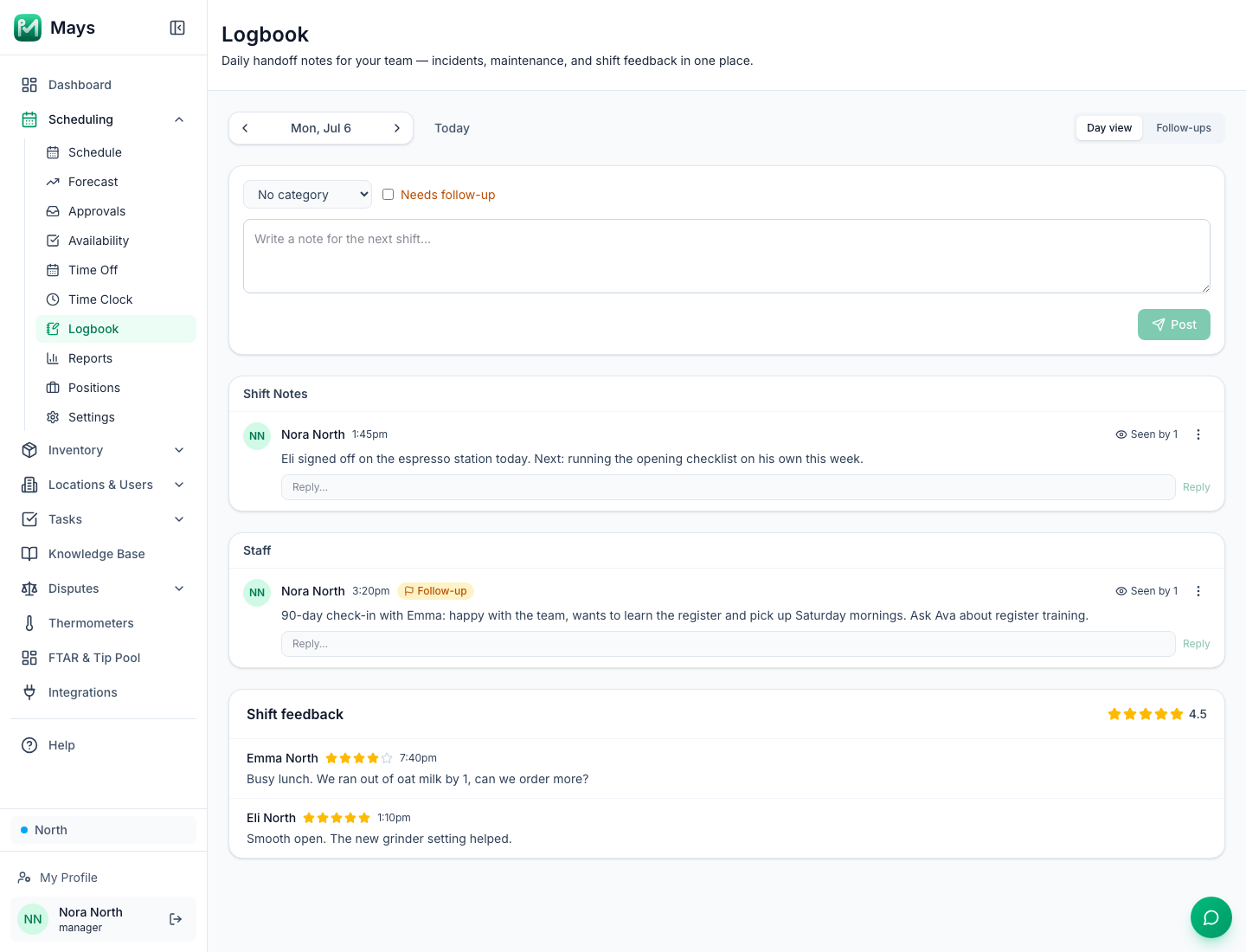
- Shift feedback: after clocking out on their phone, staff are asked "How was your shift?" with one to five stars and an optional comment. Managers see the ratings and comments for each day in the Logbook (the image at the top of this post), next to the day's notes. Ratings aren't anonymous, so read them as a conversation starter.
- Recognition: coworkers and managers can like and comment on completed tasks in the app's activity feed, and the person gets a notification.
- When someone leaves: Deactivate removes their access right away and keeps their history. Shifts already assigned to them stay on the schedule, so reassign those.
Your first-team checklist
- A written first-week plan and a buddy for every new hire
- Check-ins on day 3, day 30 and day 90
- A schedule published early, with regular shifts where possible
- Specific thank-yous, the same day
- A visible ladder from new hire to shift lead
- A short check-in with everyone every few months, and one change made from it
- An exit conversation, a final paycheck on time, and access removed the same day
- A list of who left and why, reviewed every few months
Keep your team with Mays
Plan the first week, publish a schedule people can count on, and hear how every shift went.
Start your free trial: 30 days, every module, no card needed. Still hiring? Start with Hiring your first restaurant team.