Planning labor for a slow season
Every restaurant has a slow stretch: the hottest weeks of summer, the weeks after the holidays, the month the students leave town. Sales drop faster than the schedule does, and for a few weeks you pay a busy-season crew to stand behind a quiet counter.
A slow season is easier to plan than it looks. This guide shows how to find the slow hours in your own sales, turn a labor target into hours, trim shifts before you cut people, share the cuts fairly, and use the quiet weeks well, with the pay and scheduling rules to keep in mind.
This is general information, not legal advice. Updated September 24, 2026: the Department of Labor, eCFR, FloridaCommerce and city and state pages cited here were re-checked.
Step 1: Find the slow hours
Pull four recent weeks of sales by hour from your POS and set them next to four busy weeks. Group the hours into dayparts, and add the labor hours you scheduled in each.
The number to look at is sales per labor hour: sales divided by the staff hours worked in the same stretch. With made-up numbers for a café's weekdays:
Daypart | Sales per hour, busy season | Sales per hour, now | Staff on | Sales per labor hour, now |
|---|---|---|---|---|
7–10 am | $210 | $180 | 3 | $60 |
10 am–1 pm | $150 | $110 | 2 | $55 |
1–4 pm | $120 | $45 | 2 | $22.50 |
The morning barely moved. The afternoon lost more than half its sales but kept both people. That's where the hours go. Look at transactions too: a few big catering orders can hide a quiet day.
Step 2: Turn a target into hours
Labor % is labor cost divided by sales for the same period. Use your own target; there's no universal right number. Then turn it into hours, with made-up numbers:
- Busy season: $12,000 a week in sales at 30% is $3,600, or about 225 hours at a $16 average wage.
- Slow season: $8,400 a week at 30% is $2,520, or about 157 hours.
Some labor doesn't shrink with sales: you can't open with half a person, and nobody should close alone with the cash. Write down your minimum crew per daypart first. If the minimum crew alone puts you above target on the slowest days, accept a higher labor % for those weeks, or look at your hours (below).
Step 3: Trim shifts before you cut people
Instead of | Try |
|---|---|
Two people from 1 to 4 pm | One person, with the second leaving after the lunch rush |
8-hour shifts | 6-hour shifts built around the rush |
Prep every morning | Batch prep on two or three mornings |
A separate cashier at quiet hours | One cross-trained person on counter and bar |
Opening the full day every day | Shorter hours on your slowest day, if the numbers say so |
Step 4: Cut hours fairly
When trimming isn't enough, the way you cut matters as much as the cut:
- Ask first. Some people want fewer hours in the slow season, for school or travel. Collect time-off requests early.
- Use criteria you can explain: availability, the skills each daypart needs, then rotate the reductions so the same person isn't cut every week.
- Tell people early, with the reason and how long you expect it to last.
- Protect your core team, the people you need back when it's busy.
Two groups need extra care:
- Salaried managers. An exempt employee "must receive the full salary for any week in which the employee performs any work," and "If the employee is ready, willing and able to work, deductions may not be made for time when work is not available" (DOL Fact Sheet #17G; 29 CFR 541.602). Don't dock a salaried manager for a slow afternoon.
- Tipped staff. Fewer customers means fewer tips. If you take a tip credit, cash wages plus tips must reach the minimum wage in each workweek, and "the employer must make up the difference" (DOL Fact Sheet #15). In Florida that's $14.00 an hour, with a cash wage of at least $10.98, through September 29, 2026; the minimum wage rises to $15.00 on September 30, 2026 (FloridaCommerce announcement; FloridaCommerce). Check tipped hours weekly in a slow stretch.
Overtime doesn't disappear in slow weeks either: it's still counted per workweek, and the regulation "does not permit averaging of hours over 2 or more weeks" (29 CFR 778.104).
Step 5: Cross-train in the quiet hours
A slow season is the cheapest time to teach people a second station, and a cross-trained team is what lets you schedule one person where you used to need two.
If they work | Teach them | So you can |
|---|---|---|
Counter | The bar's core drinks | Run quiet hours with one person |
Bar | Register, cash count and close | Close with one opener-closer pair |
Prep | The line's simplest items | Cover a sick call without calling in a cook |
Training time is paid time, unless it's outside normal hours, voluntary, not job-related, and no other work is done at the same time (DOL Fact Sheet #22).
Step 6: Publish early, and know where scheduling laws apply
Publish the slow-season schedule as early as you can and change it as little as possible. People can plan around fewer hours; they can't plan around surprises.
Some cities, and Oregon, have "fair workweek" laws that require advance notice and extra pay for schedule changes. They cover larger employers, so a single café is usually outside them, but a franchise may not be:
Where | Who's covered | Notice |
|---|---|---|
Seattle | Retail and food service with 500+ employees worldwide; full-service restaurants also need 40+ full-service locations | Schedules 14 days ahead; time-and-a-half for hours between a closing and an opening shift less than 10 hours apart (Seattle) |
Oregon | Retail, hospitality and food service with at least 500 employees worldwide | 14 calendar days (Oregon BOLI) |
Chicago | Covered industries including restaurants; for restaurants, 250 employees and 30 locations | Advance notice of schedules; 1 hour of predictability pay for any shift change within 14 days (Chicago) |
New York City | Fast food workers | 14 days; premiums for schedule changes (NYC DCWP) |
These pages list more conditions (pay caps, rest rules, consent); read the whole page for your city. If you're opening somewhere new, check the local rules before you cut hours on short notice.
Step 7: Use the slow weeks
- Encourage vacations now, not in the busy season.
- Schedule the deep cleaning and maintenance you postponed.
- Train, test new menu items and update your SOPs.
- Lower your inventory pars so stock doesn't expire on the shelf (see Café inventory from day one).
Where Mays fits
- Forecast (Scheduling → Forecast): with Square or Union connected, Mays projects each day's sales from the same weekday over the last 8 weeks, with recent weeks counting more, and shows actual sales, the weather and the week's Projected labor %. Because it averages recent weeks, it follows a slowdown a few weeks late, so click a day's projection and type your own when you know the season is turning. The Unit forecast shows how many of the items you pick sell each hour, and the peak hour.
- Labor Cost (Insights, for admins): a Staffing vs Revenue Heatmap colors each half hour of the week by labor % of revenue, and Scheduled vs. Actual Hours by Hour of Day shows where you're overstaffed. It uses your POS sales and time clock punches.
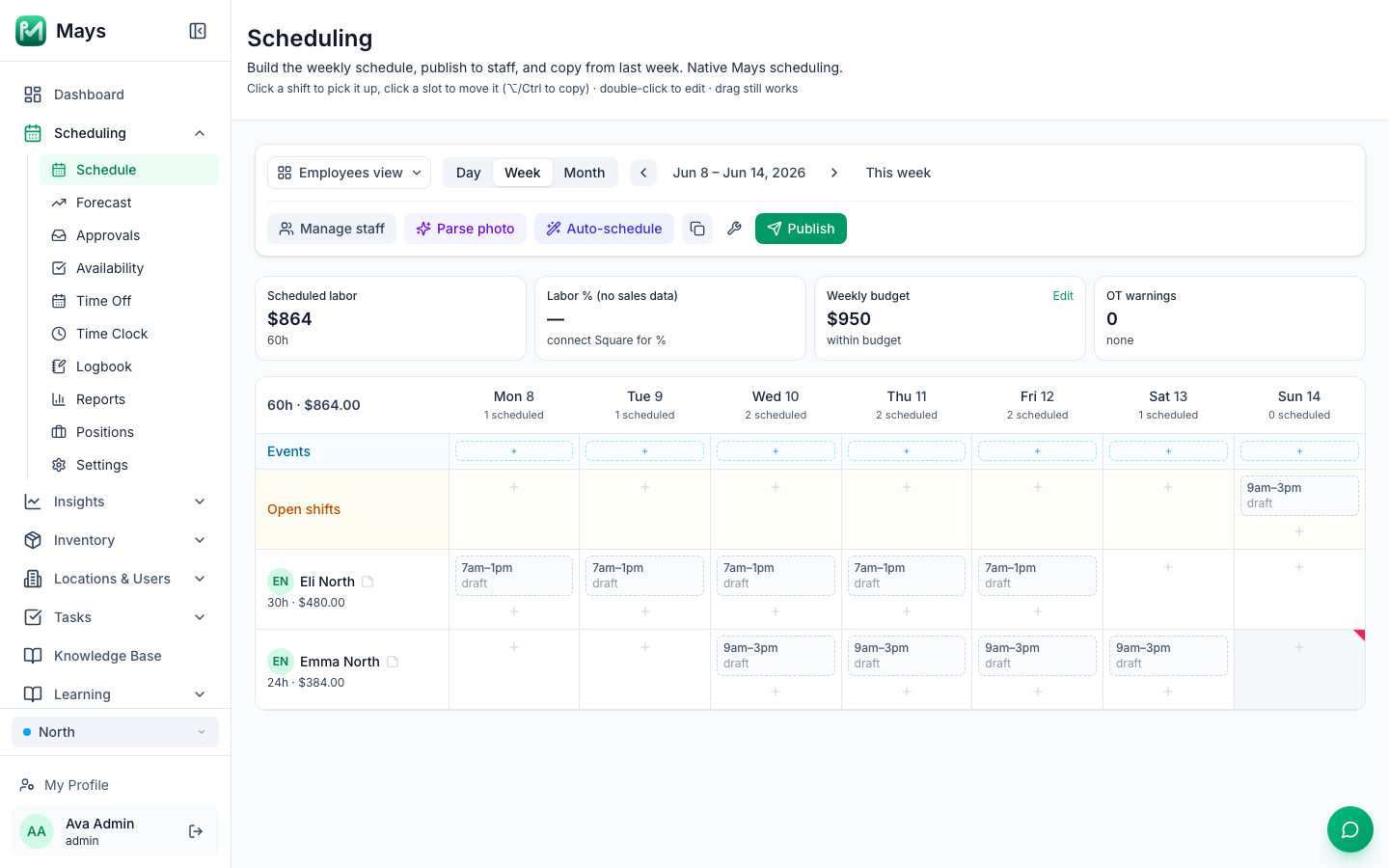
- The schedule (the image at the top of this post): set a Weekly budget and watch Scheduled labor as you build. Labor % appears once Square is connected. Copy week → Last week gives you last week's shifts as drafts to trim.
- Open shifts: a shift you may need can go out as Open shift (unassigned). Once you publish, staff can claim it in the app and you approve it in Approvals.
- Time off: staff request it in the app. Blocked Days stops requests for days you can't spare anyone, like the week the busy season returns.
- Publishing with Notify only affected people sends a push notification and an email to just the people whose shifts changed.
Mays doesn't track fair workweek rules or predictability pay, so keep a record of schedule changes yourself if they apply to you.
Your slow-season checklist
- Four weeks of sales by hour, next to four busy weeks
- Sales per labor hour for each daypart
- A weekly hour budget from your labor target
- Minimum crew per daypart written down
- Shifts trimmed at the edges before anyone's hours are cut
- Volunteers asked first; cuts rotated and explained
- Salaried and tipped pay checked against the rules
- Cross-training scheduled for the quiet hours
- The schedule published early, with local scheduling laws checked
- Vacations, deep cleaning and training planned into the slow weeks
Plan the slow weeks in Mays
Set the budget, trim from last week's schedule, and publish early.
Start your free trial: 30 days, every module, no card needed. Still building your first schedule? Start with How to build your first restaurant staff schedule.