Hiring your first restaurant team: roles, job posts and interviews
Most new owners hire their first team the same way: a sign in the window, a pile of messages, and a gut feeling after a ten-minute chat. That works until the third no-show.
Hiring is a process you can repeat. This guide covers the roles a small café or restaurant needs, the job post and where to put it, an interview you run the same way every time, paid trial shifts, and the paperwork for every new hire, with the Florida rules and the extra ones for teens.
This is general information, not legal advice. Employment rules depend on your state, your size and your facts, so check with an employment lawyer or your payroll provider. Updated September 24, 2026: the USCIS, IRS, Florida Department of Revenue, FloridaCommerce and Florida Statutes pages cited here were re-checked. Use whichever Form I-9 edition the USCIS page lists as current.
The roles a small team needs
Start from the work, not from job titles. A café open 7 am to 4 pm, or a small counter-service restaurant, usually needs these roles covered:
Role | What they own | Hire for |
|---|---|---|
Shift lead | Opening or closing, the cash drawer, problems during the shift | Calm under pressure, reliability, someone others follow |
Barista or line cook | The main product, made to your recipe and speed | A skill you can test, or the attitude to learn it fast |
Counter and cashier | Orders, payments, the dining room, restocking | Friendliness, accuracy, pace |
Prep and dish | Prep lists, dishes, cleaning | Dependability and food-safety habits |
On a small team most people cover two roles, such as counter and bar or prep and dish. Hire people who can learn both.
How many people? Add up the weekly hours in your coverage plan (see How to build your first restaurant staff schedule) and divide by the hours each person wants. With made-up numbers: 220 hours at about 28 hours a person is 8 people. Hire one more, because someone will always be sick, away or in exams.
Write a job post people can act on
A good post answers the questions candidates would ask anyway:
- The title and the pay. A range is fine.
- The schedule: days, times, weekends and hours a week.
- What the job actually is: three or four lines of the real work.
- Must-haves only, like "available Saturday mornings." Leave out the wish list.
- How to apply, and when you'll reply.
Write about the job, not the person. The EEOC says it's illegal for an employer to publish a job ad that "shows a preference for or discourages someone from applying" because of race, color, religion, sex, national origin, age (40 or older), disability or genetic information; an ad seeking "recent college graduates," for example, may discourage people over 40 (EEOC). Those laws cover businesses with 15 or more employees, or 20 for age (EEOC coverage), and the Florida Civil Rights Act uses the same 15-employee line (s. 760.02(7), F.S.). A new café may be smaller, but "young, energetic team" is an ad you'd have to rewrite later anyway.
A post you can adapt:
Barista, morning shifts, [pay range] an hour + tips
[Your café], [neighborhood]

We need two baristas for 6:30 am to 1 pm shifts, 4 or 5 days a week, including one weekend day.

You'll make coffee drinks to our recipes, take orders when the line is long, keep the bar clean and stocked, and help open.

You need to be available at least one weekend morning. Experience helps; we train, and training is paid.

To apply, send your availability to [email]. We reply to everyone within 3 days.
Where to post it
- Your own channels first: a sign at the counter, your website and social accounts, your regulars.
- Referrals from your first hires, suppliers and neighboring businesses.
- Job boards, for reach. Use the same text everywhere and keep one list of applicants.
- Nearby schools, for part-time roles (see the rules for teens below).
Reply to everyone, even when the answer is no.
Run a structured interview
A structured interview means the same questions, in the same order, scored the same way for every candidate. It keeps you from hiring whoever you enjoyed chatting with most.
Keep it to 20 minutes, and score each answer from 1 to 3 right after:
Question | Listen for |
|---|---|
Tell me about a shift that went badly. What did you do? | Owns the problem, stays calm, gives specifics |
A customer says their order is wrong and the line is ten deep. Walk me through it. | Fixes it first, apologizes, keeps the line moving |
What does a clean station look like at the end of your shift? | Detail and pride in the work |
Which days and hours can you work, and what's fixed in your week? | A real match with your schedule |
What would make you leave a job after a month? | Honest expectations |
What would you like to ask us? | Interest in the work, not only the pay |
Stick to the job: don't ask about age, family plans, religion, national origin or health.
Trial shifts: pay for them
A trial shift (a "stage") shows you more than any interview. But if the candidate makes drinks, washes dishes or preps, that's work:
- Under the FLSA, to "employ" includes "to suffer or permit to work," and "Work not requested but suffered or permitted to be performed is work time that must be paid for" (DOL Fact Sheet #22).
- The Department of Labor says employees "may not volunteer services to for-profit private sector employers" (DOL elaws).
- Training counts as work time unless it's outside normal hours, voluntary, not job-related, and no other work is done at the same time (Fact Sheet #22). A trial shift on your bar meets none of those.
So keep it short, two to four hours, and pay at least minimum wage. In Florida that's $14.00 an hour from September 30, 2025, rising to $15.00 on September 30, 2026 (FloridaCommerce). Put the shift on payroll like any other. A paid trial makes the candidate your employee for that shift, so the paperwork below applies.
New-hire paperwork
What | When | Keep it | Source |
|---|---|---|---|
Form I-9, for every hire, citizens included | The employee completes Section 1 by the first day of work. You complete Section 2 within 3 business days, or by the first day if the job lasts less than 3 days | 3 years after the hire date, or 1 year after employment ends, whichever is later. Don't file it with USCIS | |
Form W-4 | When they start | At least 4 years | |
Florida new-hire report: name, address, Social Security number and hire date, plus your name, address and FEIN | Within 20 days of the hire date | s. 409.2576, F.S.; report online through the Florida Department of Revenue | |
E-Verify, required for private employers with 25 or more employees since July 1, 2023 | Within 3 business days after the employee starts working for pay | The documents and any verification, at least 3 years | |
Proof of age, for anyone under 18 | Before they start | For as long as they work for you |
Three details that trip people up:
- The employee chooses the I-9 documents from the lists of acceptable documents; you can't specify which ones (USCIS Handbook, M-274).
- Under 25 employees, Florida still expects you to check the same documents the I-9 asks for and keep a copy for at least 3 years (FloridaCommerce).
- Independent contractors you pay $600 or more in a year are reported too (s. 409.2576).
Hiring teens in Florida
Teens are often a café's first part-timers. Florida and federal law both limit their hours and tasks, and "when both are applicable, the law with the stricter standard must be obeyed" (DOL Fact Sheet #43).
Ages 14 and 15 | Ages 16 and 17 | |
|---|---|---|
Florida, school in session | Not before 7 am or after 7 pm when there's school the next day; 3 hours on a school day unless there's no school the next day; 15 hours a week | Not before 6:30 am or after 11 pm when there's school the next day; 8 hours on those days, except holidays and Sundays; 30 hours a week, which a parent or the school superintendent can waive |
Florida, holidays and summer | 7 am to 9 pm, up to 8 hours a day and 40 a week | |
Federal | 3 hours on a school day and 18 in a school week; 7 am to 7 pm, or 9 pm from June 1 to Labor Day | No federal hour limits |
Meal break (Florida) | 30 minutes after 4 hours in a row | The same, on days they work 8 hours or more |
Sources: s. 450.081, F.S. and DOL Fact Sheet #43. Florida's limits don't apply to 16- and 17-year-olds who have graduated from high school or earned an equivalency diploma.
- Minimum age: 14. Florida doesn't use work permits, but you must keep proof of age on file (DBPR child labor FAQs).
- Tasks: 14- and 15-year-olds may cashier, bus and clean, and do limited cooking on electric or gas grills without an open flame. They may not bake, or use fryers (unless the baskets raise and lower automatically), slicers, grinders or mixers. Nobody under 18 may operate or clean power-driven meat slicers, commercial mixers or certain bakery machines (DOL Fact Sheet #2A).
- Beer and wine: Florida generally makes it unlawful for a business licensed under the Beverage Law to employ anyone under 18, with specific exceptions. Read s. 562.13, F.S. before you hire a teen.
Where Mays fits
Mays doesn't post jobs, track applicants, or store I-9s and W-4s. It takes over once someone is hired:
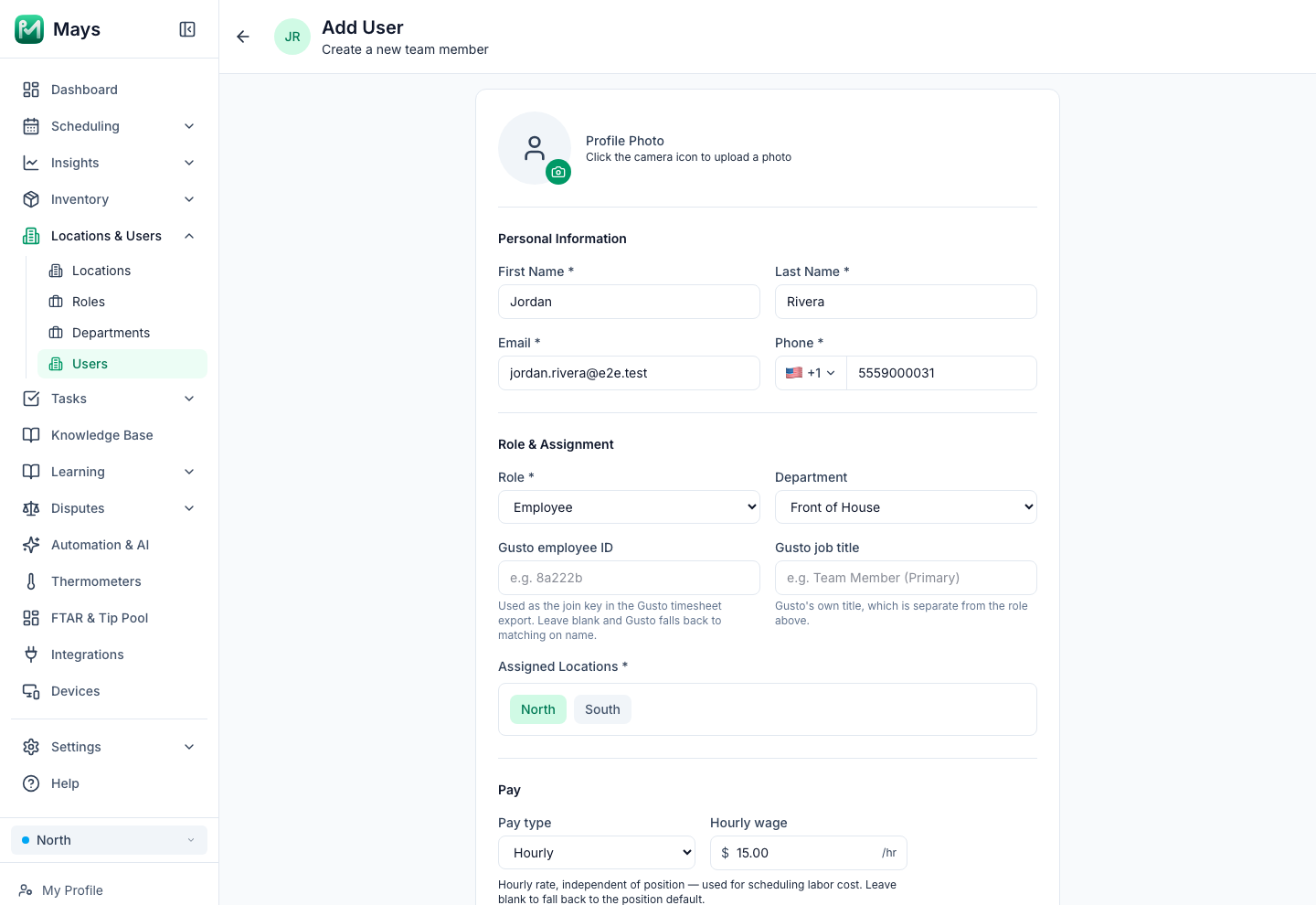
- Add each hire under Locations & Users → Users → Add User (the image at the top of this post): name, email, phone, role, department, assigned locations and hourly wage. A new employee gets a text message with a link to download the app and sign in with their phone number. Managers and admins get an email invitation.
- Bringing a team over? An admin can paste or upload a staff list as a .csv, .tsv or .txt file on Import employees. The AI reads it, you review the rows, and they're added to one location. No invitations go out.
- Roles: employees use the phone app only; managers see and manage the locations they're assigned to; admins see everything.
- Positions and wages: create positions such as Barista and Cashier, each with a default hourly wage, under Scheduling → Positions, then add them to each person.
- A first-week checklist: build a "New hire: week one" checklist template and leave its locations empty, so it never runs on its own. On day one, use Tasks → Create Task → From Template and assign it to the new hire; every task on it is created for that day.
- Your SOPs go in the Knowledge Base, which staff read in the app. The training post covers quizzes.
Mays stores a birthday for the celebration message, but it doesn't track minors' hours. Check teens' shifts against the table above yourself when you build the schedule.
Your hiring checklist
- Roles listed, with the pairs each person can cover
- Headcount worked out from your coverage plan, plus one
- A job post with pay, schedule, the real duties and must-haves only
- The same six questions for everyone, scored right after
- Trial shifts kept short, scheduled and paid
- I-9, W-4, the new-hire report within 20 days, and E-Verify at 25 employees
- Proof of age and hour limits checked for anyone under 18
- The app, a named trainer and a week-one plan ready before day one, with food handler training booked
Bring your first hires on board
Add your team, give each new hire a first-week checklist, and publish the schedule they'll see on their phone.
Start your free trial: 30 days, every module, no card needed. Next up: Training your first hires in one week.