Bookkeeping setup for a new café: a chart of accounts, a weekly close and what to give your accountant
Bookkeeping is easy to push to "later." Then the first sales tax return is due, the accountant asks for three months of receipts, and the shoebox comes out. A simple setup in the first month saves days of digging later, and gives you numbers you can actually use while there's still time to act on them.
This is the last post in our series on money basics for a new café. The earlier posts covered the 13-week cash flow forecast, paying for the build-out and equipment, card processing fees, raising menu prices, vendor payment terms and insurance basics. Good books feed every one of them.
This is general information, not accounting or tax advice. Set up your books with an accountant or bookkeeper who knows restaurants, and follow their advice where it differs from this outline.
Three decisions before the first entry
- A separate business bank account and card. The IRS notes that "For most small businesses, the business checking account is the main source for entries in the business books" (IRS, What kind of records should I keep). Mixing personal and business spending makes every month harder.
- Cash or accrual. Your accountant decides with you. The SBA's short version: "The accrual method puts transactions on the books immediately upon completing the sale. The cash method only records this once payment has been received" (SBA, Manage your finances).
- Who does what. The SBA describes the trade-off: "A bookkeeper can provide basic day-to-day functions at a lower cost, but won't possess the formal accounting education of a CPA" (same page). One workable split: a bookkeeper or software for the weekly work, and an accountant for taxes and the year-end.
The IRS doesn't require a particular system: "You may choose any recordkeeping system suited to your business that clearly shows your income and expenses" (IRS).
A chart of accounts outline for a café
The chart of accounts is the list of categories every dollar is sorted into. Build it so your profit and loss statement shows prime cost (cost of goods sold plus labor) at a glance; see our post on tracking prime cost every week. Here's an outline to adapt with your accountant. The numbering is just one way to group accounts, not a standard you have to follow.
Range | Group | Café examples |
|---|---|---|
1000s | Assets | Business checking; cash on hand (change funds, safe); card deposits in transit; inventory (food, beverage, paper and packaging); prepaid rent or insurance; equipment; furniture and fixtures; leasehold improvements; security deposits |
2000s | Liabilities | Accounts payable (vendors); business credit card; sales tax payable; payroll taxes payable; tips owed to staff; gift cards not yet redeemed; equipment loan or lease; SBA or bank loan |
3000s | Owner's equity | Owner contributions; owner draws; retained earnings |
4000s | Sales | Food; non-alcoholic beverages; beer and wine; catering; delivery app sales; retail (beans, merchandise); discounts and comps (as negative sales) |
5000s | Cost of goods sold | Food; beverage; beer and wine; paper and packaging |
6000s | Labor | Hourly wages, front of house; hourly wages, kitchen; salaried managers; payroll taxes; workers' comp; benefits |
7000s | Operating expenses | Rent and common area charges; utilities; repairs and maintenance; smallwares; cleaning supplies; card processing fees; delivery app commissions; marketing; software and phone; insurance; licenses and permits; accounting and legal; bank fees |
8000s | Other | Interest; depreciation |
A few things trip up new cafés:
- Sales tax you collect isn't sales. It's money you hold until the return is due. In Florida, see Florida sales tax for restaurants and cafés.
- Card tips belong to the staff. They pass through your account on their way into payroll; keep them out of sales. Our first payroll post covers how tips are reported.
- Gift cards are sold before they're earned. Until a card is redeemed, the balance is something you owe.
- Loan payments split in two. Interest is an expense; the principal reduces the loan.
- Equipment isn't an expense line. A new espresso machine goes in assets, and your accountant handles depreciation.
- Keep COGS split the same way as your menu. Food, beverage and paper separately, so the percentages mean something.
The weekly close: 30 to 45 minutes
Pick a day, ideally the same day you review labor cost and update the cash forecast:
- Sales. For each day, compare the POS sales summary with what reached the bank: card deposits, cash deposits from your deposit log, delivery app payouts. Record sales by category, sales tax, tips, discounts and refunds.
- Vendor invoices. Make sure every delivery has an invoice entered, every invoice matches what you ordered and received, and every short or return has a credit memo requested (see vendor payment terms).
- Bills. Enter rent, utilities, software and other bills that arrived, with their due dates.
- Payroll. Check the period's hours and tips before they go to payroll.
- The numbers. Look at prime cost, then update your 13-week cash flow forecast with the real bank balance.
- File the paper. Scan or photograph receipts and file them by week, so nothing waits until month-end.
The monthly close
Once a month, usually within the first two weeks:
- Reconcile the bank account and every business credit card to their statements, line by line.
- Count inventory on the last day of the month, so cost of goods sold reflects what you actually used (see café inventory from day one).
- File and pay sales tax by the due date.
- Check payroll tax filings and deposits with your payroll provider.
- Review the profit and loss statement against your budget and your break-even point, and write down one or two things to change.
What to give your accountant
The IRS lists the supporting documents a business generates: "sales slips, paid bills, invoices, receipts, deposit slips, and canceled checks," and asks you to keep them "in an orderly fashion and in a safe place. For instance, organize them by year and type of income or expense" (IRS, What kind of records should I keep). For a café, a monthly folder usually holds:
- Bank and credit card statements
- POS sales summaries: sales by category, sales tax, tips, discounts, refunds
- Card processor and delivery app statements
- Vendor invoices and credit memos
- Payroll reports from your payroll provider
- Sales tax returns and payment confirmations
- Loan and equipment lease statements
- Invoices for any equipment or build-out you paid for
- The month-end inventory count
- Owner contributions and draws
For equipment and other assets, the IRS lists what your records should show, including "When and how you acquired the assets," "Purchase price," "Cost of any improvements" and "Section 179 deduction taken" (same page). If your restaurant is a large food or beverage establishment, ask your accountant about Form 8027, which employers use to "Annually report to the IRS receipts and tips from their large food or beverage establishments" (IRS, About Form 8027).
How long to keep records
The IRS's general rule: "you must keep your records that support an item of income, deduction or credit shown on your tax return until the period of limitations for that tax return runs out" (IRS, How long should I keep records). From the same page:
Record | How long, per the IRS |
|---|---|
Most records supporting an income tax return | 3 years from filing, in the basic case |
If you file a claim for credit or refund | 3 years from filing or 2 years from paying the tax, whichever is later |
If you don't report income you should, and it's more than 25% of the gross income shown | 6 years |
A claim for a loss from worthless securities or a bad debt deduction | 7 years |
Employment tax records | "at least 4 years after the date that the tax becomes due or is paid, whichever is later" |
Records connected to property, such as equipment | until the period of limitations expires for the year you dispose of it |
The IRS adds a warning: "When your records are no longer needed for tax purposes, do not discard them until you check to see if you have to keep them longer for other purposes. For example, your insurance company or creditors may require you to keep them longer than the IRS does" (same page). State rules, such as sales tax, can differ too.
Common mistakes
- Paying personal expenses from the business account, or the other way round
- Booking card tips or sales tax as sales
- Expensing a big equipment purchase instead of recording it as an asset
- Leaving invoices in the delivery box until month-end
- Never reconciling the bank account, so errors pile up for months
- Throwing out records on a fixed date without checking the IRS rules
Where Mays fits
Mays isn't accounting software: it doesn't keep a general ledger, reconcile your bank or connect to an accounting app. It keeps several of the records your books are built from in one place:
- Every vendor invoice (Inventory → Invoices): photograph or scan it, upload the PDF, or email it to the location's own invoice address, and Mays drafts it with the document attached. You check the lines and post it.
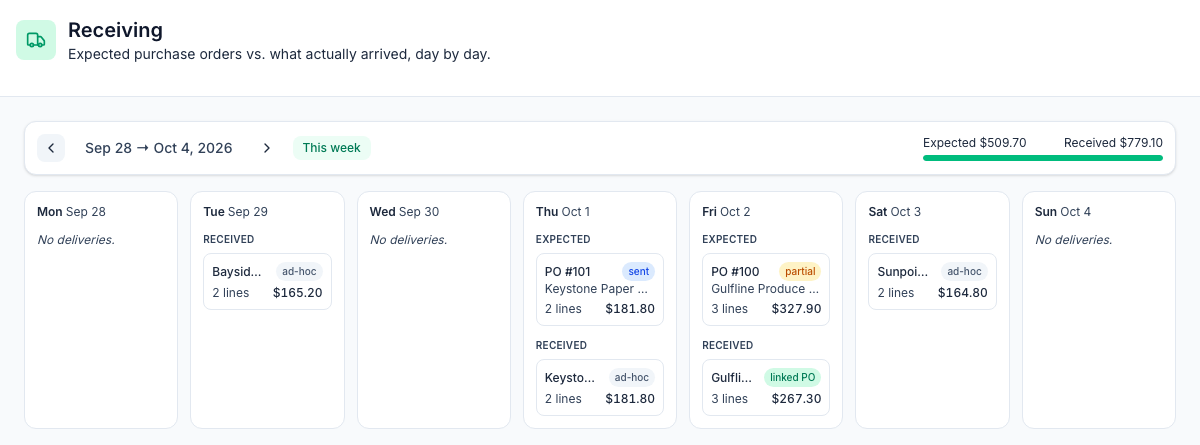
- Deliveries against orders (Inventory → Receiving, the image at the top of this post): each week's expected orders and posted invoices day by day, marked linked PO when an invoice was matched to its order and ad-hoc when it wasn't, with the week's expected and received totals.
- Spending by vendor and category (Insights → Vendor Spend): posted invoices by vendor, or by your inventory item categories, which you can set up to match your COGS accounts. You can note a GL code on each inventory item, but Mays doesn't yet report spending by GL code.
- Payroll hours (Scheduling → Time Clock): each pay period exports as a Standard CSV or a Gusto timesheet.
- Daily sales and labor (Scheduling → Reports → Actuals, with Export CSV), with sales from Square or Union POS.
Your bookkeeping checklist
- A business bank account and card, used for nothing else
- Cash or accrual, decided with your accountant
- A chart of accounts that shows food, beverage, paper and labor separately
- Sales tax, card tips and gift cards kept out of sales
- A weekly close on a fixed day
- A monthly close: reconciliations, inventory count, sales tax, P&L review
- A monthly folder for your accountant
- Records kept for at least as long as the IRS periods above, and longer when your insurer, lender or state requires it
Keep invoices and deliveries in order
Capture every invoice, match it to what you ordered and received, and hand your accountant clean records every month.
Start your free trial: 30 days, every module, no card needed.