Vendor payment terms for a new café: net terms, COD, minimums, credits, and how to negotiate
Your suppliers are some of the most important relationships the café has. They decide what arrives, when it arrives, what it costs and, just as important, when you have to pay for it. A new café often starts on the strictest terms and earns better ones over time.
This is the fifth post in our series on money basics for a new café. It builds on café inventory from day one, which covers par levels, counts and ordering, and on the 13-week cash flow forecast, where your payment terms decide which week each vendor bill lands in.
This is general information, not legal or financial advice. Every supplier has its own credit policy and contract; read yours.
The terms you'll see
Term | What it means | Effect on your cash |
|---|---|---|
COD (cash on delivery) | Pay when the delivery arrives, often by check or card | Money leaves the same week the food arrives |
Prepay | Pay when you order | Money leaves before the food arrives |
Net 7 / net 14 / net 30 | Pay the invoice within 7, 14 or 30 days of the invoice date | You can sell some of the food before you pay for it |
2/10 net 30 | Take 2% off if you pay within 10 days; otherwise the full amount is due in 30 | A discount for paying early |
Statement terms | The supplier sends one statement for a period, and you pay it by a set date | Fewer payments to track, but check every invoice on it |
A supplier may ask a new business to start on COD or prepay, or to fill in a credit application before offering net terms. If the application includes a personal guarantee, read it carefully: it can make you personally responsible for the café's bill.
Is an early-payment discount worth it?
Take 2/10 net 30 on a $1,000 invoice. Paying on day 10 instead of day 30 saves $20, which is the price of getting your money back 20 days sooner. Spread over a year, that's a high return: roughly 2% ÷ 98% × (365 ÷ 20) ≈ 37% a year. If you have the cash and your 13-week forecast stays above your buffer, the discount is worth taking. If paying early would push a week under the buffer, the discount isn't worth the risk.
Produce has its own federal rules
If you buy fresh fruit and vegetables, the federal Perishable Agricultural Commodities Act (PACA) may apply to your supplier and to you. The USDA explains that PACA "protects businesses dealing in fresh and frozen fruits and vegetables by establishing and enforcing a code of fair business practices" (USDA AMS, PACA).
Two parts matter for a café:
- Prompt payment. USDA's regulations define "full payment promptly" for a buyer as "Payment for produce purchased by a buyer, within 10 days after the day on which the produce is accepted" (7 CFR 46.2(aa)). Parties who want different terms "must reduce their agreement to writing before entering into the transaction" (same section).
- The PACA trust. Many produce invoices carry trust language. The USDA explains that "The PACA trust provisions put sellers of fresh and frozen fruits and vegetables in a priority status in the event their buyers become insolvent or file for bankruptcy protection," and that "To qualify for trust protections, terms for payment cannot exceed 30 days from the date of acceptance of the product" (USDA AMS, PACA Trust).
In plain terms: unpaid produce bills are treated differently from your other debts. Pay produce suppliers on time, and if you agree on longer terms, get them in writing first.
Minimums, delivery days and cutoffs
Most distributors have a minimum order, delivery days for your area and a cutoff time to make the next truck. They shape how often you order, and so how much cash sits on your shelves:
- Below the minimum, you may pay a delivery fee or have to wait for the next truck.
- To hit the minimum, it's tempting to order extra. That's cash tied up in stock, and more to waste if it's perishable.
- Fewer, larger orders usually mean fewer fees but more stock on hand. Your par levels decide the balance; see the inventory post.
Write down each vendor's minimum, delivery days and cutoff, and build your ordering routine around them.
Shorts, substitutions and credits
What arrives isn't always what you ordered. Handle it at the back door, not two weeks later:
- Check every delivery against the invoice before the driver leaves: count cases, check weights, look at dates and temperatures.
- Mark shorts, damages and substitutions on the invoice and ask the driver to initial it. Refuse anything that arrives out of temperature or damaged.
- Ask for a credit memo for anything short, damaged or returned, and note the credit on your copy of the invoice.
- Keep a list of open credits and check them off when they show up on a statement or reduce a payment.
- Compare the price on the invoice with the price you agreed. A price change can slip in without notice.
Unclaimed credits are money you've paid for food you didn't get. On a busy week they're easy to forget, which is why the list matters.
How to negotiate when you're new
You may not have volume yet, but you do have things a supplier wants: a steady weekly order, on-time payment and the chance to grow with you. Things you can reasonably ask about:
- Payment terms. Start where they offer, pay on time for a few months, then ask to move from COD to net 7 or net 14.
- Prices on your top items. Ask for a price list and when it changes. For your biggest items (coffee, milk, bread), ask whether a price can be held for a period.
- Delivery fees and minimums. Ask what triggers a fee, and whether a lower minimum is possible on certain days.
- Substitution rules. Agree in advance which items can be substituted and which can't.
- Credits and returns. Ask how shorts and returns are credited, and how quickly.
- A second quote. Getting a quote from a second supplier for your top ten items tells you where your prices stand, even if you don't switch.
Keep the relationship professional and the paperwork clean: on-time payments and tidy credit requests are what earn better terms.
Common mistakes
- Signing a credit application without reading the personal guarantee
- Ordering extra to reach a minimum, then wasting it
- Letting the driver leave before checking the delivery
- Never following up on credit memos
- Paying a statement without matching it to the invoices and credits
- Agreeing longer terms on produce verbally instead of in writing
Where Mays fits
Mays doesn't pay your suppliers or track invoice due dates, so payment terms and open credits still live with your bookkeeping. Mays handles the ordering and receiving side:
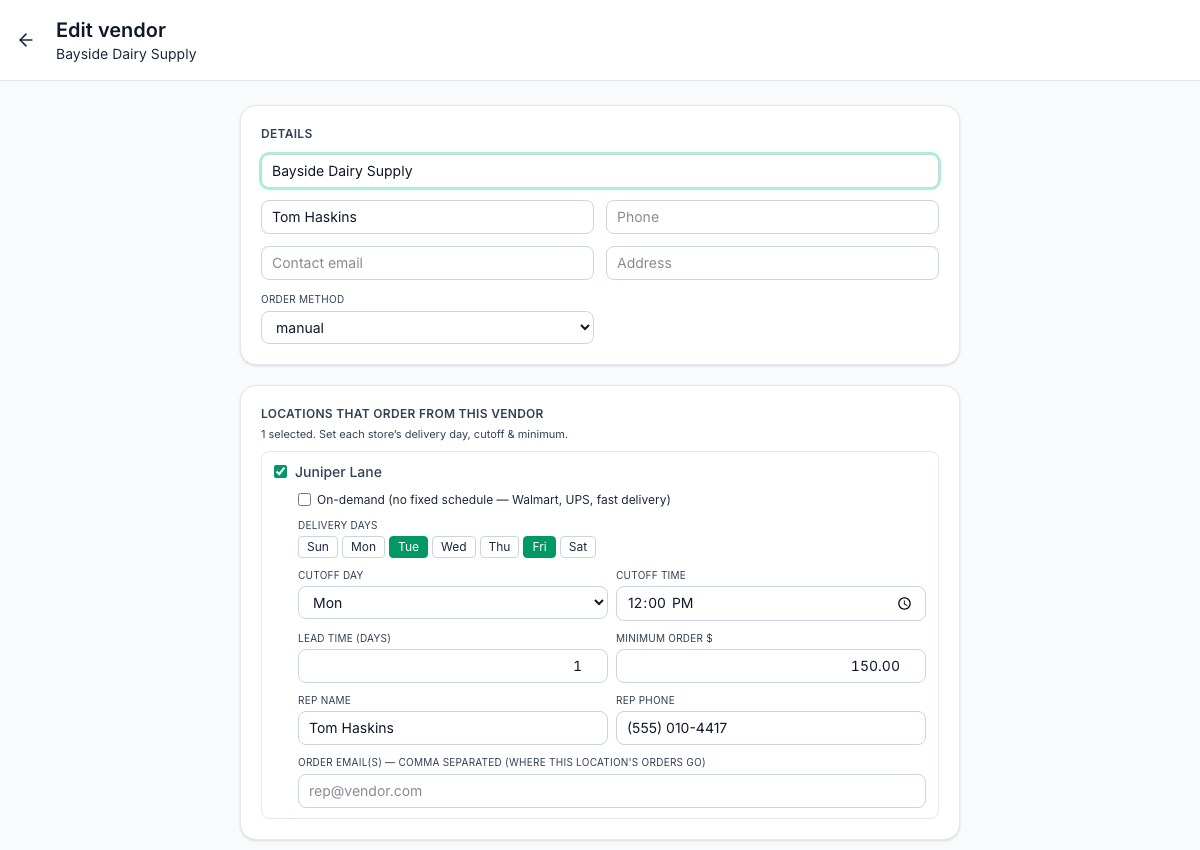
- Vendor profiles per location (Inventory → Vendors, the image at the top of this post): each location's delivery days, cutoff day and time, lead time, minimum order and rep for a vendor. The order form then shows the next delivery you can make and how far you are from the minimum.
- Orders from your par levels (Inventory → Orders): Order to par fills in what you need, and Mays makes one order per vendor. For a vendor set up for email orders, Send order emails a PDF purchase order.
- Receiving against the order: after you post the vendor's invoice, Receive · 3-way match on the order compares ordered and invoiced quantities and prices item by item, and the order stays partial if something is short.
- Invoices that handle credits (Inventory → Invoices): lines can be marked as backordered, returns come in as a negative quantity and credits as a negative price, and neither changes your item prices. If the same vendor and invoice number are already in Mays, the draft warns you. See Vendor invoices.
Your supplier checklist
- Each vendor's terms written down: COD, net days or discount
- Credit applications read, including any personal guarantee
- Produce terms on time, or longer terms agreed in writing first
- Minimum, delivery days and cutoff for every vendor
- Every delivery checked against the invoice before the driver leaves
- Shorts and damages marked and initialed, with a credit memo requested
- A running list of open credits
- A second quote on your top items once a year
Order, receive and match in one place
Build orders from your pars, check every delivery against its order, and keep supplier prices current from each invoice.
Start your free trial: 30 days, every module, no card needed. Next in this series: restaurant insurance basics for a new café.