Cash handling for a small restaurant: tills, drops and daily reconciliation
Cash is the one part of a small restaurant where a mistake stays invisible until the bank statement arrives. A drawer that's $20 short once is a miscount. A drawer that's short every Tuesday is a pattern, and you only see it if every count is written down.
This guide sets up a routine that works with one register or three: opening and closing counts, blind counts, safe drops, voids and refunds, over/short tracking and the deposit log, with a sample count sheet you can copy.
This is general information, not legal advice. Updated September 24, 2026: the Department of Labor pages and the regulation cited here were re-checked.
Five rules for a clean drawer
- One drawer, one person, one shift. If three people work the same till, nobody owns a shortage. If you can't give everyone their own drawer, make the shift lead its owner and count at every handoff.
- Every drawer starts with the same amount. A fixed starting bank (the float), say $150 in set denominations, makes every count simpler.
- Count whenever the drawer changes hands: at opening, at shift change and at close.
- Write it down the same way every time. Same sheet, same order, signed.
- Look for patterns, not culprits. One short drawer is usually a miscount or wrong change. The same drawer short week after week is worth a closer look.
Opening the drawer
- Count the starting bank before the doors open, by denomination, and record it.
- If it doesn't match, recount with a manager before the first sale. A wrong opening count makes the closing count wrong too.
- Stock the float with the change you actually give: plenty of ones and fives, and coin rolls.
During the shift: safe drops, paid-outs, voids
Safe drops keep too much cash from sitting in the drawer. Set a limit, for example "large bills over $300 go to the safe," and log every drop:
Time | Drawer | Amount | Dropped by | Witness |
|---|---|---|---|---|
11:40 am | 1 | $200.00 | Shift lead | Manager |
Paid-outs are cash taken from the drawer to pay for something, like milk from the store next door. Each one needs a receipt in the drawer and a line on the count sheet, or it shows up as a shortage.
Voids, refunds and no-sales are where drawer problems often hide. Decide in your POS who can do them. A common setup is manager approval for every void and refund, and a log of every no-sale drawer open. Read your POS's void and refund report every day, next to the count.
Closing: the blind count
In a blind count, the person counting doesn't know what the drawer should hold. They count and record the total; then a manager compares it with the POS. Nobody is tempted to "find" the right number, and counting mistakes show up instead of being quietly corrected.
Once the counted total is in:
- Expected cash = starting bank + cash sales (after cash refunds) − paid-outs − safe drops
- Over/short = counted cash − expected cash
A sample cash-count sheet
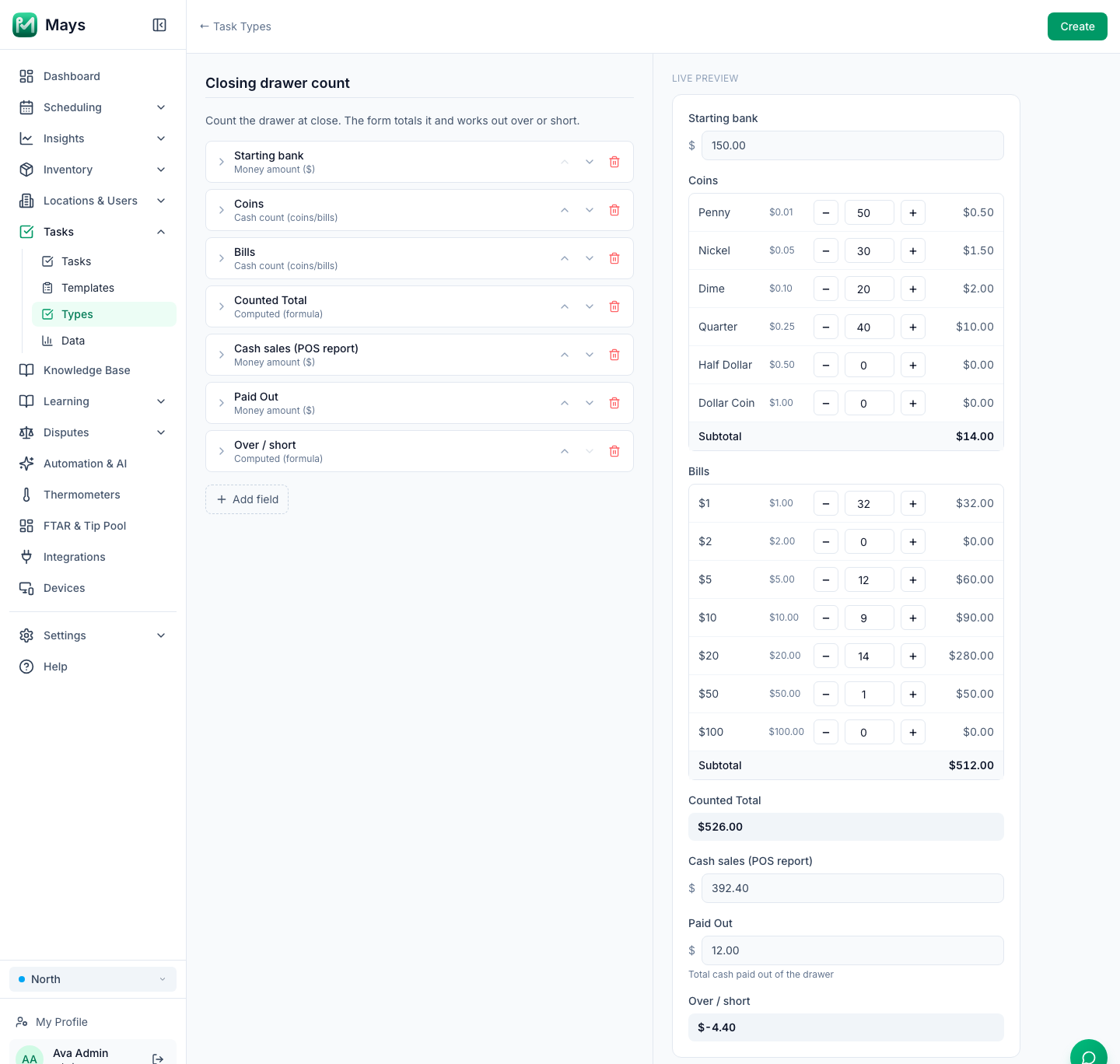
Made-up numbers for one drawer at close. The same numbers are in the image at the top of this post.
Line | Count | Amount |
|---|---|---|
Pennies | 50 | $0.50 |
Nickels | 30 | $1.50 |
Dimes | 20 | $2.00 |
Quarters | 40 | $10.00 |
$1 bills | 32 | $32.00 |
$5 bills | 12 | $60.00 |
$10 bills | 9 | $90.00 |
$20 bills | 14 | $280.00 |
$50 bills | 1 | $50.00 |
Counted cash | $526.00 | |
Starting bank | $150.00 | |
Cash sales from the POS report | $392.40 | |
Paid-outs, with receipts | $12.00 | |
Safe drops | $0.00 | |
Expected cash (150.00 + 392.40 − 12.00 − 0.00) | $530.40 | |
Over/short | −$4.40 |
The counter signs, then the manager signs.
Over/short without blaming people
- Record every drawer, every day, even when it's exact. A log full of zeros is what makes the one bad week stand out.
- Pick a tolerance you'll accept without a second look, and investigate anything outside it: recount, check the void and refund report, look for a missing paid-out receipt.
- Review the log weekly by drawer, day and person. Repeated shortages on the same shift say more than any single count.
- Overages matter too. A drawer that's over can mean a customer was short-changed.
Don't dock pay for shortages
It's tempting to take a shortage out of the cashier's paycheck. Federal law sharply limits that:
- Deductions for "cash or merchandise shortages" are "not legal to the extent that they reduce the wages of employees below the minimum rate required by the FLSA or reduce the amount of overtime pay due under the FLSA" (DOL, Handy Reference Guide to the FLSA).
- That's true "even if an economic loss suffered by the employer is due to the employee's negligence," and having the employee pay you back in cash doesn't get around it. One of the Department's own examples of a problem: a minimum wage cashier "illegally required to reimburse the employer for a cash drawer shortage" (DOL Fact Sheet #16).
- If you take a tip credit, deductions for "walkouts, breakage, or cash register shortages" are illegal, because any such deduction would reduce the tipped employee's wages below the minimum wage (DOL Fact Sheet #15).
- Tips aren't the fix either: an employer "may not keep tips received by its employees for any purposes" (29 CFR 531.52).
Treat shortages as a process problem: retrain, change who has drawer access, tighten void approvals. Talk to an employment lawyer before any deduction; state law can add limits of its own.
The deposit log
- Build the deposit from the counted cash, minus the next day's starting bank.
- Two people count it and both sign.
- Log the date, amount, bag or slip number, who prepared it and who took it to the bank.
- Match every deposit to the bank statement weekly, so a missing one is found in days, not months.
Date | Amount | Bag / slip # | Prepared by | Verified by | Deposited by | On statement |
|---|---|---|---|---|---|---|
Mon | $376.00 | 0412 | Shift lead | Manager | Manager | Yes |
Where Mays fits
Mays isn't a POS: the drawer, voids and refunds live in your POS. Mays makes sure the counts happen the same way every day, and keeps them.
- A cash-count form (the image at the top of this post). Admins build custom forms under Tasks → Types. The Register / Cash count preset has coin and bill counts that total themselves (you can edit the denominations), a Paid Out amount and a Counted Total. For the image, we added Starting bank and Cash sales (POS report) amounts, and changed the preset's last formula field into Over / short:
counted - (starting_bank + cash_sales_pos_report - payouts). Formulas refer to fields by ID, which Mays makes from each field's label. - For a blind count, leave the POS figures off the closer's form, and compare its Counted Total with the POS report yourself.
- Part of closing: add a task with the answer type Custom form to your closing checklist, assigned to the closing role with a visibility window. Staff fill it in on their phone, and a Photo task can capture the deposit slip.
- The log: Tasks → Data lists every submitted form for a location and date range, with who submitted it, and Export CSV gives a column for each amount. Coin and bill counts come out as their totals.
- Alerts: under Insights → Alerts & Reports, an admin can add a Task Form Field Threshold alert on Over / short, for example At or below −$5.00. The team members you pick get a push notification, and any email addresses you add get an email.
- Refunds: once Square is connected, a built-in automation gives whoever is on shift a task for each new refund, "Refund issued — explain why," with the amount and the reason recorded in Square.
- Anything unusual goes in the manager Logbook, with Needs follow-up ticked.
Your cash-handling checklist
- One person owns each drawer, every shift
- A fixed starting bank, counted at opening
- A safe-drop limit and a drop log
- A receipt and a line for every paid-out
- Void and refund permissions set in the POS, and the report read daily
- A blind count at close, compared with the POS by a manager
- Over/short recorded for every drawer, every day
- Two signatures on every deposit, matched to the statement weekly
- No pay deductions for shortages without legal advice
Count every drawer the same way
Build the count once, add it to the closing checklist, and let the log build itself.
Start your free trial: 30 days, every module, no card needed. Setting up your closing routine? Read Opening and closing checklists your staff will actually follow.