Paying for the build-out and equipment: SBA 7(a), 504 and microloans, and leasing vs. financing
Before a café sells its first latte, it has usually spent a lot of money: the build-out, the espresso machine and grinders, a walk-in or reach-ins, furniture, the opening order of inventory and enough cash to get through the first slow weeks. Few owners pay for all of it from savings.
This is the second post in our series on money basics for a new café. It covers the three SBA loan programs a café owner is most likely to hear about, the difference between financing equipment and leasing it, and what to prepare before you talk to a lender. The first post, on a 13-week cash flow forecast, shows how to check that you can carry the payments once you have them.
This is general information, not financial, legal or tax advice. Loan terms, rates and eligibility change, and every lender has its own rules. Check the current terms with the lender and your accountant before you sign anything.
Start with the list of what you're paying for
Lenders want to know exactly what the money is for, and the answer decides which program fits. Split your startup budget into four groups:
Group | Café examples |
|---|---|
Real estate and build-out | buying or renovating a building, leasehold improvements, plumbing, hood, electrical |
Equipment | espresso machine, grinders, ovens, walk-in, reach-ins, dishwasher, ice machine, POS hardware |
Furniture, fixtures and supplies | tables, chairs, shelving, smallwares, signage |
Working capital and inventory | the opening inventory order, payroll and rent until sales catch up, a cash buffer |
The SBA's guidance for a loan request is to "Give a detailed description of how you'll use your funds. Specify if you need funds to buy equipment or materials, pay salaries, or cover specific bills until revenue increases" (SBA, Plan your business).
SBA loans: the SBA guarantees, a lender lends
The SBA mostly doesn't lend to you directly. For the 7(a) program it "provides a loan guarantee to lenders that allow them to provide financial help for small businesses," and "You will always work directly with your lender and not with SBA" (SBA, 7(a) loans). To find a participating lender, the SBA points to its Lender Match tool.
The SBA's general advice: "If you have trouble getting a traditional business loan, you should look into SBA-guaranteed loans" (SBA, Plan your business).
7(a) loans: the general-purpose program
The SBA calls 7(a) its "primary business loan program." According to the SBA, 7(a) loans can be used for (SBA, 7(a) loans):
- "Acquiring, refinancing, or improving real estate and buildings"
- "Short- and long-term working capital"
- "Refinancing current business debt"
- "Purchasing and installation of machinery and equipment, including AI-related expenses"
- "Purchasing furniture, fixtures, and supplies"
- "Changes of ownership (complete or partial)"
- "Multiple purpose loans, including any of the above"
"The maximum loan amount for a 7(a) loan is $5 million." To be eligible, the SBA lists, among other things, that a business must "Be an operating business," "Operate for profit," "Be located in the U.S.," "Be small under SBA size requirements," and "Be creditworthy and demonstrate a reasonable ability to repay the loan" (same page).
On repayment, the SBA says "Most 7(a) term loans are repaid with monthly payments of principal and interest from the cash flow of the business" (same page). That monthly payment goes straight into your cash flow forecast.
504 loans: long-term financing for big fixed assets
The 504 program "provides long-term, fixed rate financing for major fixed assets that promote business growth and job creation" (SBA, 504 loans). It's offered through Certified Development Companies: "504 loans are available exclusively through Certified Development Companies (CDCs)" (same page).
What a 504 loan can pay for, per the SBA, includes "The purchase, construction or renovation of existing buildings or land" and "Long-term machinery and equipment with a useful remaining life of a minimum of 10 years." What it can't: "Working capital or inventory" (same page). The SBA lists "10-, 20- and 25-year maturity terms."
For a café, that makes 504 a fit for buying or renovating a building, or for heavy equipment that will last; it won't cover your opening inventory or the payroll you carry before sales ramp up.
Microloans: small amounts through nonprofit lenders
"The microloan program provides loans up to $50,000 to help small businesses and certain not-for-profit childcare centers start up and expand. The average microloan is about $13,000" (SBA, Microloans). The SBA funds "specially designated intermediary lenders, which are nonprofit community-based organizations," and those lenders "make all credit decisions and set all terms" (same page).
The SBA's examples of uses: "Working capital," "Inventory," "Supplies," "Furniture," "Fixtures," "Machinery" and "Equipment." But "Proceeds from an SBA microloan cannot be used to pay existing debts or to purchase real estate." The "Maximum repayment term allowed for an SBA microloan is seven years," and interest rates "vary depending on the intermediary lender," "Generally, between 8%-13%" (same page, as the SBA lists it today).
The three side by side
7(a) | 504 | Microloan | |
|---|---|---|---|
Who you apply to | a participating lender | a Certified Development Company | an SBA intermediary lender |
Equipment | yes | long-term machinery and equipment | yes |
Working capital and inventory | yes | no | yes |
Buying real estate | yes | yes | no |
Maximum amount, per the SBA | $5 million | see the 504 page | $50,000 |
Check each program's page for current terms before you apply; the SBA updates them.
Equipment: finance it or lease it?
Outside the SBA programs, equipment is often paid for in one of two ways.
An equipment loan. You buy the machine, you own it, and the lender usually holds a claim on it until the loan is paid off. Your monthly payment includes interest.
An equipment lease. You pay to use the machine for a term. At the end, depending on the lease, you return it, renew, or have an option to buy it. Read the end-of-term terms before you sign, along with who pays for repairs and what happens if you close early.
The tax treatment differs, and it's a question for your accountant, not a reason on its own to choose. IRS Publication 946 explains that "if you lease property from someone to use in your trade or business or for the production of income, generally you cannot depreciate its cost because you do not retain the incidents of ownership" (IRS, Publication 946 (2025)). For property you buy, the same publication describes the section 179 deduction: "You can elect to recover all or part of the cost of certain qualifying property, up to a limit, by deducting it in the year you place the property in service."
Questions to ask yourself for each big piece of equipment:
- How long will I use it? A walk-in or a hood will likely outlast any lease term. A POS terminal or a tablet may be out of date sooner.
- Who fixes it? For an espresso machine, a service plan can matter as much as the price.
- What's the total I'll pay? Add up every payment plus any buyout, then compare with the cash price.
- What happens if I close or move? Some leases and loans have to be paid off in full.
- How does the payment fit the forecast? Put the monthly payment into your 13-week cash flow and look at the lowest week.
What to have ready before you talk to a lender
The SBA's list is short: "To increase your chances of securing a loan, you should have a business plan, expense sheet, and financial projections for the next five years" (SBA, Plan your business). For a new café, that means:
- A business plan with your concept, location and menu.
- A startup cost list in the four groups above, with quotes for the build-out and equipment.
- Projections: monthly for the first year, then yearly. The break-even post gives you the core numbers: fixed costs, contribution margin and the daily sales you need.
- A cash flow forecast that includes the new loan payment.
- Your personal credit history. The SBA notes that "loan eligibility for a new business is typically based on its owner's personal credit score" (same page).
- Your lease, or a letter of intent, since the lender will want to know the location is secured.
- Licenses you'll need. In Florida, see DBPR or FDACS licensing for a new café.
Common mistakes
- Borrowing for equipment and forgetting working capital, then running short in month two
- Picking a program before listing what the money is for
- Comparing monthly payments instead of total cost over the term
- Signing an equipment lease without reading the end-of-term and early-closing terms
- Leaving the loan payment out of the break-even point (it belongs in fixed costs)
- Not asking who services the equipment, and how fast
Where Mays fits
Mays doesn't lend money, arrange financing or prepare financial statements, so the loan application itself is between you, your lender and your accountant. Once the café is open, Mays helps with the numbers that show the loan is being paid from a working business:
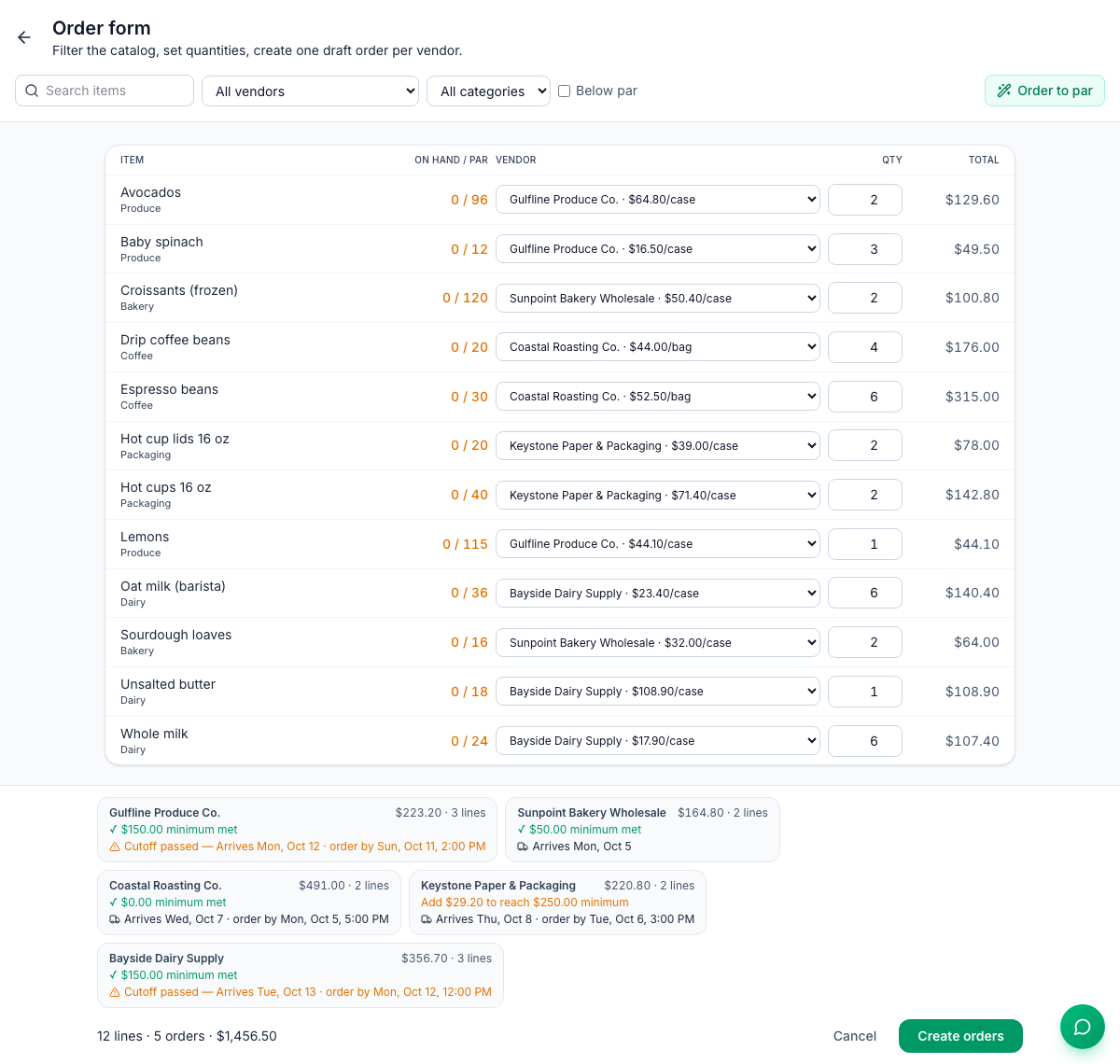
- Your opening order (Inventory → Orders → New order, the image at the top of this post): set a par level for each item, click Order to par, and Mays fills in the packs you need (par minus on hand, rounded up to whole packs), each item on its cheapest vendor unless you pick another, then makes one draft order per vendor. The total is a working-capital line for your startup budget: inventory a 7(a) loan or a microloan can pay for, and a 504 loan can't.
- What your inventory is worth (Inventory → Reports → On-hand value): the value of the stock on hand at a location, item by item.
- Vendor invoices (Inventory → Invoices): photograph or email in each supplier invoice, check the lines and post it, which adds the stock and updates your prices.
- Sales, labor and food cost: daily sales and labor % in Scheduling → Reports → Actuals, and labor and theoretical food cost as a share of sales in Insights → Prime Cost (for admins). Those are the numbers your projections promised.
Your financing checklist
- A startup cost list in four groups: real estate and build-out, equipment, furniture and supplies, working capital
- The SBA program pages read for current terms: 7(a), 504, microloans
- A business plan, an expense sheet and projections, monthly for year one
- Quotes for each big piece of equipment, with the lease and loan options side by side
- The total cost of each option over its full term
- Every new payment added to your 13-week cash flow forecast
- Your accountant's view on the tax side before you sign
Keep the numbers your lender cares about
Track sales, labor, food cost and what's on your shelves in one place from the first week.
Start your free trial: 30 days, every module, no card needed. Next in this series: card processing fees, and the rules for surcharges and cash discounts.