Card processing fees for a café: interchange, markups, and the rules on surcharges and cash discounts
For most cafés, card fees are one of the bigger costs nobody budgets for properly. They come out before the money reaches your bank, and the statement is hard to read. In the break-even post we used 3% of sales as a placeholder. This post shows how to find your real number, and what you can and can't do about it.
This is the third post in our series on money basics for a new café, after the 13-week cash flow forecast and paying for the build-out and equipment.
This is general information, not legal or financial advice. Card network rules and state laws change, and they apply differently depending on where your café is. Before you add a surcharge or change how you price, talk to your processor and a lawyer in your state.
Where a card fee goes
Every card sale passes through several parties: the bank that issued the customer's card, the card network (Visa, Mastercard and others), and your processor or bank (the "acquirer"). The fee you pay is split between them.
- Interchange goes to the card-issuing bank. Visa describes these as "transfer fees between acquiring banks and issuing banks for each Visa card transaction," and publishes its US rates (Visa, Rates, fees and rules). Rates differ by card type (debit or credit, rewards or not) and by how the card was taken (tapped, inserted or keyed in).
- Network fees go to the card network.
- Your processor's markup is what your processor charges on top.
You don't pay interchange directly. In Visa's words: "Merchants do not pay interchange reimbursement fees—merchants negotiate and pay a “merchant discount” to their financial institution that is typically calculated as a percentage per transaction" (same page). That merchant discount is the rate on your statement.
Debit is different. For debit cards from large banks, federal Regulation II limits the interchange fee. The Federal Reserve explains that Regulation II "establishes standards for assessing whether a debit card interchange fee received by a debit card issuer for an electronic debit transaction is reasonable and proportional to the costs incurred by the issuer," and that "Certain small debit card issuers, government-administered payment programs and reloadable general-use prepaid cards are exempt from the interchange fee limitations" (Federal Reserve, Regulation II).
Flat-rate vs. interchange-plus
Processors package these costs in a few common ways:
Pricing model | How it works | Good for | Watch out for |
|---|---|---|---|
Flat-rate | One percentage, sometimes plus a per-transaction fee, whatever the card | Simple statements; a new café with low volume | You pay the same on a cheap debit tap as on a premium rewards card |
Interchange-plus | The actual interchange and network fees, passed through, plus a fixed markup | Seeing exactly what each part costs; higher volume | Longer statements; check the markup and the monthly fees |
Tiered | Transactions sorted into "qualified," "mid-qualified" and "non-qualified" rates | Hard to compare with other offers | The processor decides which tier each card falls into |
None is always cheaper: it depends on your average ticket, your mix of debit and credit, and the extra fees.
Find your effective rate
Ignore the advertised rate and work out what you actually paid:
Effective rate = total fees for the month ÷ total card sales for the month
Say a café had $30,000 in card sales last month and paid $870 in total fees, including monthly fees. Its effective rate is $870 ÷ $30,000 = 2.9%. These numbers are made up; use your own statement.
Then read the rest of the statement for fees that aren't per transaction:
- Monthly or annual account fees
- PCI compliance fees, or a penalty for not completing your PCI questionnaire
- Terminal rental or lease payments
- Chargeback fees
- Fees for keyed-in or card-not-present transactions
- An early termination fee in the contract
Use it in your break-even math and your 13-week forecast, and recheck it every few months.
Chargebacks: a cost that comes back later
A chargeback happens when a cardholder disputes a charge with their bank. The money is pulled back from you, and you usually have a short window to send evidence that the charge was valid. A lost chargeback costs you the sale, the food, and any chargeback fee in your processor's contract.
For a café, the common cases are a customer who doesn't recognize a charge, a catering order the client says wasn't as described, and a duplicate charge. What helps you win:
- A receipt with the items, time and card details
- For catering: the signed order, the delivery confirmation and a photo of what was delivered
- Any email or text exchange with the customer
- A clear refund policy, shown at the counter and online
Respond inside the deadline. A dispute you ignore is a dispute you lose.
Surcharges: what the card network allows
A surcharge is an extra fee for paying by card. Visa's definition: "A surcharge is an additional fee or charge that a merchant adds to a consumer's bill for using a particular form of payment" (Visa, U.S. Merchant Surcharge Q and A, version February 15, 2024).
According to that Q&A, if you intend to surcharge, Visa requires that you:
- "Notify your acquirer at least 30 days prior to commencing surcharging"
- "Limit surcharging to credit cards only (debit cards and prepaid cards cannot be surcharged)"
- "Limit the amount to your merchant discount rate (MDR) for the applicable credit card or 3% whichever is lowest"
- "Disclose the surcharge as a merchant fee and, for both in-store and online transactions, clearly alert consumers to the practice at the point of entry, the point of sale or transaction, and on every receipt"
Visa also says the debit rule holds even when a customer presses "credit" on the terminal: "The cardholder is still using a Visa debit card" (same document). Mastercard, American Express and Discover have their own rules; ask your processor for them before you start.
Cash discounts
A cash discount is the other way around: a lower price for paying with cash. Visa's Q&A says that to do it correctly, the merchant must display prices either as "Only the card price per item" or as "Both the card and the cash price listed side-by-side per item," and the final card total "must be displayed in full based on the total of the items being purchased as displayed by the merchant and not achieved by applying an additional fee for a card payment as it may appear to be, and may be treated as, a surcharge and subject to Visa's surcharge rules" (same document).
In practice: if your menu shows one price and the card total comes out higher, customers and the card network may see that as a surcharge, whatever you call it.
State laws on surcharges
State law can ban or limit surcharges regardless of the card network rules. Visa itself writes that "as of February 15, 2024, Visa understands that (i) Connecticut, Maine, Massachusetts, Oklahoma and Puerto Rico, prohibit surcharging and (ii) Colorado, Minnesota, New Jersey and New York, have requirements for surcharging," and adds that its understanding "may contain errors, omissions, or inaccuracies, and should not be relied on as authoritative information or legal advice" (same document). Here is what some of the statutes say:
- Connecticut: "No person may impose a surcharge on any transaction." Discounts for paying by cash, check or debit are allowed only with a posted notice (Conn. Gen. Stat. § 42-133ff).
- Massachusetts: "No seller in any sales transaction may impose a surcharge on a cardholder who elects to use a credit card in lieu of payment by cash, check or similar means" (M.G.L. c. 140D, § 28A).
- Maine: "A seller in a sales transaction may not impose a surcharge on a cardholder who elects to use a credit card or debit card in lieu of payment by cash, check or similar means," and "A discount or reduction from the regular price is not a surcharge" (9-A M.R.S. § 8-509).
- Minnesota: surcharges on credit or charge cards are allowed if you tell customers orally and with a posted sign for in-person sales, post a notice at checkout online, and "the surcharge does not exceed five percent of the purchase price" (Minn. Stat. § 325G.051).
- Florida: the statute books still contain s. 501.0117, which says a seller "may not impose a surcharge on the buyer or lessee for electing to use a credit card in lieu of payment by cash, check, or similar means, if the seller or lessor accepts payment by credit card," and that it "does not apply to the offering of a discount for the purpose of inducing payment by cash, check, or other means not involving the use of a credit card, if the discount is offered to all prospective customers" (s. 501.0117, Florida Statutes). Visa's list above doesn't name Florida. Because the two don't line up, ask a Florida lawyer before you add a card surcharge in Florida; a cash discount offered to everyone is outside the statute by its own words.
- California: the Attorney General's guidance on the state's hidden-fees law says a business generally doesn't need to include card processing fees in its advertised price, "because a credit card processing fee is not a mandatory fee if the customer can avoid the fee by paying a different way (e.g. cash.)," but "if a business only accepts credit cards as a form of payment, then the credit card fee is mandatory and would have to be included in the advertised price" (California Attorney General, SB 478 - Hidden Fees).
This isn't a complete list. Check your own state's statutes or attorney general, and remember that a café in two states follows each state's law at each location.
Surcharge, cash discount or a price increase?
A surcharge keeps menu prices low but brings signs, receipt changes, 30 days' notice and outright bans in some states. A cash discount needs prices shown correctly and staff who can explain it. Building the cost into menu prices is the simplest for guests, and it's the subject of the next post in this series.
Where Mays fits
Mays isn't a payment processor and doesn't read your processing fees, so the effective rate comes from your processor's statement. Mays helps around it:
- Sales from your POS: Mays brings in sales from Square or Union POS, and from Square also payments, tips and refunds, so your daily sales and labor % in Scheduling → Reports → Actuals match what went through the register.
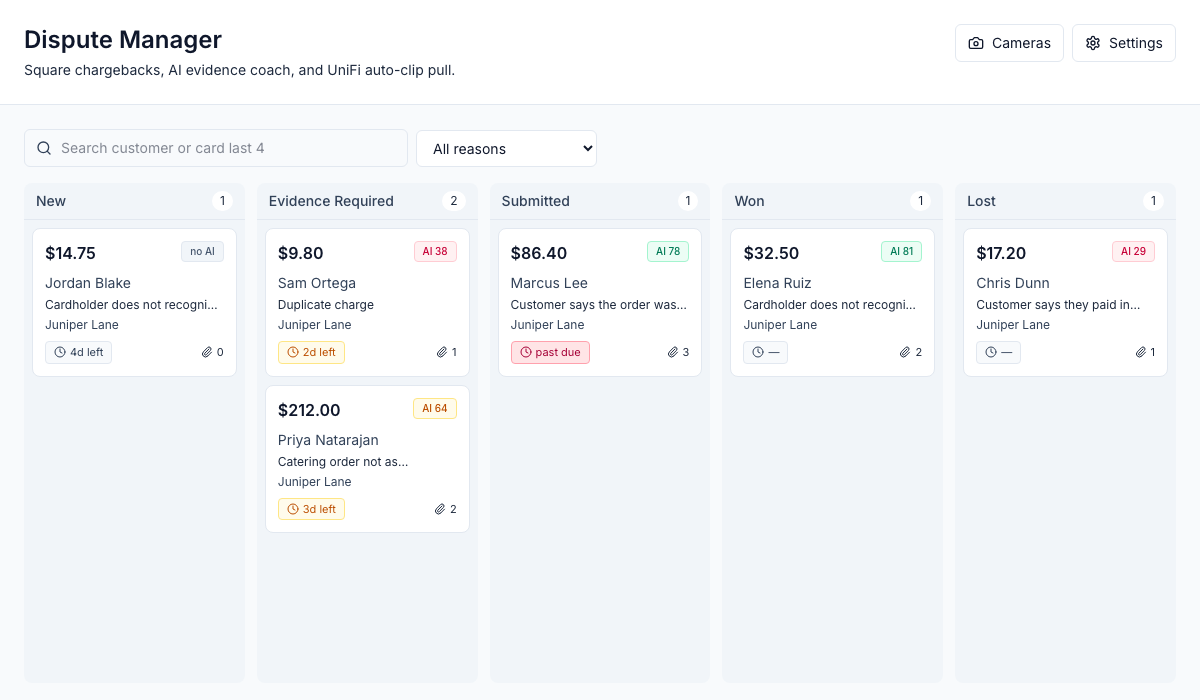
- Chargebacks (Disputes, the image at the top of this post): with Square connected, Square chargebacks arrive in a board with New, Evidence Required, Submitted, Won and Lost columns. Mays gives the location's managers and the admins a high-priority task to collect evidence, due a day before Square's deadline. You upload the evidence, an AI coach scores how complete the case looks, and you submit it to Square from Mays.
- Card fees on tips: once Labor law compliance is on for a location, its tip pool settings can take a set percentage off card tips for the processing fee. Whether that's allowed, and how much, depends on your state; our post on tip pooling for new restaurant owners covers the federal side.
Your card fee checklist
- Last month's effective rate, from the statement: total fees ÷ card sales
- Your pricing model (flat-rate, interchange-plus or tiered) and the markup
- Every monthly, PCI, chargeback and terminal fee listed
- The contract's term and early termination fee
- A plan for chargebacks: receipts, catering paperwork, a refund policy and a deadline owner
- Before any surcharge: your state's law, the network rules, and 30 days' notice to your processor
- A recheck of the effective rate every few months
See every sale and chargeback in one place
Bring your POS sales, labor and chargebacks together, so a dispute never slips past its deadline.
Start your free trial: 30 days, every module, no card needed. Next in this series: raising menu prices without losing guests.