Florida sales tax for restaurants and cafés: what's taxable, the county surtax and the DR-15
Groceries are tax-free in Florida. Meals are not. For a new café that sits somewhere in between, selling lattes to stay and bags of beans to go, the line matters on every ticket.
This is the second post in our series Florida compliance basics for a new café or restaurant. It covers registering, what's taxable, the county surtax, tips and comps, and filing the Sales and Use Tax Return (Form DR-15).
This is general information, not tax advice. Updated October 5, 2026: every source below was checked on that date. Rates and rules change, so confirm with the Florida Department of Revenue or your accountant.
Register before your first sale
The Department of Revenue's restaurant brochure is direct: "Prior to engaging in business as a restaurant, caterer, or in other taxable business activity in Florida, registration with the Department of Revenue is required" (Florida DOR, Sales and Use Tax on Restaurants and Catering, GT-800035).
You register each location online, or on the paper Florida Business Tax Application (Form DR-1). Once registered, DOR sends a Certificate of Registration (Form DR-11), a Florida Annual Resale Certificate (Form DR-13) and return forms, and "The Certificate of Registration must be displayed in a clearly visible place at your business location" (Florida DOR, Sales and Use Tax).
If you'll have employees, DOR also takes your reemployment tax registration through the Florida Business Tax Application (Florida DOR, Reemployment tax).
What's taxable in a restaurant or café
The general rule, from GT-800035: "Food products served, prepared, or sold in or by restaurants, lunch counters, cafeterias, caterers, hotels, taverns, and other like places of business where food products are ordinarily sold for immediate consumption on the seller's premises are taxable, even if sold on a 'to go' or 'take out' basis."
The statute starts from the opposite end: "Food products for human consumption are exempt," and then lists what the exemption doesn't cover (s. 212.08(1), Florida Statutes). The items a café sells most often:
Item | Taxable? | From s. 212.08(1) |
|---|---|---|
Meals, to stay or to go | Yes | "Food products sold as meals for consumption on or off the premises of the dealer" |
Anything served at tables or counters, or on your dishes | Yes | "...for consumption at tables, chairs, or counters or from trays, glasses, dishes, or other tableware" |
Sandwiches | Yes | "Sandwiches sold ready for immediate consumption on or off the seller's premises" |
Hot food | Yes | "Food products sold as hot prepared food products" |
Pastries, at a bakery with seating | Yes, unless sold to take away | "Bakery products sold by bakeries, pastry shops, or like establishments having eating facilities, except when sold for consumption off the seller's premises" |
Pastries, at a bakery with no seating | No | "Bakery products sold by bakeries, pastry shops, or like establishments that do not have eating facilities" |
Coffee beans, ground coffee, loose tea | No | "coffee, coffee substitutes, or cocoa; and tea, unless it is sold in a liquid form" |
Candy | Yes | "Candy and any similar product regarded as candy or confection" |
"For consumption off the seller's premises" means "the food or drink is intended by the customer to be consumed at a place away from the dealer's premises," and in deciding what's sold for immediate consumption, "the customary consumption practices prevailing at the selling facility shall be considered" (same section).
In practice: set up your POS so every menu item carries the right tax setting from day one, and ask your accountant about anything that sits in the middle, like retail bags of beans or a pastry case at a bakery with seats.
The rate: 6% plus your county's surtax
"Sales by restaurants, caterers, and similar businesses are generally subject to Florida's state sales tax rate of 6% plus any applicable discretionary sales surtax" (GT-800035).
The surtax is set by county. DOR: "You must collect discretionary sales surtax when the transaction occurs in – or delivery is made into – a county that imposes a surtax," and for delivered sales, "surtax is collected at the county rate where the delivery is made" (Florida DOR, Discretionary Sales Surtax). Some 2026 rates from the official table (Form DR-15DSS, calendar year 2026):
County | Surtax | State + surtax |
|---|---|---|
Collier | None | 6% |
Orange | 0.5% | 6.5% |
Palm Beach | 0.5% | 6.5% |
Miami-Dade | 1% | 7% |
Pinellas | 1% | 7% |
Duval | 1.5% | 7.5% |
Rates change. Palm Beach is an example: DR-15DSS says its 1% infrastructure surtax "is repealed effective 12/31/2025" and a new 0.5% surtax "begins 1/1/2026." DOR updates the table "yearly in November," so check it each year and update your POS.
Tips, service charges and comps
From GT-800035:
- Tips "are not subject to tax when" the tip "is separately itemized on the customer's receipt, guest check, or sales invoice," and the restaurant "receives no monetary benefit from the gratuity."
- Service charges are taxable: "Service charges, minimum charges, corkage fees, setup fees, or similar charges imposed by a restaurant, tavern, nightclub, or other like place of business are part of the sales prices subject to sales tax." If you plan to add an automatic charge, for large parties for example, ask your accountant how it's treated before you print it on the menu.
- Free food. A restaurant must "pay use tax on their cost price of food or drink provided to customers at no charge." But food that comes with a meal, like chips and salsa or bread, is "part of the taxable meal sold and use tax is not due." A buy-one-get-one-free meal is taxed on the price paid, with no use tax on the free one.
- Staff meals. Food sold to employees is taxable. Food served to employees isn't, "provided no cash changes hands as payment for the food products furnished and the assigned value of the food products is not required to be reported as income to the employee for federal income tax purposes."
Buying supplies: resale certificate and use tax
Cups, lids, straws, napkins and to-go bags that leave with the customer aren't taxed, and "Restaurants and similar businesses can use their Florida Annual Resale Certificate for Sales Tax (Form DR-13) to purchase such items tax exempt" (GT-800035). Things you use to run the business are taxable when you buy them: the brochure lists tableware, drinkware, cookware, silverware, tables, chairs and linens.
If you buy something tax-free that turns out to be for your own use, or order a taxable item from out of state without paying Florida tax, you owe use tax on it. DOR's examples include: "If you buy an item tax exempt intending to resell it, and then use the item in your business or for personal use, you owe use tax" (DOR, Sales and Use Tax).
One change worth knowing if you read older guides: the tax on commercial rent is gone. DOR's return instructions say "Sales Tax on Commercial Rentals Repealed Effective October 1, 2025" (Form DR-15N, R. 10/25).
On every receipt
"Any person making taxable sales in Florida must separately state Florida sales tax on each customer's invoice, sales slip, receipt, billing, or other evidence of sale." Since July 1, 2021, the tax is computed to the third decimal and "if the third decimal place is greater than 4, the tax must be rounded up to the next cent" (DOR, Sales and Use Tax). Your POS does both, as long as each item's tax setting is right.
Filing the DR-15
You report on the Sales and Use Tax Return, Form DR-15. From the instructions (DR-15N) and DOR's page:
- Due date. "Tax returns and payments are due on the 1st and late after the 20th day of the month following each reporting period." If the 20th is a weekend or holiday, the next business day counts. Electronic payments must be started, with a confirmation number, by "5 p.m. ET on the business day prior to the 20th."
- File even with nothing to report. "File on time for each reporting period even if no tax is due."
- The surtax goes on the back. "If you are reporting discretionary sales surtax (county tax) collected, you must complete the back of your return."
- Don't include the tax in gross sales, or "it will increase the amount of tax due and you will receive a bill for additional tax due."
- Collection allowance. File and pay electronically on time and you keep "2.5% (.025) of the first $1,200 of tax due, not to exceed $30 for each reporting location."
- Late penalty. 10% of the amount due or $50, whichever is more, and "If your return or payment is late, the minimum penalty is $50 even if you file a late return with no tax due," plus interest.
- E-filing. Voluntary for most new businesses, but anyone who "paid $5,000 or more in sales and use tax during the State of Florida's prior fiscal year (July 1 through June 30)" must file and pay electronically the next calendar year.
How often you file
Monthly is the default: the return covers "the preceding calendar month" (s. 212.11(1)(b), F.S.). The department may move small dealers to a longer period, based on the tax remitted over the previous four quarters (s. 212.11(1)(c)):
Tax remitted, last four quarters | Filing |
|---|---|
More than $1,000 | Monthly (or a quarterly return with monthly payments, up to $12,000) |
$1,000 or less | Quarterly |
$500 or less | Semiannual |
$100 or less | Annual |
A busy café passes $1,000 of tax a year quickly, so plan on monthly returns. File on whatever schedule DOR assigns you.
Your sales tax checklist
- Registered with DOR before the first sale; DR-11 certificate displayed
- Every POS item set taxable or exempt, with the right county rate
- Service charges taxed; tips itemized and passed to staff
- Comps and staff meals handled the way GT-800035 describes
- Disposables bought with your DR-13 resale certificate; use tax on anything else bought tax-free
- A calendar reminder before the 20th of every month, and e-filing set up
- The DR-15DSS surtax table checked every November
Where Mays fits
Mays isn't tax software: it doesn't file the DR-15 or calculate what you owe. Your POS keeps the tax report you file from. What Mays does with sales:
- Sales without tax for your numbers. With Square or Union POS connected, Insights → Prime Cost counts revenue as net sales "without tax, tips or service charges," so your labor and food percentages aren't inflated by tax you hand to the state.
- Tax in custom reports. The sales data Mays syncs keeps each order's tax, so you can ask Mays AI for a custom report like tax collected by location (building a report uses AI credits). The report's days follow UTC, so late-evening sales can land on the next day: file from your POS's own report.
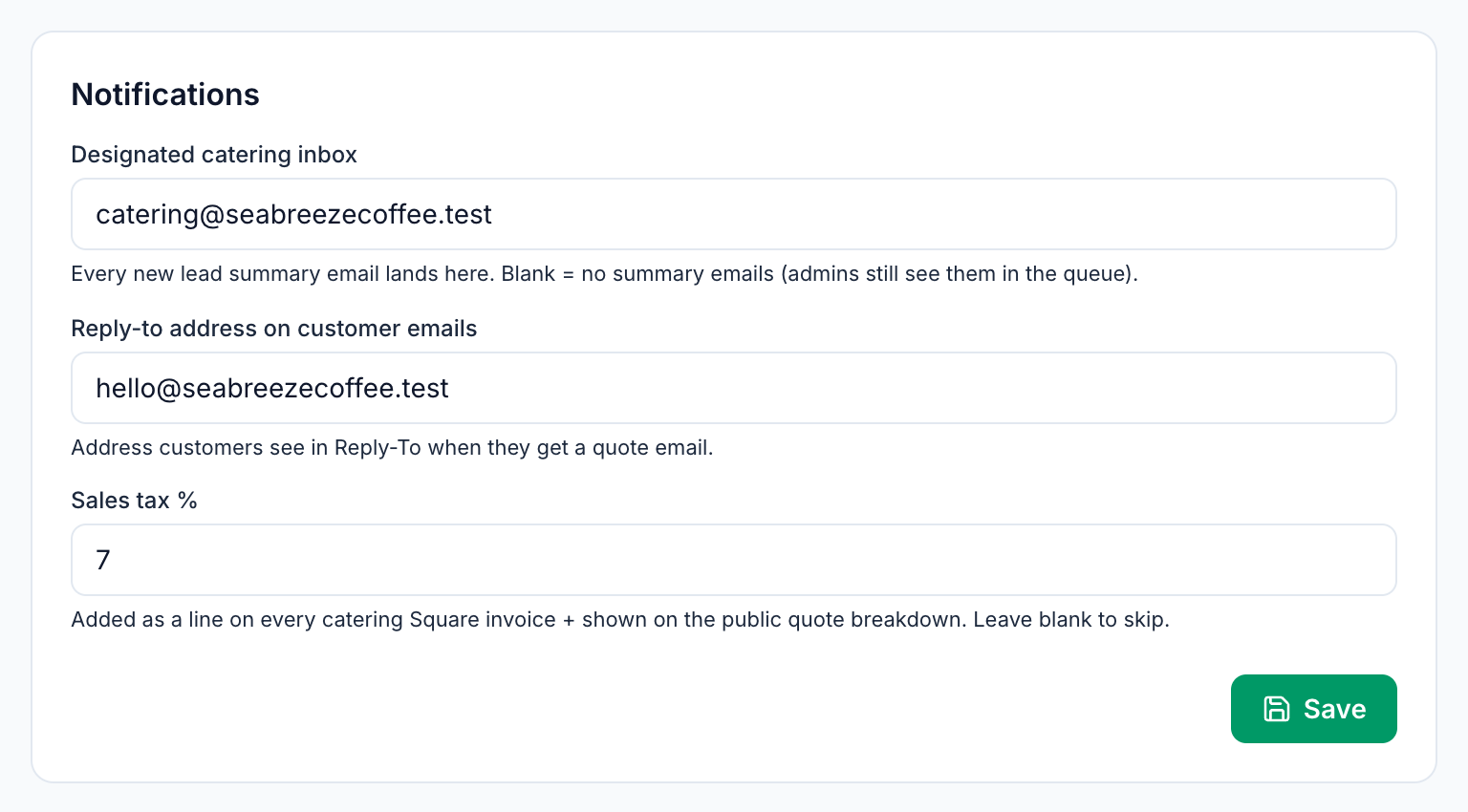
- Catering quotes and invoices. Under Catering → Settings, Sales tax % adds a tax line to every catering Square invoice and the public quote (the image at the top of this post). Catering is set up with our team.
Keep your numbers clean
Connect your POS, and watch prime cost and labor on sales that leave the tax out.
Start your free trial: 30 days, every module, no card needed. Or book a walkthrough and we'll connect your POS with you.
Previous in the series: Florida food service licensing: DBPR or FDACS? · Next: Required workplace posters in Florida.