Restaurant insurance basics for a new café: liability, property, workers' comp, liquor, business interruption and cyber
A lease or a loan may require proof of insurance before you open. For many new owners, that's the first time they sit down with an agent and hear a dozen policy names at once.
This is the sixth post in our series on money basics for a new café. It doesn't recommend a policy or a price, and it can't: coverage, exclusions and premiums depend on your location, your menu, your building and the insurer. What it does is explain the main coverages in plain terms, with official sources, so you can ask better questions.
This is general information, not insurance or legal advice. Your policy's own wording decides what's covered. Work with a licensed agent and read every exclusion.
Start with what you couldn't pay for yourself
The U.S. Small Business Administration's rule of thumb: "As a general rule, you should insure against things you wouldn't be able to pay for on your own." It also reminds owners: "You also may be legally required to purchase certain types of business insurance" (SBA, Get business insurance).
For a café, the big risks are a guest or delivery driver getting hurt, a fire or storm closing the building, an employee injured on the line, food spoiling in a broken cooler, and a data breach on your ordering system. Each maps to a different kind of coverage.
General liability
The Texas Department of Insurance describes it: "Commercial General Liability (CGL) insurance protects business owners against claims of liability for bodily injury, property damage, and personal and advertising injury (slander and false advertising)" (Texas Department of Insurance, Commercial general liability insurance).
For a café, that's the guest who slips on a wet floor or the customer whose coat is ruined by a spilled tray. Points to ask about:
- Occurrence or claims-made. TDI explains that "Occurrence policies cover claims arising from injury or damage occurring while the policy is in force, regardless of when the claim is first made," while claims-made policies need both the injury and the claim to fall inside the policy period, unless you buy extra reporting time (same page).
- Exclusions. TDI lists common ones, including that "CGL policies are not intended to provide coverage for workers' compensation or employer's liability" (same page). Injured employees need their own coverage.
- Premium audits. Many CGL policies estimate the premium from your expected payroll or sales and then audit it: "If the actual payroll, sales, or units sold is greater than was estimated, you may owe additional premium" (same page). Estimate honestly.
- Umbrella or excess liability. Washington's insurance commissioner describes these as policies that "step in after a large loss and extend your liability coverage" (Washington OIC, Learn how business insurance works).
Commercial property
TDI: "Commercial property insurance pays to repair or replace your building and business property damaged by a fire, storm, or other event covered by the policy" (TDI, Commercial property insurance guide). Even if you rent, you own the equipment, furniture, inventory and often the build-out you paid for.
Two questions decide what a claim pays:
- Replacement cost or actual cash value? "Replacement cost coverage pays to repair or replace your property at current costs," while "Actual cash value coverage pays replacement cost minus depreciation" (same guide). For a two-year-old espresso machine, the difference can be large.
- Which causes of loss? TDI describes basic, broad and special forms, and notes that "Most policies exclude damages from floods, earth movement, war, nuclear disaster, wear and tear, and insects or vermin" (same guide).
TDI also lists boiler and machinery coverage, which "covers boilers, air conditioning units, compressors, steam cookers, electric water heaters, and similar machinery" (same guide). For a café full of refrigeration, ask whether equipment breakdown is covered, and whether food that spoils because of a breakdown or a power outage is covered too.
Flood: a separate policy
Standard property policies usually leave flooding out. TDI: "Most commercial property policies don't cover damage from flooding. To be protected from flooding, you'll need to buy a separate flood policy," and "There's a 30-day waiting period after you buy a flood policy before the coverage goes into effect" (same guide). Washington's commissioner says the same about business insurance and points to the National Flood Insurance Program (Washington OIC).
In a coastal state like Florida, don't wait until a storm is in the forecast to ask about flood coverage.
Business interruption
If a fire closes the café for two months, the property policy fixes the building, but rent, loan payments and your key staff still need paying. That's what business interruption coverage is for. TDI: "Business interruption coverage pays for the income you lose if your business can't operate normally because it was damaged or destroyed," and "Extra expense coverage pays additional costs to return your business to normal after it's damaged" (same guide).
Washington's commissioner: business interruption "protects you if a covered loss forces you to close your business" (Washington OIC). The word to notice is covered. Ask your agent which causes of a closure would count, with examples of what would and wouldn't trigger it.
Your 13-week cash flow forecast is a good way to size it: add up the bills you'd still have to pay with the doors closed.
Workers' compensation
Injured employees are covered by workers' comp, not general liability. Whether you must carry it depends on your state and your headcount. For Florida, see our post on workers' compensation for a Florida restaurant or café, which covers who has to carry it, owner exemptions and the steps after an injury.
Liquor liability
If you serve beer, wine or cocktails, ask about liquor liability. State "dram shop" laws decide when a business that serves alcohol can be held responsible for what an intoxicated guest does afterwards. In Florida, the statute says a person who serves alcohol to someone of lawful drinking age isn't liable for the resulting injury or damage, "except that a person who willfully and unlawfully sells or furnishes alcoholic beverages to a person who is not of lawful drinking age or who knowingly serves a person habitually addicted to the use of any or all alcoholic beverages may become liable for injury or damage caused by or resulting from the intoxication of such minor or person" (s. 768.125, Florida Statutes). Other states' rules differ.
Ask your agent whether your general liability policy covers liquor at all, or whether you need a separate liquor liability policy. Train staff to check IDs, and write down what happens when someone is refused.
Cyber and crime
A café's card terminals, online ordering and email all hold customer and employee data. The Federal Trade Commission's small-business guidance: "Cyber insurance is one option that can help protect your business against losses resulting from a cyber attack," and it suggests discussing with your agent whether you need first-party coverage (your own losses), third-party coverage (claims from others), or both (FTC, Cyber Insurance).
TDI lists crime coverage options that include "Robbery and safe burglary," "Employee theft" and "Cyber crime" (TDI, Commercial property insurance guide). For a business that handles cash, ask about employee theft too.
Bundles: the business owner's policy
TDI notes that "Many insurance companies offer business owner's policies that bundle multiple coverages together. They're usually cheaper than buying the coverages separately" (same guide). The SBA describes a business owner's policy as "an insurance package that combines all of the typical coverage options into one bundle" (SBA). Check what the bundle leaves out, and ask about liquor, flood, cyber and workers' comp by name.
How to shop
The SBA's steps include "Find a reputable licensed agent" and "Shop around. Prices and benefits can vary significantly. You should compare rates, terms, and benefits for insurance offers from several different agents" (SBA). TDI adds: "Buy only from licensed companies. If you buy from an unlicensed company, your claims might not get paid" (TDI). Check that both the agent and the insurer are licensed with your state's insurance department.
Bring the same list to every agent: your square footage and building, your equipment list with values, expected sales and payroll, whether you serve alcohol, whether you deliver or cater, and what your lease and lender require.
Common mistakes
- Insuring the build-out for what you paid years ago instead of what it would cost today
- Assuming the property policy covers flood
- Not asking whether spoiled food after a breakdown or outage is covered
- Under-estimating payroll or sales to lower the premium, then paying at audit
- Serving alcohol without checking how liquor liability is handled
- Not re-reviewing coverage when you add catering, delivery or a second location
Where Mays fits
Mays doesn't sell or manage insurance. It does help you keep the records that make a claim, or an inspection, easier to document:
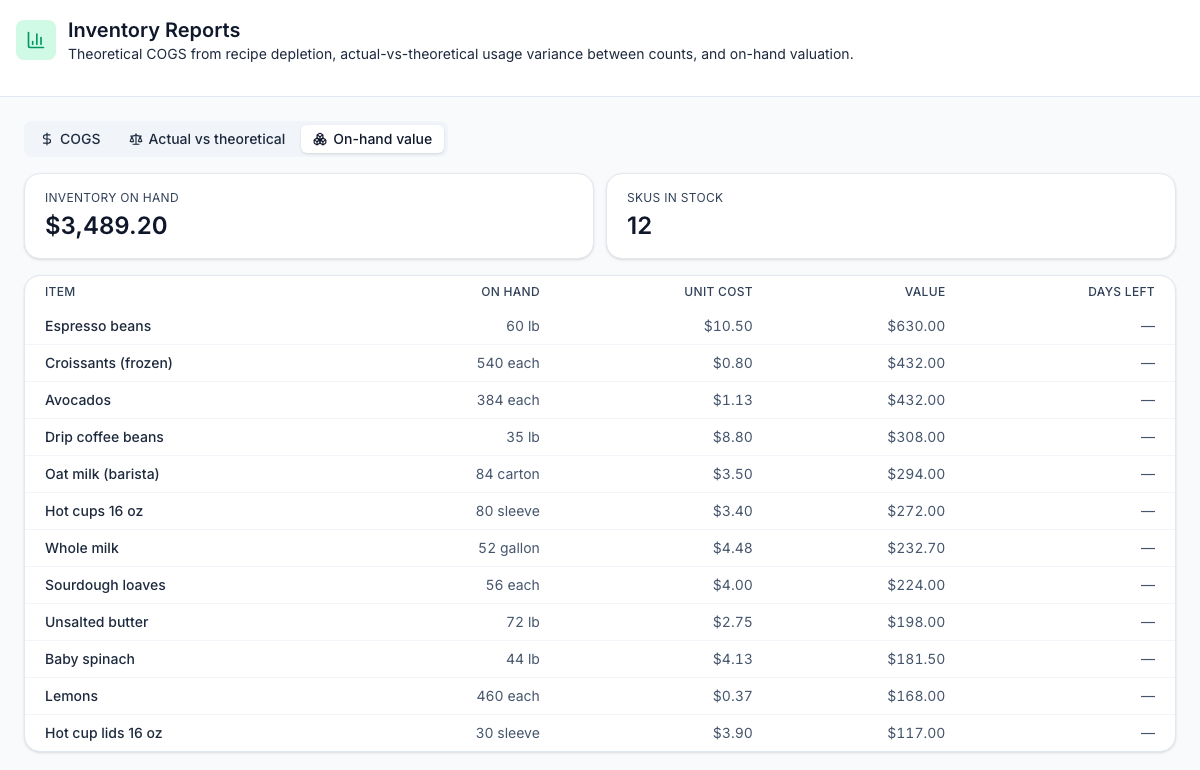
- What your stock is worth (Inventory → Reports → On-hand value, the image at the top of this post): the value of the stock on hand at a location, item by item, with its count and unit cost. It's a starting point when you set the contents limit on a property policy, or list what was lost after a cooler failure.
- Temperature monitoring (Thermometers): sensors report every five minutes, and when a unit stays outside its safe range past its alert delay, Mays creates a task at the location to check it. A temperature log for any dates downloads as a PDF or CSV.
- Incidents in the manager logbook (Scheduling → Logbook): a dated entry per location, with an Incidents category, for a guest fall, a broken cooler or a delivery problem, with follow-up flags and comments.
- Tasks after an incident: a one-off task with a due date and a photo answer, such as reporting an injury to your carrier, so it doesn't depend on someone remembering.
Your insurance checklist
- Your landlord's and lender's insurance requirements, in writing
- General liability: occurrence or claims-made, and the main exclusions
- Property at replacement cost, with the causes of loss you're covered for
- Equipment breakdown and spoilage, asked about by name
- Flood, priced separately, with the 30-day wait in mind
- Business interruption sized from your fixed bills
- Workers' comp, by your state's rules
- Liquor liability if you serve alcohol
- Cyber and crime, including employee theft
- Quotes from more than one licensed agent
Keep the records a claim needs
Log temperatures, incidents and follow-ups in one place, so they're there when you need them.
Start your free trial: 30 days, every module, no card needed. Next in this series: setting up bookkeeping for a restaurant.