Promoting your first shift lead: what to hand over, and what not to
There's a moment in many new cafés' first year when the owner looks at the schedule and realizes they've opened or closed every single day since the doors opened. A day off means asking someone to "just keep an eye on things," and that someone texts you six questions before noon.
That's usually the moment to promote a shift lead. Done well, it gives you days off and gives a good employee a real next step. Done badly, it gives one person your keys, your safe code and your problems, without the training or the authority to handle them.
This guide covers who to pick, what to hand over and what to keep, cash and keys, the food-safety and pay rules that come with the title, and a 30-day handover.
This is general information, not legal advice. Updated September 24, 2026: the FDA, Florida and Department of Labor pages cited below were re-checked.
Pick for judgment, not for speed
The fastest barista isn't always the best lead. What you're looking for is someone who does the right thing when you're not in the building:
- Follows the checklist when nobody's watching, properly, not just quickly.
- Stays calm with an upset customer, and knows when to fix it and when to call you.
- Is accurate with cash. Their drawer counts are right.
- Already gets asked for help. If coworkers bring them questions, the team has half-promoted them already.
- Wants it. Ask. Some of your best people want to make great coffee, not run a shift.
Before they say yes, tell them what changes: the pay, the shifts they'll run, and what they'll decide alone. If you've built a job ladder, this is the step above opener or closer (our staff turnover guide has a sample ladder).
Write a one-page role card
Many shift-lead problems start with a job nobody wrote down. The lead doesn't know whether they can comp a latte, so they either comp everything or call you for everything. One page fixes that:
Examples | |
|---|---|
They own | Running the floor on their shift; the opening or closing checklist; breaks and who's on which station; the drawer count at close; the handoff note for the next shift |
They decide alone | A remake or a comp up to a limit you set; 86-ing a sold-out item; moving people between stations; sending someone on break early in a slow hour |
They call you first | A refund over the limit; anyone hurt; a cooler that won't hold temperature; a no-show with no cover; an inspector at the door; anything involving the police |
Put the limits in numbers ("comps up to $10 a shift"), keep the card where the lead can read it on their phone, and review it after the first month.
What to hand over now, later, and not at all
A new lead doesn't need everything on day one. Hand over in stages:
Hand over in week one | After 60 to 90 days | Keep with you or a manager |
|---|---|---|
Opening or closing checklist | Counting and ordering from one vendor | Hiring, firing and discipline |
The drawer count at close | Finding cover for a call-out | Pay rates, and editing anyone's punches |
First response to complaints, within limits | Training new hires on a station | Building and publishing the schedule |
Temperature checks and what to do when one is off | Running the weekly deep clean | The safe combination, and taking the deposit to the bank |
The handoff note | Approving swaps you'd approve anyway | Vendor accounts, POS settings and the master alarm code |
The right-hand column isn't about trust. It's about separating duties: whoever counts the drawer shouldn't also be able to edit their own hours or change the POS. That protects the lead as much as you.
Opening and closing: one owner per checklist
"Whoever's closing" isn't an owner. Put a name on each opening and closing, and hand them over in three steps:
- You run it, they watch. They see the order you do things in and why.
- They run it, you watch. Step in only for safety or a waiting customer, and talk it through afterwards.
- They run it alone, with proof for the tasks that matter: a photo of the locked back door, the cooler reading, the drawer count.
End every shift with a short handoff note: what happened, what's unfinished, and what the next person needs to know ("Oat milk delivery short two cases, ordered for Thursday"). Our guide to opening and closing checklists staff follow covers how to write the tasks themselves.
Cash and keys
Cash is where a new lead most needs clear rules. Use the routine from our cash handling guide: a fixed starting bank, safe drops, a blind count at close, and two signatures on every deposit. The lead prepares the deposit; you or a manager verify it. And don't take a shortage out of anyone's pay: the same guide explains the federal limits.
Keys need the same care:
- Keep a key log: which key, who has it, the date it was issued, and the date it came back. Numbered keys make that easy.
- Give each person their own alarm code and POS login if your systems allow it, so you can see who opened, who closed and who voided what.
- Don't share the master codes. The lead gets what they need to open and close, not the owner-level login.
- Change the safe combination when anyone who knows it leaves, and collect keys the same day.
The person in charge, and Florida's certified manager rule
When you're not there, your shift lead is the person in charge. Florida inspects restaurants under the 2017 FDA Food Code, and its adoption includes the person-in-charge sections (Rule 61C-1.001, F.A.C.):
- The permit holder must be or designate a person in charge, and ensure one "is present at the FOOD ESTABLISHMENT during all hours of operation" (2017 FDA Food Code, §2-101.11(A)).
- On request, the person in charge must show the inspector their food-safety knowledge: by having no priority violations, by being a certified food protection manager, or by answering the inspector's questions correctly (§2-102.11).
- Florida adds a staffing rule: every licensed establishment needs at least one certified food protection manager "responsible for all periods of operation," designated in writing. When four or more employees at one time are storing, preparing or serving food, a certified manager must be present; with three or fewer, they don't have to be (Rule 61C-4.023(1), F.A.C.).
So if your lead will run shifts with four or more people handling food and no certified manager in the building, they need the certification. Our training guide links DBPR's list of approved exam programs and covers the deadlines. Book the exam as part of the promotion.
Pay and tips: the title changes less than you think
A title doesn't make anyone exempt from overtime. The Department of Labor is direct about it: "Job titles do not determine exempt status" (DOL Fact Sheet #17A). The executive exemption needs all of the following: a salary of at least $684 a week (DOL: salary levels), a primary duty of managing the business or a department, regularly directing the work of two or more full-time employees or the equivalent, and the authority to hire or fire, or recommendations on it that carry particular weight (DOL Fact Sheet #17B). A shift lead paid by the hour doesn't meet the salary test, so they're paid overtime at time and a half for hours over 40 in a workweek (DOL: overtime).
Tips are where the title can matter. For the tip rules, a manager or supervisor is defined by duties alone: someone who directs two or more full-time employees, has hiring or firing authority (or real weight in those decisions), and whose primary duty is managing. For this test, "an employee does not need to earn any particular level of compensation or be paid on a salary basis," and a manager or supervisor can't receive tips from a tip pool (DOL Fact Sheet #15B). If your lead's job starts to look like that, check it before the next payroll. Our tip pooling guide has the rest.
The first 30 days
- Week 1: they shadow you on the shift they'll run, role card in hand.
- Week 2: they run it with you in the building, and you talk for five minutes afterwards.
- Weeks 3 and 4: they run it alone. Next morning, read the checklist, the count and the handoff note.
- Every week: a 15-minute check-in on what went well and what they escalated. Add them to your weekly manager meeting once they're settled.
After 30 days, update the role card and decide what moves from the middle column into their hands.
Where Mays fits
Pick the access, not just the title. Mays has three built-in roles. Employees use the phone app. Managers also use the web app and, at their own locations, build and publish the schedule, approve requests, edit the time clock and add team members. Admins see everything. Many first shift leads can stay on Employee: checklists, the time clock and chat all work in the app.
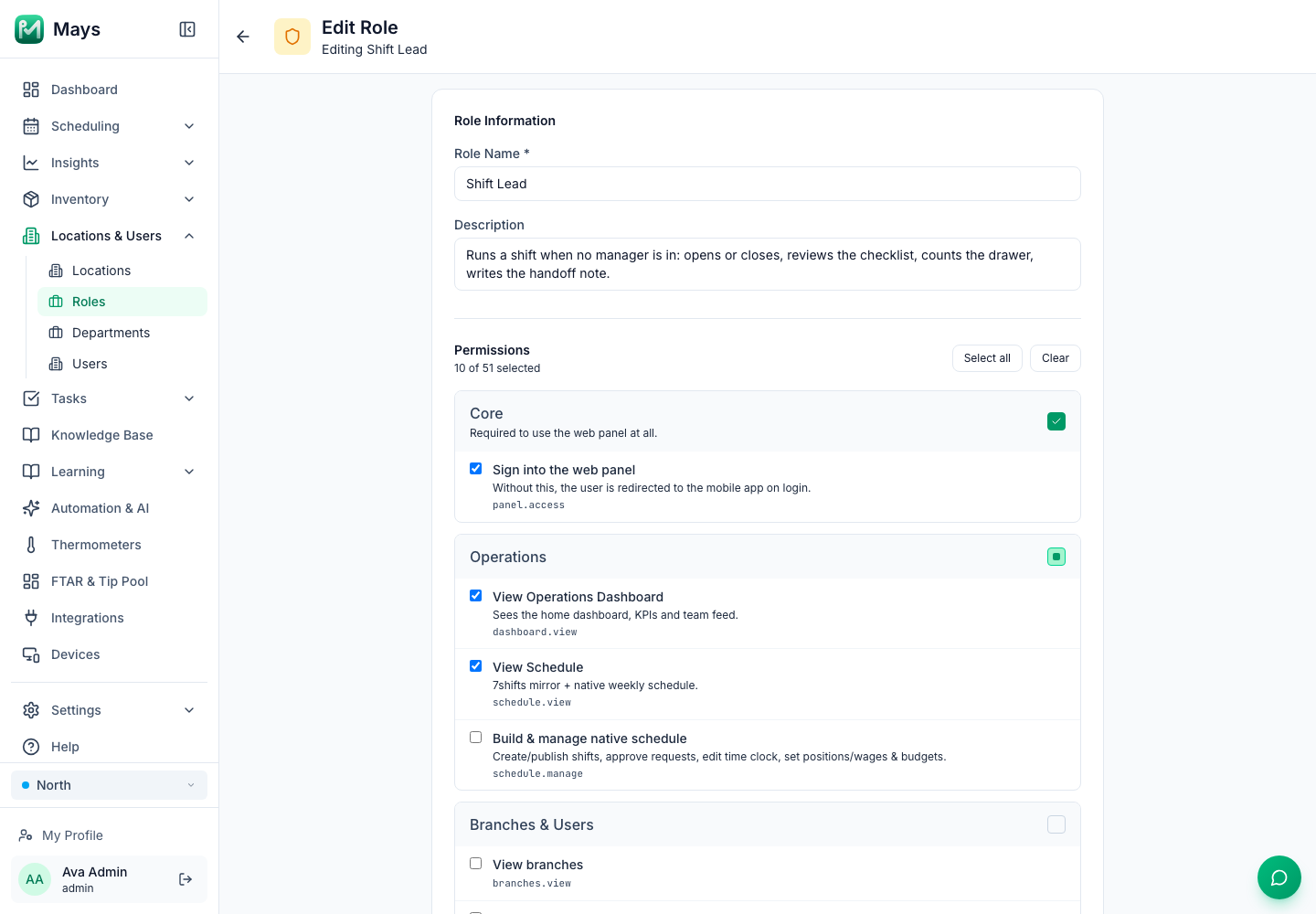
A custom role for what's in between. Under Locations & Users → Roles → Add Role, an admin can build a role like the Shift Lead at the top of this post: the web app, the operations dashboard, a view of the schedule, checklists and the knowledge base, rejecting submitted tasks, thermometer readings and the logbook, but nothing that builds the schedule, edits users or changes settings. A custom role gets exactly the web permissions you tick, but the phone app shows its people the employee screens, and they don't get managers' notifications. So a custom-role lead reviews checklists and writes the logbook on the web.
Who can promote whom. A manager can move someone onto a custom role only if it carries no permission the manager lacks. Making someone a Manager is an admin's job: when we tried it as a manager in our test account, Mays refused with "You cannot assign an elevated role." Everyone except admins sees only their assigned locations, and only admins change them.
Checklist ownership. On a template's Assignments tab, choose Specific people to give the lead their own copy of the closing checklist, or give a single task to one person with Assign to person. A Visibility Window keeps the closing tasks off the list until it's time.
The cash count. An admin builds a count form from the Register / Cash count preset under Tasks → Types, and adds it to the closing checklist as a Custom form task. Managers see every submitted count for their locations under Tasks → Data.
The handoff note. The manager Logbook is a daily journal for each location, with a Needs follow-up flag. Managers and admins use it on the web and in the app; a custom role with View log book and Manage log book uses it on the web.
Mays doesn't track keys, safe combinations or alarm codes, so keep the key log in your own records, and never put codes in chat or in a shared article.
Your shift lead checklist
- The person chosen for judgment, and asked, not told
- A one-page role card with the limits in numbers
- The week-one list handed over; the right-hand column kept
- One named owner for each open and close, with a handoff note
- A key log, individual codes and logins, and no shared master codes
- A certified food protection manager on every shift that needs one
- Overtime and tip-pool status checked against the duties, not the title
- A 30-day handover, then an updated role card
Hand over the close with Mays
Give your first shift lead the right access, their own closing checklist and a place for the handoff note.
Start your free trial: 30 days, every module, no card needed. Still building the team they'll lead? Start with hiring your first restaurant team.