Tip pooling for new restaurant owners: fair and legal
The tip jar fills up on day one. By the end of the first week, someone asks how it's being split, and "we'll figure it out" stops being an answer. Tip pooling is one of the few places where a well-meaning new owner can break federal law without noticing, usually by putting the wrong person in the pool.
This guide covers who can and can't share in tips, how a tip credit changes the rules, what you can do about card fees, Florida's tipped wage, and three ways to split a pool, with a worked example.
This is general information, not legal advice. Tip rules depend on your facts and your state. Have an employment lawyer review your written tip policy.
Rule one: the business, managers and owners don't keep tips
This rule applies to every employer, whatever you pay your staff. The FLSA says an employer "may not keep tips received by its employees for any purposes, including allowing managers or supervisors to keep any portion of employees' tips, regardless of whether or not the employer takes a tip credit" (29 U.S.C. §203(m)(2)(B)). Congress added that sentence in March 2018 (Pub. L. 115–141, per the amendment notes on the same page).
The Department of Labor spells out what it means in practice (Fact Sheet #15 and Fact Sheet #15B):
- A manager or supervisor can't receive anything from a tip pool or a shared tip jar, because those hold other employees' tips.
- Who counts as a manager or supervisor is decided by duties, not job title or pay: someone whose primary duty is managing the business or a department, who regularly directs the work of at least two full-time employees (or the equivalent), and who can hire or fire, or whose recommendations on it carry particular weight.
- Owners count too. An owner with at least a bona fide 20% equity stake who is actively engaged in managing the business is treated as a manager for tip purposes.
- A manager may keep tips for service they "directly and solely" provide, and can be required to contribute them to the pool, but still can't take anything out.
Fact Sheet #15B includes an example that fits most new cafés almost exactly: a café manager who supervises staff while working the counter alongside them, where customers tip on card at the register or into a common jar. The manager "may not keep any portion of these tips because it is not possible to attribute the tips solely to the service" they provide.
So if you're the owner working the bar every morning, the tip jar isn't yours. Neither is it your general manager's.
What about shift leads? It depends on their duties. A shift lead who makes drinks, runs the floor for a few hours and has no say in hiring doesn't meet all three parts of the duties test. One who schedules the team, disciplines staff and effectively picks new hires may. Write down what each role actually does, and get advice on the borderline ones.
Tip credit or not: that decides who can be in the pool
A tip credit lets you pay tipped employees a lower cash wage and count part of their tips toward the minimum wage.
In Florida, the minimum wage is $14.00 an hour from September 30, 2025, and employers who take the tip credit must pay a direct wage of at least $10.98 an hour: the minimum wage minus a fixed $3.02 tip credit (FloridaCommerce, 2025 announcement). The minimum wage rises to $15.00 on September 30, 2026, which puts the direct wage at $11.98 under the same formula. FloridaCommerce's announcement adds that, for state purposes, the definitions of employer, employee and wage are the same as under the FLSA, and that the tip credit is for employers of tipped employees who meet the FLSA's eligibility requirements.
Whether you take a tip credit changes the pool (Fact Sheet #15):
Rule | You take a tip credit | You pay everyone the full minimum wage, no tip credit |
|---|---|---|
Who can be in a mandatory pool | Only employees who customarily and regularly receive tips: the DOL lists waiters, bellhops, counter personnel who serve customers, bussers and service bartenders | Tipped staff and employees who don't usually receive tips, such as cooks and dishwashers |
Managers, supervisors, owners | Never | Never |
Notice | You must tell tipped employees about the tip credit before taking it | — |
For a café, that usually means: if you pay counter staff and baristas $10.98 plus tips, keep the pool to the people serving customers. If you want the kitchen or prep staff in the pool, pay everyone at least the full minimum wage.
Before taking a tip credit, the FLSA requires you to tell tipped employees the cash wage you pay, the tip credit amount, that the credit can't exceed the tips they actually receive, that they keep all their tips except through a valid pool, and that the credit doesn't apply without this notice (Fact Sheet #15).
Card fees, service charges and payday
Three more rules from Fact Sheet #15:
- Card fees: if you can show you pay the card company a percentage on sales, you may pay employees the card tip minus that percentage (for example, 97% of the tip at a 3% fee). Never deduct more than the actual fee, never let it push anyone below the minimum wage, and pay the tip by the regular payday without waiting for the card company. Some states may not allow the deduction at all.
- Service charges aren't tips. A mandatory charge on the bill, such as 15%, isn't a tip. If you share it with staff, it counts as wages, including in the regular rate for overtime.
- Pay the pool out on time: tips collected for a pool must be fully distributed by the regular payday for that workweek or pay period.
Keep records of the tips each employee receives, weekly or monthly. The FLSA requires tip records whether or not you take a tip credit; the exact list differs, so check Fact Sheet #15.
Three ways to split the pool
Once you know who's in, decide how to divide it. Here are three common methods, with made-up numbers: one week, $1,200 in pooled tips, four eligible employees.
Employee | Role | Hours | By hours | Equally | By points |
|---|---|---|---|---|---|
Ana | Barista | 30 | $450 | $300 | $480 |
Ben | Barista | 25 | $375 | $300 | $400 |
Cal | Counter | 20 | $300 | $300 | $256 |
Dee | Counter | 5 | $75 | $300 | $64 |
Total | 80 | $1,200 | $1,200 | $1,200 |
- By hours ($1,200 ÷ 80 hours = $15 an hour): the most common and easiest to explain. Everyone earns the same per hour worked.
- Equally ($1,200 ÷ 4): simple, but Dee gets the same as Ana for a sixth of the hours. It only feels fair when people work similar schedules.
- By points: each role gets a weight per hour (here, barista 1.0 and counter 0.8), so points = hours × weight. That's 75 points in total, or $16 a point. It rewards the roles you consider more tip-producing, but the weights are a judgment call, so write them down and share them.
Whatever you choose, apply it the same way every period, and put it in writing.
Put your tip policy on one page
Your written policy should answer:
- Who is in the pool, by position, and who is never in it (managers, supervisors, owners)
- Whether you take a tip credit, and the notice you give
- How the pool is split, and over what period (per shift, per day, per pay period)
- Whether card fees are deducted, and how much
- When tips are paid, and how (paycheck or cash)
- Where the records are kept
Give it to every new hire, and have them sign that they received it.
Where Mays fits
Mays's tip pool is set per location, on the location's Scheduling tab:
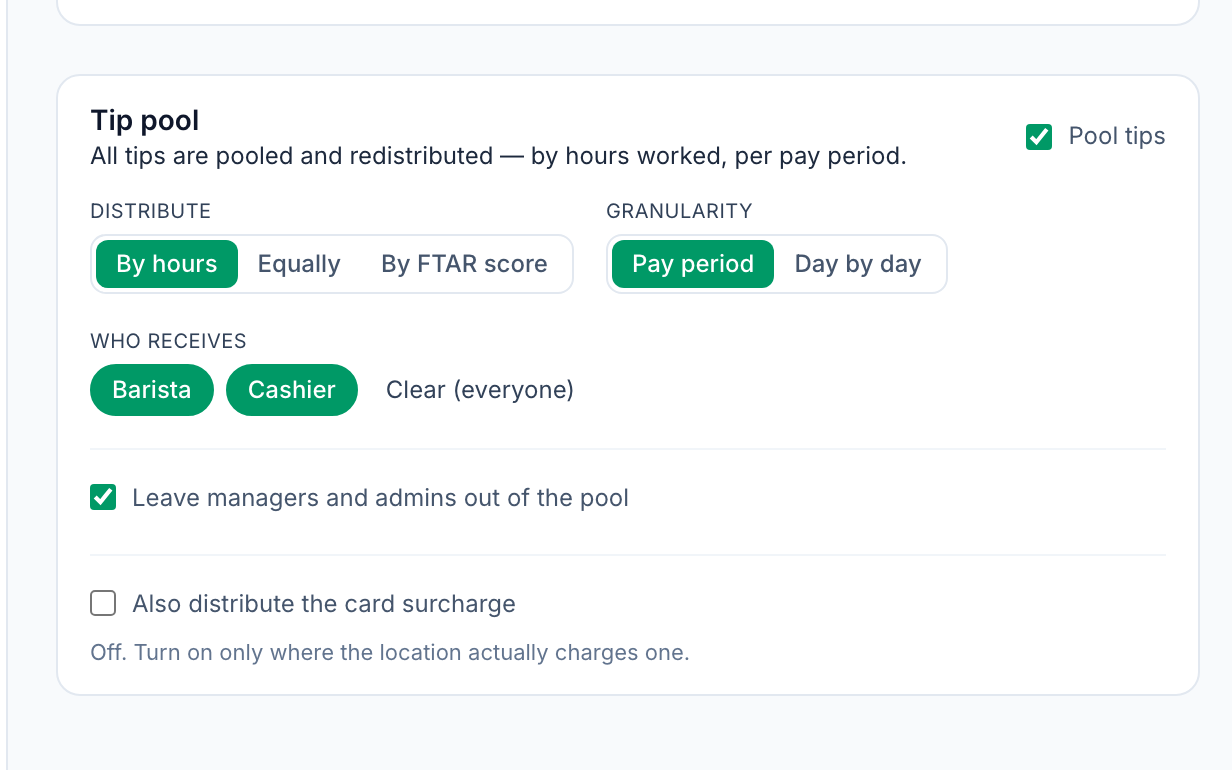
- Split by hours worked, equally, or by FTAR score. FTAR weights each person's hours by how often their completed tasks are approved the first time, and by their productivity. Split per pay period or day by day.
- Choose who receives by position, for example baristas and cashiers only. By default, everyone who worked is included.
- Leave managers out. Tick "Leave managers and admins out of the pool." It's off by default, so turn it on when you set up the pool. It works from each person's account role (manager or admin); if a shift lead with manager duties has an employee account, leave their position out of the pool as well.
- Where the tips come from: the tips recorded by your connected POS at that location (Square), or tips synced with 7shifts time punches.
- Where they go: each person's share appears in the Tip Payouts report and in the payroll export, as a Tips column in the standard CSV or as paycheck tips in the Gusto-format CSV.
Mays doesn't deduct card processing fees from tips. If your policy deducts them, handle that in payroll.
The image at the top of this post shows a pool split by hours per pay period between baristas and cashiers, with managers and admins left out.
Your tip pool checklist
- Managers, supervisors and owners are out of the pool, including when they work a shift on the floor
- The tip credit decision is made, and the notice is given if you take one
- Pool members match that decision (tipped staff only with a tip credit)
- The split method and period are written down and applied the same way every time
- Card fee deductions, if any, match the actual fee
- Tips are paid out by the regular payday, and records are kept for each employee
Set up a pool your team can trust
Turn on the pool, pick the positions, leave managers out, and let the export carry each person's share to payroll.
Start your free trial: 30 days, every module, no card needed. Setting up payroll for the first time? Read Time clock, breaks and overtime: first-month payroll mistakes to avoid.