Employee handbook outline for a small restaurant: what to include
A handbook is where your team finds the answers to "how do I get paid", "what happens to tips", "can I swap a shift" and "what do I do if I'm sick", without asking you at 6 am. It also puts in writing the policies the law expects you to have and to communicate.
This post is an outline, not a finished handbook. It lists the sections a small restaurant or café needs, what goes in each, and, for the legal topics, the official federal source to read before you write. State and city rules often go further than federal law, so each legal section has a line for "your state".
This is general information, not legal advice. Have an employment lawyer or your state's labor agency review your handbook before you hand it out.
Before you write
- Write it in plain words at the reading level of your newest hire. If your team speaks more than one language, plan for a translation.
- Don't promise what you won't do. A handbook that says "raises every six months" will be read as a promise.
- Keep it short. Twenty pages people read beat sixty pages nobody does. Station procedures and recipes go in your training material, not here.
- Date it and version it, so you know which version someone signed.
The outline
1. Welcome and how we work
Who you are, what you serve, what good service looks like here. One page. This is the only section that's all yours.
2. Equal opportunity, harassment and how to report it
What to include: a statement that you don't discriminate, what harassment is, at least two people an employee can report to (so nobody has to report to the person they're reporting), that you'll investigate, and that nobody is punished for reporting.
The federal source: the EEOC. Which laws cover you depends on size: "If you have at least one employee: You are covered by the law that requires employers to provide equal pay for equal work to male and female employees. If you have 15 to 19 employees: You are covered by the laws that prohibit discrimination based on race, color, religion, sex (including pregnancy, sexual orientation, or transgender status), national origin, disability and genetic information", and at 20 or more, age (40 or older) is added (EEOC, small business coverage). The EEOC's harassment page describes when harassment "becomes unlawful" and that the laws also "prohibit harassment against individuals in retaliation for filing a discrimination charge" (EEOC, Harassment). Many states cover smaller employers. Your state: __.
3. Hiring paperwork
What to include: what a new hire brings on day one and what they fill in.
The federal source: "All U.S. employers must properly complete Form I-9 for every individual they hire for employment in the United States" (USCIS, Form I-9). The paperwork itself is in hiring your first restaurant team.
4. Schedules, attendance and call-outs
What to include: how the schedule is posted and when, how to request time off, how to swap a shift, how much notice to give for a call-out and who to call, what counts as a no-show. Your state or city may have fair workweek rules.
Write the call-out policy from handling call-outs and no-shows into this section.
5. Pay, timekeeping and overtime
What to include: the pay period and payday, how to clock in and out, that nobody works off the clock, how missed punches get fixed, overtime, and how to raise a pay question.
The federal source: the Fair Labor Standards Act, enforced by the Department of Labor's Wage and Hour Division. The common mistakes are in time clock, breaks and overtime. Your state's minimum wage and overtime rules: see your state's page on our blog.
6. Tips and the tip pool
What to include: who is in the tip pool, how it's split, how card tips are paid out and when, and that managers don't take from it.
The federal source: the DOL's tipped-employee fact sheet says "the FLSA prohibits employers from keeping any portion of employees' tips for any purpose, whether directly or through a tip pool" (DOL Fact Sheet #15). The rest is in tip pooling for new restaurant owners.
7. Breaks and meals
What to include: when breaks happen, whether they're paid, how to clock them.
The federal source: the DOL says "Federal law does not require lunch or coffee breaks", but short breaks you do give are paid work time, and a meal period of usually 30 minutes or more can be unpaid (DOL, Breaks and Meal Periods). Several states require meal or rest breaks; minors often have their own rules (for one state's, see employing minors in Florida). For nursing employees, the FLSA requires reasonable break time and a private place to pump that isn't a bathroom, for one year after the child's birth (DOL, PUMP at Work). Your state: __.
8. Time off and leave
What to include: vacation (if any), sick leave, how to request each, and any unpaid leave.
The federal source: the FMLA covers private employers with 50 or more employees in 20 or more workweeks in the current or previous calendar year (DOL, FMLA), so many small restaurants aren't covered. Paid sick leave is a state and city question; our state and city pay-rules pages list them. Your state: __.
9. Food safety and hygiene
What to include: handwashing, hair restraints, nails, eating and drinking at stations, and above all illness reporting.
The source: the 2022 FDA Food Code, as adopted by your state. Food employees report to the person in charge "information about their health and activities as they relate to diseases that are transmissible through FOOD" (§2-201.11(A)), and the person in charge makes sure they "are informed in a verifiable manner of their responsibility to report" (§2-103.11(P)). "Verifiable" is why this section needs a signature. On hygiene: food employees "shall keep their fingernails trimmed, filed, and maintained" and can't wear nail polish or artificial nails when working with exposed food unless wearing intact gloves (§2-302.11), and they wear hair restraints such as "hats, hair coverings or nets, beard restraints" (§2-402.11(A)). (The FDA has since published a 2026 edition; these rules haven't changed in substance.)
10. Safety, injuries and chemicals
What to include: report every injury to the manager on duty right away, where the first-aid kit is, how to use chemicals and where the safety data sheets are, and lifting, knives, wet floors and burns.
The federal sources: OSHA requires employers with hazardous chemicals to "have labels and safety data sheets for their exposed workers, and train them to handle the chemicals appropriately" (OSHA, Hazard Communication), and every employer reports a work-related death, in-patient hospitalization, amputation or loss of an eye to OSHA (29 CFR 1904.39). Workers' compensation is a state program (for one example, see workers' compensation in Florida). Your state: __.
11. Conduct, dress code, phones and social media
What to include: uniform and dress code (tied to hygiene where it applies), phones on the floor, alcohol on shift, discounts and shift meals, and what happens when rules are broken.
A caution: under federal labor law, employees can talk to each other about pay and working conditions. The National Labor Relations Board says employees "have the right to communicate with their coworkers about their wages" and that a rule prohibiting it is unlawful (NLRB, Your Right to Discuss Wages). Don't write a "pay is confidential" rule, and have a lawyer read your social media and confidentiality sections.
12. Leaving
What to include: how much notice you ask for, returning uniforms and keys, the final paycheck (timing is set by your state). Your state: __.
13. Acknowledgment
One page the employee signs: they received the handbook, they'll read it, they know who to ask, and they understand the illness reporting rule. Keep the signed page. The handbook doesn't replace the required workplace posters; see the posters a Florida restaurant needs for one state's list.
How to get it read
- Walk through the illness, harassment and safety sections on day one, in person; see the 30-minute onboarding plan.
- Make it searchable on the phone, not just a binder in the office.
- Re-sign after big changes, with the new version date.
Where Mays fits
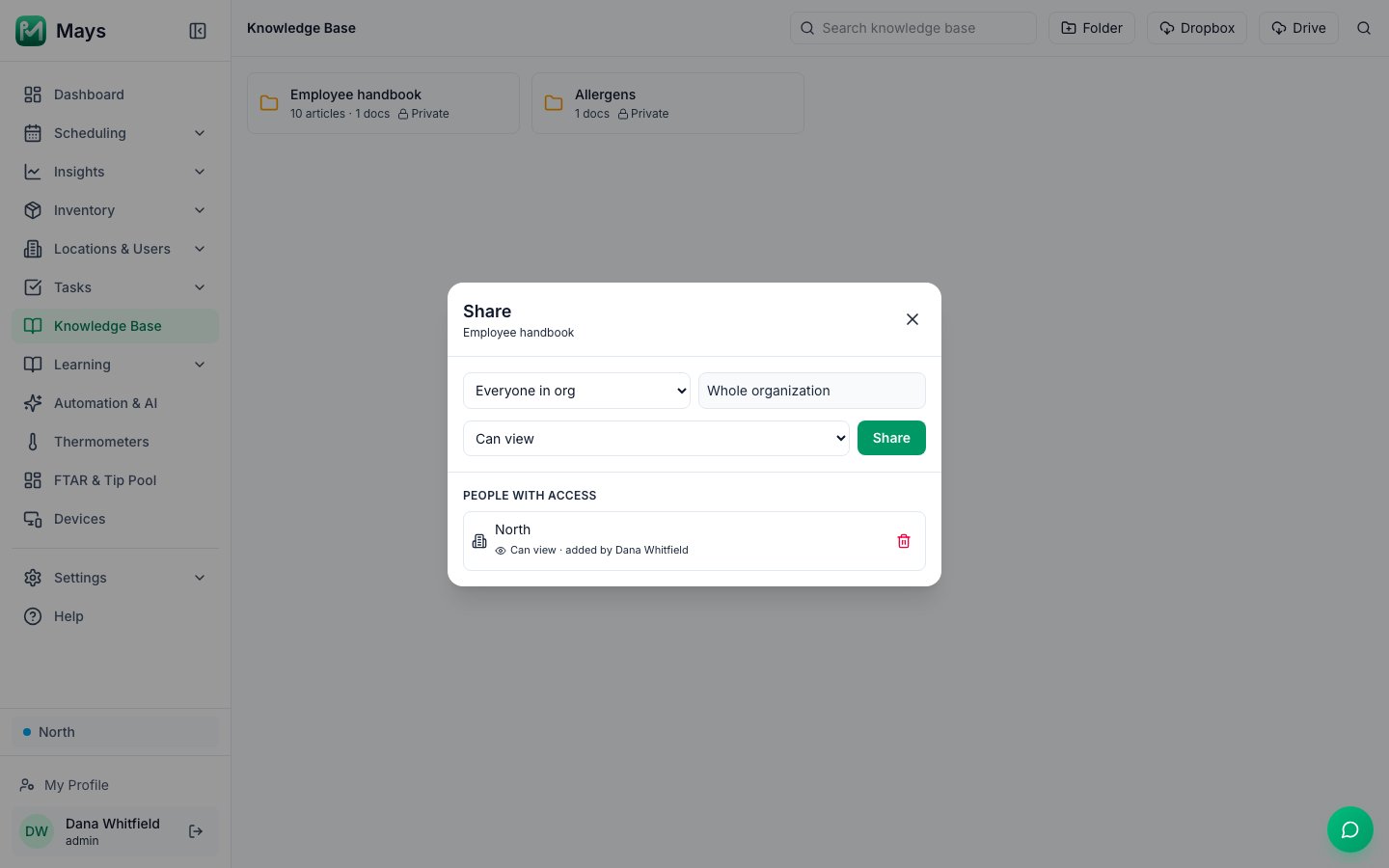
- Keep the handbook in the knowledge base. Make an Employee handbook folder, write each section as an article (or upload the whole handbook as a PDF or Word file, up to 50 MB), and share the folder with A location or Everyone in org. Your team reads it in the Mays app, and search finds sections by title.
- Answers from your own handbook. The AI Assistant in the app's Chat tab answers from what's shared with each person ("how much notice do I give to call out?"); it uses AI credits.
- A signature you can find later. Mays doesn't have a built-in "I've read it" button, so build a short form under Tasks → Types (a Checkbox for each statement and a Signature field), then send it to the new hire as a one-off task from Tasks → Tasks → Create Task. Every submission is listed under Tasks → Data, with Export CSV. Picking a form needs access to Tasks → Types (admins, by default).
- Check it was understood. On the Pro plan, admins can have the AI write a short quiz from the handbook articles under Learning → Modules, and see who passed.
Write it once, keep it current
Start with sections 4 to 10 (the ones your team asks about every week), get them reviewed, and put them where everyone can read them on their phone.
Start your free trial: 30 days, every module, no card needed. Or book a walkthrough and we'll set up your handbook folder with you.