A 30-minute onboarding plan for every new hire
A new hire's first shift often starts like this: they arrive at 7 am, the owner is on bar, somebody hands them an apron, and they spend the morning trying to stay out of the way. By noon they've learned where the cups are and not much else, and they've already decided whether this job feels organized.
The first 30 minutes set the tone for everything after. They don't have to be long or fancy. They have to be the same for every hire, so nobody depends on who happened to be working that day.
This guide gives you a minute-by-minute plan for those 30 minutes, what to prepare the day before, how to pick a buddy, and how short quizzes and check-ins carry it through the first two weeks. For the full first week, station by station, see our one-week training plan.
This is general information, not legal advice. Updated September 24, 2026: the Department of Labor, USCIS and Florida pages cited below were re-checked.
The day before
Everything that isn't teaching should be done before the new hire walks in:
- Paperwork started. The employee completes Section 1 of Form I-9 "no later than their first day of employment" (USCIS: Section 1), and you complete Section 2 "within 3 business days of the date of hire" (USCIS: Section 2). Our hiring guide lists the rest of the new-hire paperwork.
- The app installed and their login working, so the first shift doesn't start with a password reset.
- The first shift on the schedule, labeled as training, with a named buddy on the same hours.
- An apron, a name tag and a locker or shelf with their name on it.
- A reminder to the buddy that tomorrow they're teaching, not just working.
The 30 minutes are paid time. Under federal rules, training counts as working time unless it's outside normal hours, voluntary, not job related, and no other work is done at the same time (DOL Fact Sheet #22). A first-shift welcome meets none of those, so the new hire clocks in first.
The 30-minute plan
Run it the same way every time. Someone who isn't on bar during the rush does it: you, a manager, or your shift lead.
Minutes | What | Done when |
|---|---|---|
0–5 | Welcome and clock in. Say what today looks like and who their buddy is. They clock in themselves. | They know the plan for the day and have punched in |
5–10 | The tour. Exits, the first-aid kit, the fire extinguisher, the handwashing sink, the break area, what's off-limits. | They can find each one without you |
10–15 | Four food-safety musts. Wash hands at the handwashing sink; cold food at 41°F or below and hot food at 135°F or above; never guess about allergens; tell the lead before a shift if they're sick. | They can repeat all four |
15–20 | The app and the rules. Where the schedule is, how to swap or drop a shift, how to call out, where the recipes and SOPs live. | They've opened each screen on their own phone |
20–25 | Today's job. The one station they'll learn today, what "good" looks like, and what they won't do yet (the register close, the slicer, anything hot). | They know what they're doing for the next two hours |
25–30 | Questions, then the handoff to the buddy at the station. | The buddy has them |
Two things to leave out: long policy readings (send the handbook to read later) and every menu item at once (one station a day).
Book the food handler course while they're there. In Florida, every food service employee needs training from a DBPR-approved program within 60 days of employment, and you must be able to show proof on request (s. 509.049(5), F.S.). Put the date in their first-week schedule.
Pick the buddy on purpose
The buddy teaches more in the first week than any document. Choose them the way you'd choose a trainer:
- Someone who does it right, and can explain why. Fast and sloppy teaches fast and sloppy.
- Patient on a busy morning. Watch how they talk to coworkers during a rush.
- Scheduled on the same hours, for every buddy shift, not "whoever's on."
- With a lighter load. If the buddy is also covering a full station alone, they'll hand the new hire a broom.
- With a short list: what the new hire should be able to do by the end of the shift, and what to report back.
Keep the same buddy for the first few shifts, until the new hire has been signed off on the stations they'll work. Thank the buddy by name when it goes well. It's a skill worth recognizing.
Short quizzes, early and often
A quiz in the first week isn't a grade. It catches the one rule someone misunderstood before it reaches a customer.
- Five questions on one topic. Temperatures, allergens, handwashing, the call-out policy.
- Written from your own SOPs, in the words your team uses.
- Taken after the first shift, while it's fresh, then again in week two if they missed something.
- Retakes are fine. The goal is that everyone ends up knowing it.
- Go through wrong answers in person. A missed allergen question is a five-minute conversation, not a note in a file.
The questions worth asking first are the ones where a mistake hurts someone: the cold and hot holding temperatures, what to do when the hot well reads low, which items contain nuts, and when to tell the shift lead they're sick.
The first two weeks
The 30 minutes start the process. Put the rest on the calendar the same day:
- After the first shift: five minutes with the buddy. What went well, what was confusing, what they'd like to see again.
- Day 3: a short check-in with you. Is the schedule working? Does anything feel unclear?
- Sign-offs by station: the buddy or lead confirms they can do each station to standard, and you date it.
- The first solo shift comes after the sign-offs, not on a fixed date.
- Day 14: a longer conversation about how it's going, and what they'd like to learn next.
Early turnover is expensive and common in food service. Our guide to keeping your first team has the Bureau of Labor Statistics numbers and the check-ins that help people stay.
A first-shift checklist for the buddy
Give the buddy this list, and ask them to tick it off before the new hire leaves:
- Clocked in on time and knows how to clock out and take a break
- Washed hands at the handwashing sink before touching food
- Can name the four food-safety musts
- Has seen where the recipe cards and SOPs are
- Worked the day's station with you, and did it alone at least once
- Knows who the shift lead is today and how to reach them
- Knows their next shift and how to check the schedule
- Asked their questions, and you wrote down any you couldn't answer
Where Mays fits
- Getting them into the app. When you add someone with their phone number, Mays texts them a link to download the app, and they sign in with that number. Managers and admins get an email invitation.
- The first shift and the buddy. Put both on the schedule for the same hours and give the new hire's shift a label like "Training." They see it in the app, and can add their shifts to Apple or Google Calendar.
- A "Start here" folder. Keep the welcome, the tour, the call-out policy and the allergen list as Knowledge Base articles, with photos. Staff read them in the app's Knowledge tab, and the AI Assistant in the app's chat answers questions from your articles.
- The buddy's checklist. Build it once as a template under Tasks → Templates, and leave its locations empty so it never runs on its own. On the first day, Tasks → Create Task → From Template gives it to the buddy, or to the new hire.
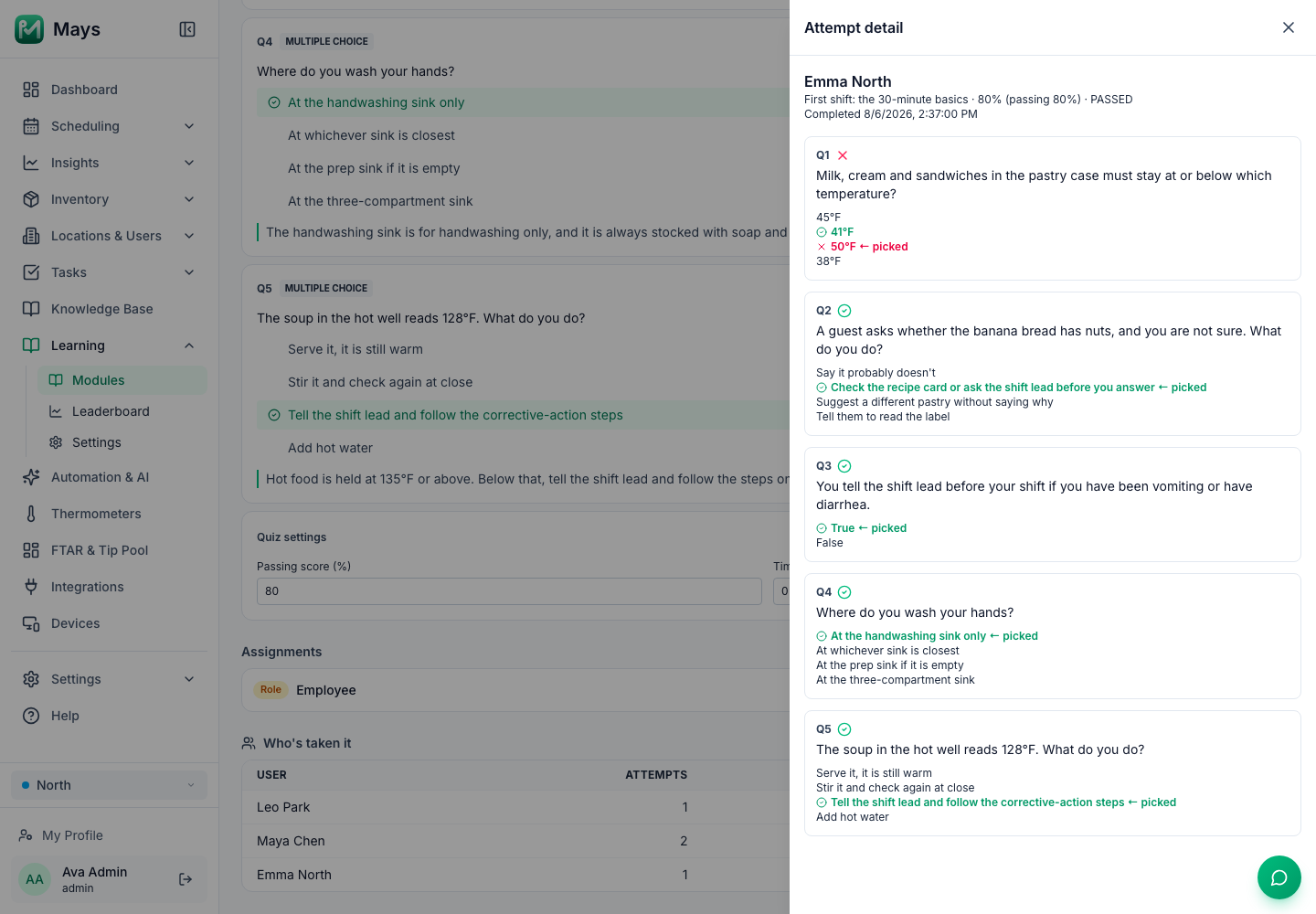
- Quizzes (Learning). An admin builds a module from Knowledge Base articles and documents, lets the AI write the quiz and reviews every question, sets a passing score (80% by default) and assigns it to a role, location, department or person. Staff take it in the app, one question at a time, and see the right answers afterwards. The module page lists everyone who has taken it, with their attempts and best score, and View answers shows each answer (the image at the top of this post).
- Certificates. Mark a module compliance-critical, and passing it issues a PDF certificate that the employee can download in the app.
- Snap quizzes. While someone is on a published shift, Mays can send a "Pop quiz" notification, at most one a day, with a question from an assigned module they haven't passed yet. Tapping it opens the quiz.
- How the first shift went. After clocking out on their phone, staff are asked "How was your shift?" with one to five stars and an optional comment, which managers see in the Logbook.
Learning is switched on for your account by our team, and building or assigning modules is for admins. Mays doesn't send reminders for due dates, and it isn't a DBPR-approved food handler program, so keep outside certificates and the 60-day deadline in your own records.
Your 30-minute onboarding checklist
- Paperwork started, the app installed and the first shift labeled on the schedule
- A named buddy on the same hours, with their list
- The six blocks of the 30-minute plan, the same for every hire
- Food handler training booked on day one
- A five-question quiz on the first topics, reviewed in person
- A day-3 check-in, station sign-offs and a day-14 conversation on the calendar
Onboard your next hire with Mays
Put your "Start here" folder, the buddy's checklist and a first quiz in one place, and give every new hire the same first 30 minutes.
Start your free trial: 30 days, every module, no card needed. Planning the whole first week? Read Training your first hires in one week.