Employing minors in a Florida restaurant or café: hours, breaks, proof of age and the jobs teens can't do
Teenagers are often a café's first part-timers. They also come with two sets of rules, Florida's and the federal government's, on how long they work and what they may touch.
This is the last post in our series Florida compliance basics for a new café or restaurant. Our hiring guide has a one-table summary and our back-to-school scheduling guide covers the switch to the school-year limits. This post goes through the rules themselves: age and proof, hours and breaks, the equipment teens can't use, alcohol, and what happens if you get it wrong.
This is general information, not legal advice. Updated October 5, 2026: every source below was checked on that date. Florida's Child Labor Program (DBPR) answers questions at 1-800-226-2536.
Two laws, and the stricter one wins
Florida's child labor law (chapter 450, Florida Statutes) and the federal Fair Labor Standards Act both apply to most restaurants. The Department of Labor's rule of thumb: "Both Federal and State laws govern the employment of young workers and when both are applicable, the law with the stricter standard must be obeyed" (DOL Fact Sheet #43).
Minimum age and proof of age
- 14 is the minimum. Florida: "no person 13 years of age or younger shall be employed, permitted, or suffered to work in any gainful occupation at any time," with narrow exceptions (s. 450.021(3), F.S.). DBPR puts it simply: "A minor must be 14 years old to work" (DBPR, Child Labor FAQs).
- No work permit, but proof of age. "Do minors need a work permit or working papers to work? No. Employers must obtain and keep proof of age on record during the employment of the minor" (DBPR FAQs). The law lists what counts: "A photocopy of the child's birth certificate," "A photocopy of the child's driver license," "An age certificate issued by the district school board," or "A photocopy of a passport or visa which lists the child's date of birth" (s. 450.045(1), F.S.).
- A poster. Anyone who employs a minor posts DBPR's child labor poster "at a conspicuous place" (s. 450.045(2)); the posters post has the download link.
Hours: Florida's limits
From s. 450.081, F.S.:
15 and younger | 16 and 17 | |
|---|---|---|
Before a school day | Not "Before 7 a.m. or after 7 p.m. when school is scheduled the following day" | Not "Before 6:30 a.m. or after 11 p.m. when school is scheduled the following day"; not "more than 8 hours in any one day when school is scheduled the following day, except when the day of work is on a holiday or Sunday" |
On a school day | Not "more than 3 hours, unless there is no session of school the following day" | Not "during school hours" |
Week, school in session | Not "more than 15 hours" | Not "more than 30 hours," unless a parent or the school superintendent waives it on DBPR's form |
Holidays and summer | Not "before 7 a.m. or after 9 p.m., for more than 8 hours in any one day, or for more than 40 hours in any one week" | No state hours limit |
Days in a row | Not "more than 6 consecutive days in any one week" | No state limit |
The school-day rules differ for students in a career education program. DBPR's FAQ adds that the 30-hour waiver "grants an additional 10 hours, no more than 40 hours per work week."
Federal limits apply to 14- and 15-year-olds only: work "Outside of school hours," up to 3 hours on a school day and 18 in a school week, 8 on a non-school day and 40 in a non-school week, and only "Between 7 a.m. and 7 p.m. in any 1 day, except during the summer (June 1 through Labor Day) when the evening hour will be 9 p.m." (29 CFR 570.35). There are no federal hours limits at 16 and 17. Put together for a 15-year-old during the school year: Florida's 15 hours a week is stricter than the federal 18, and after Labor Day the federal 7 p.m. limit applies every day, weekends included.
Who's exempt from the hours rules
Florida's hours limits don't apply to, among others, "Minors 16 and 17 years of age who have graduated from high school or received a high school equivalency diploma," minors with a school superintendent's certificate of exemption or hardship waiver, and "Minors 16 and 17 years of age who are in a home education program" or an approved virtual program (s. 450.081(5)). For a graduate, DBPR says "The employer will need to keep a copy of the diploma on file or a letter from the school," and "the limits regarding hazardous occupations still apply until they turn 18."
Meal breaks
Florida requires a meal break for minors: those 15 and younger may not work "more than 4 hours continuously without an interval of at least 30 minutes for a meal period," and "a period of less than 30 minutes is not deemed to interrupt a continuous period of work." For 16- and 17-year-olds, the same 30-minute break applies on days they work "8 hours or more in any one day" (s. 450.081(4)). Build it into the shift when you schedule it.
The jobs and equipment teens can't use
A teen working legal hours can still be working illegally on the wrong machine.
Under 16: federal rules
Federal rules for 14- and 15-year-olds start from a list of allowed jobs, and "Employment that is not specifically permitted is prohibited" (29 CFR Part 570, Subpart C). In a restaurant (29 CFR 570.33 and 570.34):
- Allowed: cashiering, bussing, clean-up, and kitchen work "including operating machines and devices used in performing such work," such as "dishwashers, toasters, dumbwaiters, popcorn poppers, milk shake blenders, coffee grinders, automatic coffee machines," warmers, steam tables, heat lamps, and microwaves used only to warm food that "do not have the capacity to warm above 140 °F."
- Cooking, with limits: only "Cooking with electric or gas grills which does not involve cooking over an open flame," and deep fryers "equipped with and utilize a device which automatically lowers the baskets into the hot oil or grease and automatically raises the baskets." Rotisseries, broilers, pressure fryers and high-temperature ovens are out.
- Not allowed: "All baking and cooking activities" beyond the above; operating or cleaning "food slicers, food grinders, food choppers, food processors, food cutters, and food mixers"; "all work requiring the use of ladders"; and "Work in freezers and meat coolers," except entering "momentarily to retrieve items." Hot oil and grease can be filtered, poured or carried only when it doesn't "exceed a temperature of 100 °F."
Under 18: the hazardous orders
Some equipment is off-limits until 18, whatever the hours:
- Slicers and grinders (Hazardous Order 10). No operating, feeding, setting up, adjusting, repairing or cleaning meat slicers, grinders, choppers and similar machines "regardless of the product being processed by these machines (including, for example, the slicing in a retail delicatessen of meat, poultry, seafood, bread, vegetables, or cheese, etc.)" (29 CFR 570.61).
- Bakery machines (HO 11). No "horizontal or vertical dough mixer; batter mixer; bread dividing, rounding, or molding machine; dough brake; dough sheeter; combination bread slicing and wrapping machine; or cake cutting band saw." The exception is a lightweight countertop mixer "comparable to, models intended for household use": not hardwired, no more than 1/2 horsepower, a bowl of no more than five quarts, and not used for meat (29 CFR 570.62).
- Balers and compactors (HO 12). No operating "any baler" or "any compactor" for materials other than paper, or a "paper box compactor" (29 CFR 570.63).
- Driving (HO 2). Under 17, no driving on public roads for work. At 17, only "occasional and incidental" driving under strict conditions, and never "urgent, time-sensitive deliveries" (29 CFR 570.52). DBPR's answer to "Can a minor be a delivery driver?" is "No. No one under 18 can be a delivery driver or operate a motor vehicle as a regular part of their job."
Florida's own list
Florida adds its own hazardous jobs (s. 450.061, F.S.). For 15 and younger: work "In connection with power-driven machinery" and "In working with meat and vegetable slicing machines." For everyone under 18: work "On any scaffolding, roof, superstructure, residential or nonresidential building construction, or ladder above 6 feet," and "In the operation of power-driven bakery machinery." Florida's freezer rule for 15 and younger "shall not prohibit work done in the normal operations of a food service facility licensed by chapter 509," but the stricter federal freezer rule above still applies.
Alcohol
"No person 17 years old or younger ... shall be employed, permitted, or suffered to work in any place where alcoholic beverages are sold at retail, except as provided in s. 562.13" (s. 450.021(4), F.S.). Section 562.13 has the exceptions. If you serve beer or wine, DBPR's FAQ says to contact the Child Labor Program or the Division of Alcoholic Beverages and Tobacco before you hire a teen.
Penalties
Florida can fine an employer "not to exceed $2,500 per offense," and a violation can also be "a misdemeanor of the second degree," where "Each day during which any violation of this law continues shall constitute a separate and distinct offense" (s. 450.141, F.S.). Before a fine, the department gives written notice with a deadline for "remedial action" (s. 450.141(3)).
Your checklist for teen hires
- Proof of age filed and the child labor poster up
- School status known: in school, graduated (diploma on file), home-educated or exempt
- Shifts checked against Florida's and the federal limits, with your district's school calendar
- A 30-minute meal break built into every shift over 4 hours for 15 and under, and into 8-hour days for 16 and 17
- Positions set up so teens never run slicers, mixers, fryers without auto-lift, balers or the delivery car
- No teens on shift where you serve alcohol until you've checked s. 562.13
Where Mays fits
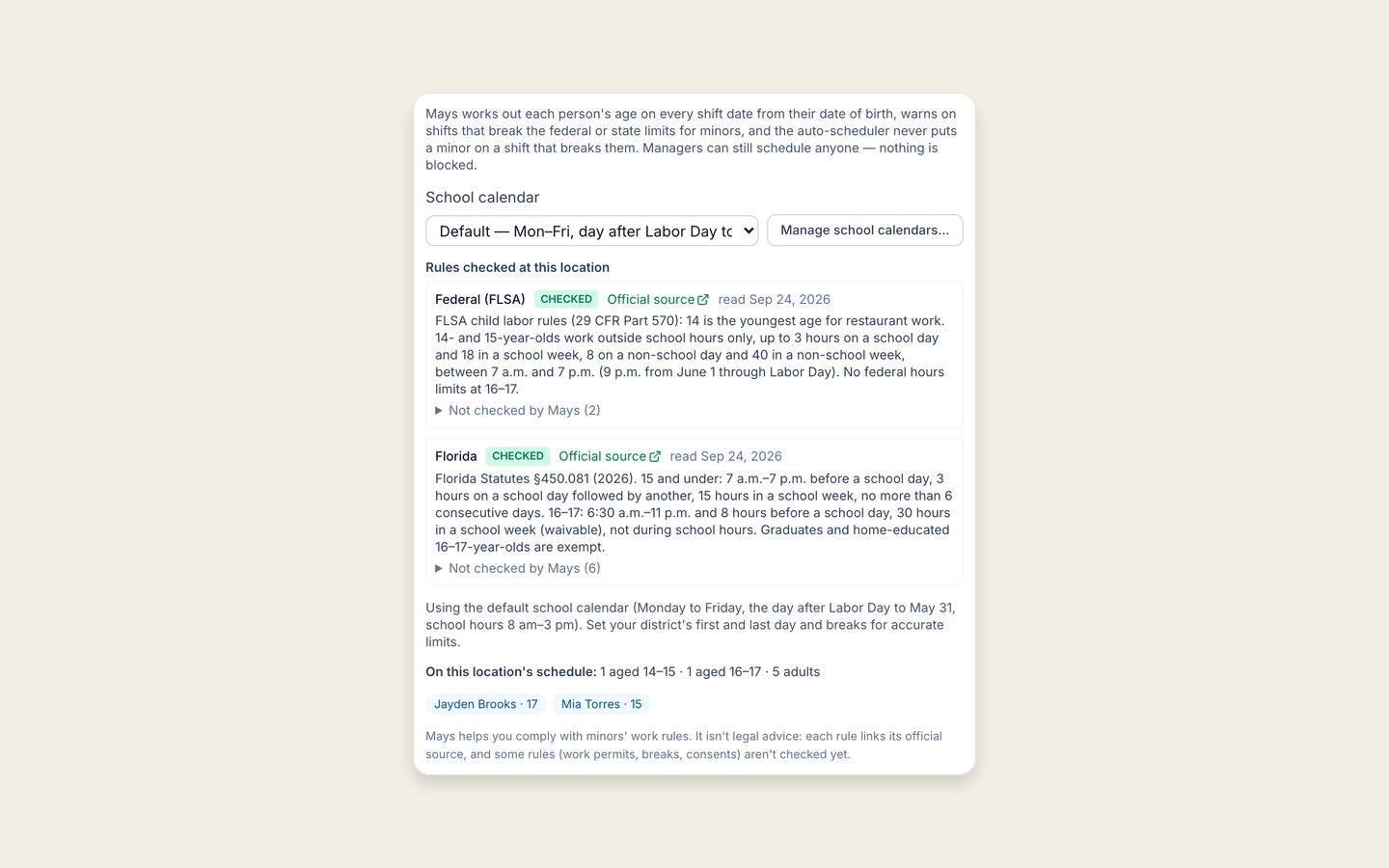
Turn on Labor law compliance in Settings → Organization, then switch on Minors (under 18) on a location's Labor & compliance card (the image at the top of this post):
- Ages from dates of birth. Add each person's Date of birth on their Employment tab, and their School status (In school, Graduated from high school, Excused from school attendance or Home-educated). Only people who can edit that person see the date; the schedule shows an age band like Minor · 15.
- The federal and Florida hours rules, read from 29 CFR 570.35 and s. 450.081, each with its official source. A shift that breaks one is outlined as Minor rule on the schedule and listed with a MINOR tag before you publish. Warnings never block publishing.
- Your district's school calendar. Add your district's first and last day and breaks under Manage school calendars…; until then Mays uses a default school year.
- The auto-scheduler stays inside the limits. It never puts a minor on a shift that breaks one; it reassigns the shift or leaves it open, and says why.
- Positions with a minimum age and tasks. Under Scheduling → Positions, set Minimum age and tick the tasks a position involves, such as Meat or deli slicer, meat grinder, patty former, Dough or batter mixer, dough sheeter or brake, Delivery driving or Baking. A minor scheduled into a position they're too young for gets a warning.
What Mays doesn't check yet: minors' meal breaks, proof of age or work papers, consents and waivers, open-shift claims and trades, and the time clock. There's no alcohol task on positions either, so handle those yourself.
Schedule teens without second-guessing
Turn on minors' rules at your location and check every shift against both laws as you build the week.
Start your free trial: 30 days, every module, no card needed. Or book a walkthrough and we'll set it up with you.
Previous in the series: Food manager certification and food handler training in Florida · Back to the start: Florida food service licensing: DBPR or FDACS?