Workers' compensation for a Florida restaurant or café: who needs it, exemptions and what to do after an injury
Kitchens are full of hot oil, sharp knives and wet floors. When someone gets hurt, workers' compensation pays for their medical care and part of their lost wages, and it protects the business from paying those costs itself. In Florida, whether you must carry it depends on how many people you employ.
This is the fourth post in our series Florida compliance basics for a new café or restaurant. It covers who has to carry coverage, the exemptions for owners, the penalties for going without, and the steps after an injury.
This is general information, not legal or insurance advice. Updated October 5, 2026: every source below was checked on that date. Talk to a licensed insurance agent about your policy, and to the Florida Division of Workers' Compensation about your situation.
Who has to carry it: four or more employees
Restaurants and cafés fall under Florida's non-construction rule. The Division of Workers' Compensation (part of the Department of Financial Services, DFS) says: "Employers with four (4) or more employees, including business owners who are corporate officers or Limited Liability Company (LLC) members, must have workers' compensation coverage" (DFS, Coverage Requirements). The statute covers "All private employments in which four or more employees are employed by the same employer" (s. 440.02(20)(b)2., Florida Statutes). Construction is stricter: there, one employee is enough.
How the count works:
- Part-timers count. DFS's guidance for sole proprietors talks about "three or fewer full or part-time employees" (DFS, Educational Information). A café with two full-timers and two weekend baristas has four employees.
- Corporate officers and LLC members count unless they've filed an exemption. Florida's definition of corporate officer "includes a member owning at least 10 percent of a limited liability company" (s. 440.02(11)).
- Sole proprietors and partners don't. DFS: in the non-construction industry, the sole proprietor or partner "is NOT included in the employee count for determining whether the non-construction business is required to obtain workers' compensation coverage" (Educational Information). They can choose to be covered.
Ask your agent about coverage before your fourth hire starts, not after. A new hire's first shift is the wrong day to find out the policy isn't bound.
Owner exemptions
If you run the café as a corporation or LLC, you as an owner count toward the four, and you're covered unless you opt out. "Any officer of a corporation may elect to be exempt from this chapter by filing notice of the election with the department," and an officer who does "is not an employee" (s. 440.02(18)(b)1. and 3.).
From DFS's exemptions page:
- The purpose is "for officers of a corporation or members of a limited liability company to exclude themselves as employees from workers' compensation insurance laws."
- "Upon issuance of an exemption, the officer or member is not considered an employee of the business and may not recover workers' compensation benefits."
- "Exemptions are issued to officers of a corporation and members of limited liability companies - not to the business."
- You apply online with a Notice of Election to be Exempt, and the applicant "must personally sign the application."
The trade-off is real: an exempt owner who gets hurt on the line has no workers' comp benefits. Weigh that with your agent before you file.
If you don't carry it when you should
Florida treats it seriously. If DFS determines an employer that must carry coverage hasn't, that's "deemed an immediate serious danger to public health, safety, or welfare sufficient to justify service by the department of a stop-work order on the employer, requiring the cessation of all business operations," and DFS "shall issue a stop-work order within 72 hours" (s. 440.107(7)(a), F.S.).
On top of that, DFS assesses "a penalty equal to 2 times the amount the employer would have paid in premium when applying approved manual rates to the employer's payroll during periods for which it failed to secure the payment of workers' compensation required by this chapter within the preceding 12-month period or $1,000, whichever is greater" (s. 440.107(7)(d)1.).
The notices to post
With coverage in place, keep DFS's notice posted: the "Broken Arm" poster, "Workers' Comp Works For You," with your insurer's sticker on it (s. 440.40, F.S.; DFS posters). An employer under four employees who legally goes without coverage posts a notice that staff aren't entitled to benefits instead (s. 440.055, F.S.). The posters post in this series lists every notice and where to download it.
After an injury: the steps and deadlines
A burn on the steam wand, a cut from the mandoline, a fall on a wet floor. Here's the order of things.
1. Get care first
Call 911 for anything serious. For the rest, the employer provides the care: "the employer shall furnish to the employee such medically necessary remedial treatment, care, and attendance for such period as the nature of the injury or the process of recovery may require" (s. 440.13(2)(a), F.S.). DFS's poster tells employees: "Notify your employer immediately to get the name of an approved physician. Workers' comp insurance may not pay the medical bills if you don't report your injury promptly to your employer." Know before the first injury how your carrier wants you to send someone for treatment.
2. The employee tells you, within 30 days
"An employee who suffers an injury arising out of and in the course of employment shall advise his or her employer of the injury within 30 days after the date of or initial manifestation of the injury" (s. 440.185(1), F.S.). DFS tells employers to "encourage employees to report accidents as soon as the work related injuries or illnesses occur" (DFS, Important Workers' Compensation Information for Florida's Employers.pdf)). Make it part of your training: any injury, however small, gets reported to the manager on duty that day.
3. You report it to your carrier, within 7 days
"Within 7 days after actual knowledge of injury or death, the employer shall report such injury or death to its carrier, in a format prescribed by the department, and shall provide a copy of such report to the employee or the employee's estate" (s. 440.185(2)). Your carrier's report form or online portal is how you do it.
Report it even if you doubt it happened at work. DFS's answer to "Do I have to report a claim if I do not believe it is a work-related injury or illness?" is "Yes," because "It is your workers' compensation insurance carrier's responsibility to investigate all claims" (DFS employer brochure).
4. Don't retaliate, and don't charge for coverage
"No employer shall discharge, threaten to discharge, intimidate, or coerce any employee by reason of such employee's valid claim for compensation or attempt to claim compensation" (s. 440.205, F.S.). And the premium is yours alone: "It is the employer's responsibility to pay the entire premium for workers' compensation" (DFS employer brochure).
5. Know what the employee can expect
Medical care is covered from the start. Wage benefits wait a week: "Compensation is not allowed for the first 7 days of the disability, except for benefits provided under s. 440.13. However, if the injury results in more than 21 days of disability, compensation is allowed from the commencement of the disability" (s. 440.12(1), F.S.). If there's a problem with the claim, DFS's poster points employees to the Division's Employee Assistance and Ombudsman Office at 1-800-342-1741.
6. Serious injuries: OSHA too
Separately from your carrier, federal OSHA rules apply to every employer, including small restaurants that don't have to keep injury logs. "Within eight (8) hours after the death of any employee as a result of a work-related incident, you must report the fatality" to OSHA, and "Within twenty-four (24) hours after the in-patient hospitalization of one or more employees or an employee's amputation or an employee's loss of an eye," you must report that too, by phone or online (29 CFR 1904.39).
The OSHA injury log (the 300 log) is a different matter. Companies with "10 or fewer employees at all times during the last calendar year" don't need to keep it unless asked (29 CFR 1904.1), and "Full-Service Restaurants" and "Limited-Service Eating Places" are on the list of partially exempt industries (29 CFR 1904.2 and Appendix A). The 8- and 24-hour reports still apply to them.
Your workers' comp checklist
- Count your employees, part-timers and owners included; get coverage before the fourth
- Decide with your agent whether any officer or LLC member files an exemption
- The "Broken Arm" poster up, with your insurer's sticker
- Your carrier's claim phone number and portal written down where managers can find them
- Staff trained to report every injury the same day
- Every injury reported to the carrier within 7 days, with a copy to the employee
- OSHA's 8- and 24-hour reporting rules known to every manager
Where Mays fits
Mays doesn't sell insurance or file claims, and it has no injury report built in. What it can do:
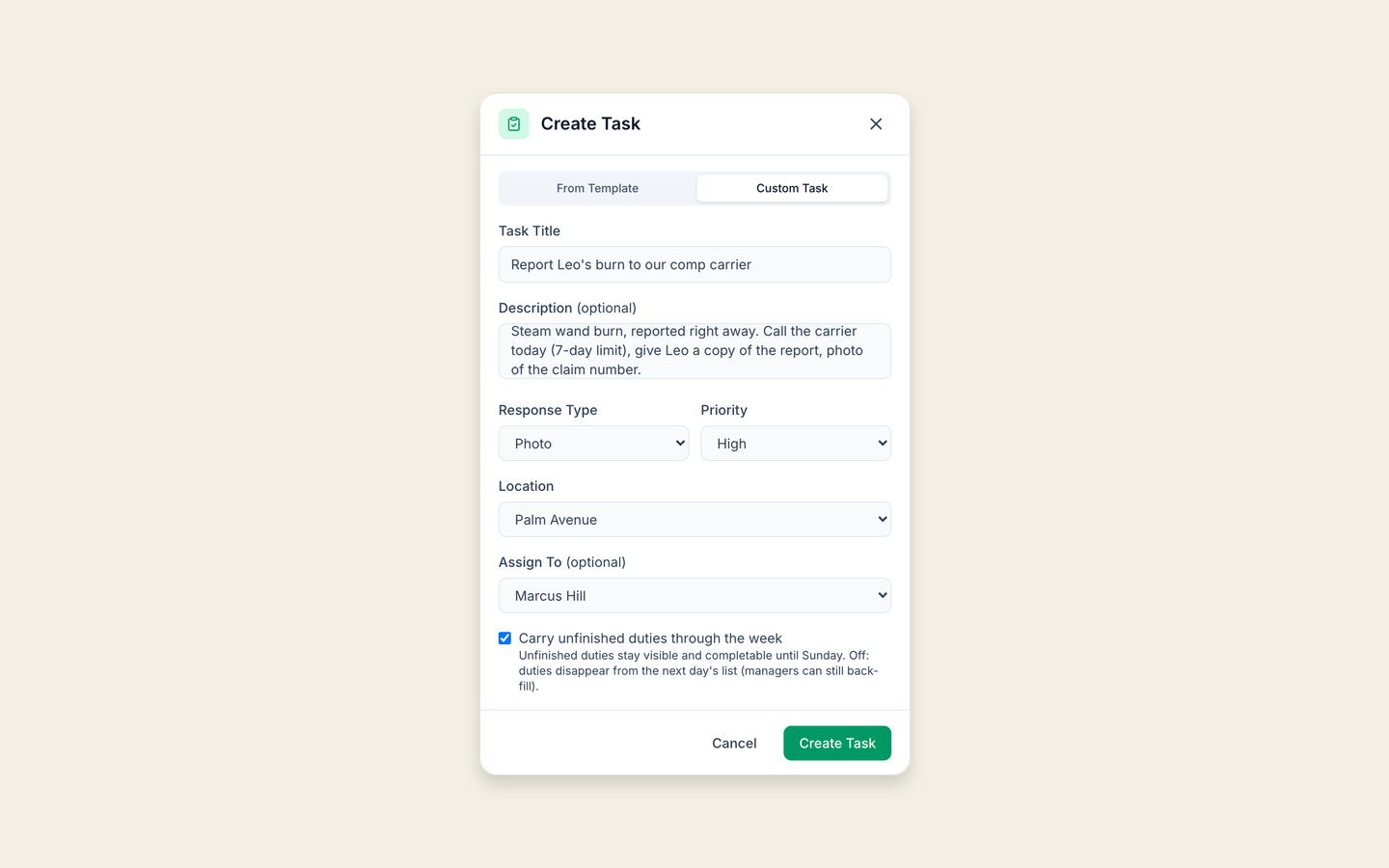
- Make the 7-day deadline a task. When someone reports an injury, the manager on duty creates a one-off task under Tasks → Create Task, assigned to the person who calls the carrier, with a Photo answer for the claim confirmation (the image at the top of this post). Tick Carry unfinished duties through the week so it stays on their list until it's done.
- Write it down the same day. The manager logbook has Incidents and Health & Safety categories, so what happened, who saw it and what you did is on record for the next shift. The logbook is for managers and admins, and it's text only.
- Build your own injury report form. Under Tasks → Types, an admin can build a custom form with the fields your carrier asks for (date, time, what happened, body part, witnesses), and use it on a task whenever someone gets hurt.
- Teach the reporting rule. Put your "if you get hurt" steps in the knowledge base, where every new hire can read them in the app.
Be ready before the first injury
Put your injury steps where managers will find them, and turn the 7-day report into a task nobody forgets.
Start your free trial: 30 days, every module, no card needed. Or book a walkthrough and we'll set it up with you.
Previous in the series: Required workplace posters in Florida · Next: Food manager certification and food handler training in Florida.