The grand opening plan for a new café: soft opening, week one and the rush
Every new café gets one first day. The line is out the door at 8, the grinder jams at 8:20, the new barista freezes on the oat-milk cortado, and the pastry case is empty by 10. Some of that is unavoidable. Most of it can be rehearsed.
This guide is a plan for the three stages of opening: the soft opening, opening day and the first week. It covers staffing for a rush you can't predict yet, the legal checks before the doors open, and how to use the first week to fix what the rehearsals missed.
It's the last post in our Marketing a new café series. For the schedule itself, see your first restaurant staff schedule. For big days later in the year, see holiday and event staffing.
This is general information, not legal advice. Florida rules are noted where they apply; other states have their own.
Before anything: the license and the inspection
You can't hold a soft opening, even a free one, until you're allowed to operate. In Florida, anyone opening a public food service establishment "shall apply for and receive a license from the division prior to the commencement of operation" (s. 509.241(2), Florida Statutes).
The Division of Hotels and Restaurants says "Each new license requires a satisfactory opening inspection", and to contact them "several business days prior to your opening date to schedule the inspection." It also warns: "Please don't call to schedule an opening inspection unless you are absolutely ready to open." After passing, "the operator will receive a temporary paper license on the spot" (DBPR: licensing).
Build your timeline backward from the inspection, not from the date you announced.
Six weeks out: tell people when
Set your opening date on Google. If you haven't opened yet, you can create a Business Profile and "set your future opening date". The date can be "up to one year in the future", your profile "shows up on Google 90 days prior to your opening date", and once open, it shows a "Recently opened" tag for 90 days (Google: add a business opening date). Our Google Business Profile guide covers the rest of the setup.
Start posting. Build-out photos, the first test drinks, the team. Our Instagram guide has the 90-day plan, and short video covers Reels.
Announce the date only when the inspection is booked. A moved opening date costs more goodwill than a late announcement.
Two to three weeks out: train and rehearse
Rehearsal shifts are paid shifts. Federal rules say training time doesn't count as work only if all four criteria are met: it's outside regular hours, "in fact voluntary", "not directly related to the employee's job", and no productive work is done (29 CFR 785.27). Making drinks for a practice run fails every one of those, and "Attendance is not voluntary, of course, if it is required by the employer" (29 CFR 785.28). Schedule rehearsals as real shifts and pay them.
Run at least two rehearsals:
- A dry run: the team makes the full menu for each other, then you time the slowest drinks and fix the station layout.
- A soft opening: real guests, a short window, a limited invite list (below).
Our guide to training your first hires in one week has the day-by-day plan.
The soft opening
A soft opening is a rehearsal with an audience: friends, family, neighbors, other business owners nearby. Keep it small and short, two or three hours, so the team can recover and fix things before the real opening.
Decide what it costs guests. Free is generous, but know what it costs you. In Florida, restaurants "are required to pay use tax on their cost price of food or drink provided to customers at no charge". The same brochure says that with buy-one-get-one, "The restaurant does not owe use tax on the second meal" (Florida DOR: GT-800035). Ask your accountant which fits your plan.
Collect feedback on purpose. A short card at each table: what was slow, what was great, what you'd order again. Read them that night.
Measure the real bottleneck. Have one person note every ticket that takes too long and why: the grinder, the steam wand, the register, the pastry case. That list is your fix list for opening day.
Staffing opening day
You don't have sales history yet, so you can't forecast the rush. Staff for more than you expect, then cut back as you learn.
Station | Normal day | Opening day |
|---|---|---|
Bar | 1–2 baristas | 2 baristas plus a runner restocking milk, cups and lids |
Register | 1 | 1, plus a line greeter taking orders on a second device if you have one |
Food | 1 | 1, with the morning bake doubled and a mid-morning bake planned |
Floor | Shared | 1 person bussing, wiping and answering questions |
Lead | The owner or shift lead | Both: one on the floor, one fixing problems |
Stagger the starts. Everyone in early for a 15-minute walkthrough, then cover the peak with overlapping shifts instead of one long shift for everyone.
Watch the hours. A week of long days is how a new team gets overtime and burnout at the same time. Plan days off before the week starts.
Minors have their own limits. In Florida, 16- and 17-year-olds may not work before 6:30 a.m. or after 11 p.m., or more than 8 hours in a day, "when school is scheduled the following day" (s. 450.081, Florida Statutes). Younger workers have tighter limits.
Have an on-call list. Two people who agreed to come in if the line gets long, with their numbers in the shift lead's phone.
Giveaways and opening offers
An opening offer gives people a reason to come on a specific day. Keep it simple enough that it doesn't slow the line:
- The first 50 drinks free, or a free pastry with any drink, for one morning
- A punch card started with two punches (our guide to loyalty programs has the math)
- A sign-up for your email list at the register (see building an email and text list)
What not to do: don't offer anything in exchange for a review. Google's and Yelp's rules both prohibit incentives, and our guide to your first 50 Google reviews explains why.
The first week: debrief every day
For the first seven days, hold a ten-minute debrief after close:
- What ran out, and when?
- Which drinks or dishes slowed the line?
- What did customers ask that nobody could answer?
- What broke?
- One fix for tomorrow, with a name next to it.
Write the answers down. By day seven, you'll have your real par levels, your real rush times and a list of questions for your first training update.
Where Mays fits
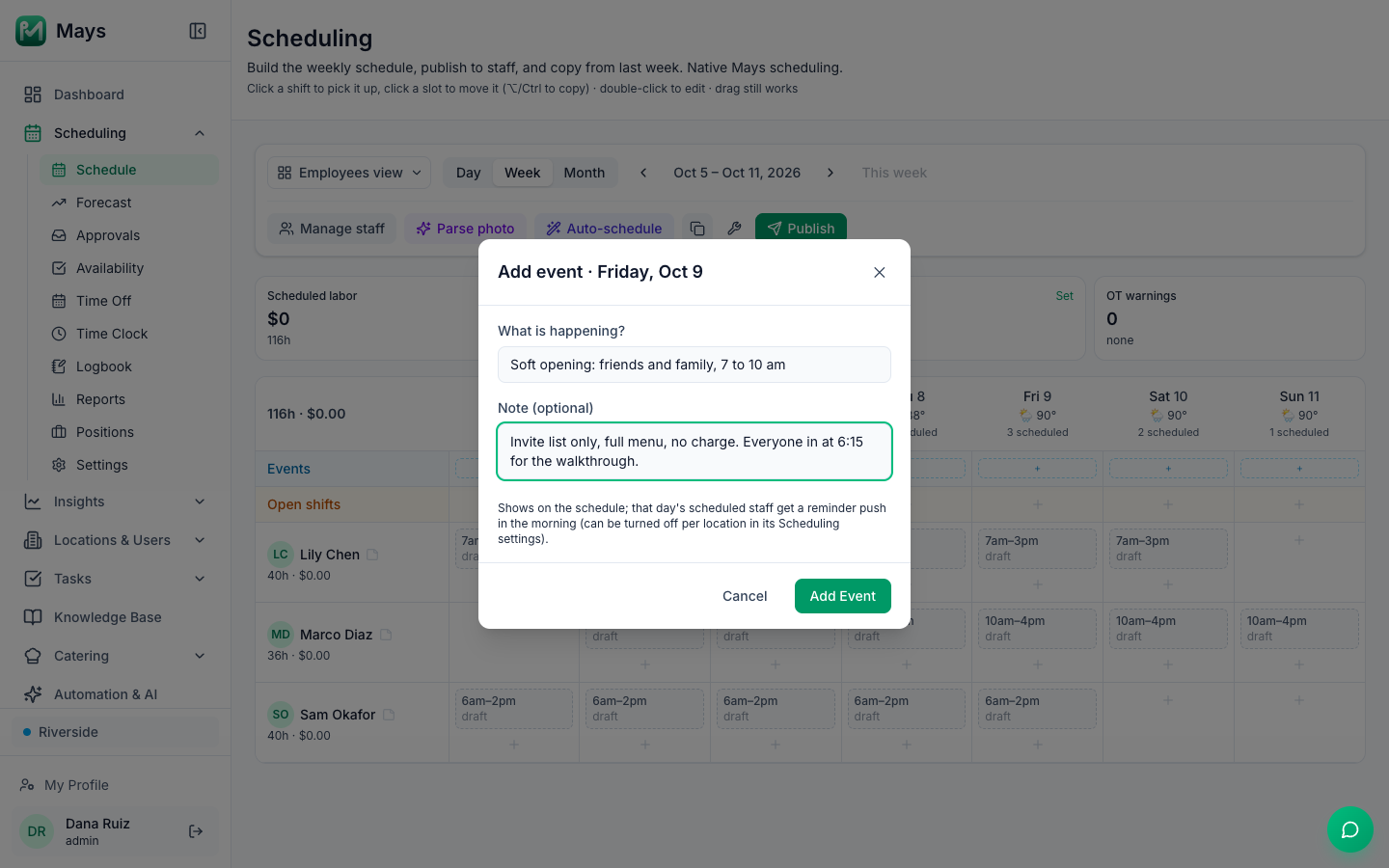
- The soft opening on the schedule. In Scheduling → Schedule, click + in the Events row on the day and add it, with a note. The image at the top of this post shows one. Everyone with a published shift that day gets a reminder push that morning with your note.
- Rehearsals and opening day as real shifts. Build the week as drafts, adjust, then publish: the team gets notified, and they see their shifts in the iOS and Android apps. Overtime warnings show while you build. Add an open shift for the extra pair of hands, and staff who want the hours can claim it.
- Opening checklists from day one. Build the opening and closing checklists in Tasks → Templates before the soft opening, with Photo answers for the things that matter, and use them at the rehearsals, so they're habits by opening day.
- Training before the doors open. Put recipes and station setups in the Knowledge Base, and assign training modules to every new hire before the dry run.
- The debriefs, written down. Notes in the manager logbook stay with the day, so next week's manager can read what this week's learned.
Your grand opening checklist
- License applied for; opening inspection booked when you're truly ready
- Opening date set on Google; posting started
- Two rehearsals, both paid
- A small, short soft opening with feedback cards
- Opening day staffed above your guess, with staggered starts and an on-call list
- A simple opening offer, and nothing in exchange for reviews
- A ten-minute debrief every night of week one
Open with the plan in one place
Put the soft opening on the schedule, publish the opening week, and run your first checklists before the doors open.
Start your free trial: 30 days, every module, no card needed. Or book a walkthrough and we'll set up your opening week with you.