Loyalty programs for small cafés: punch cards, points or nothing?
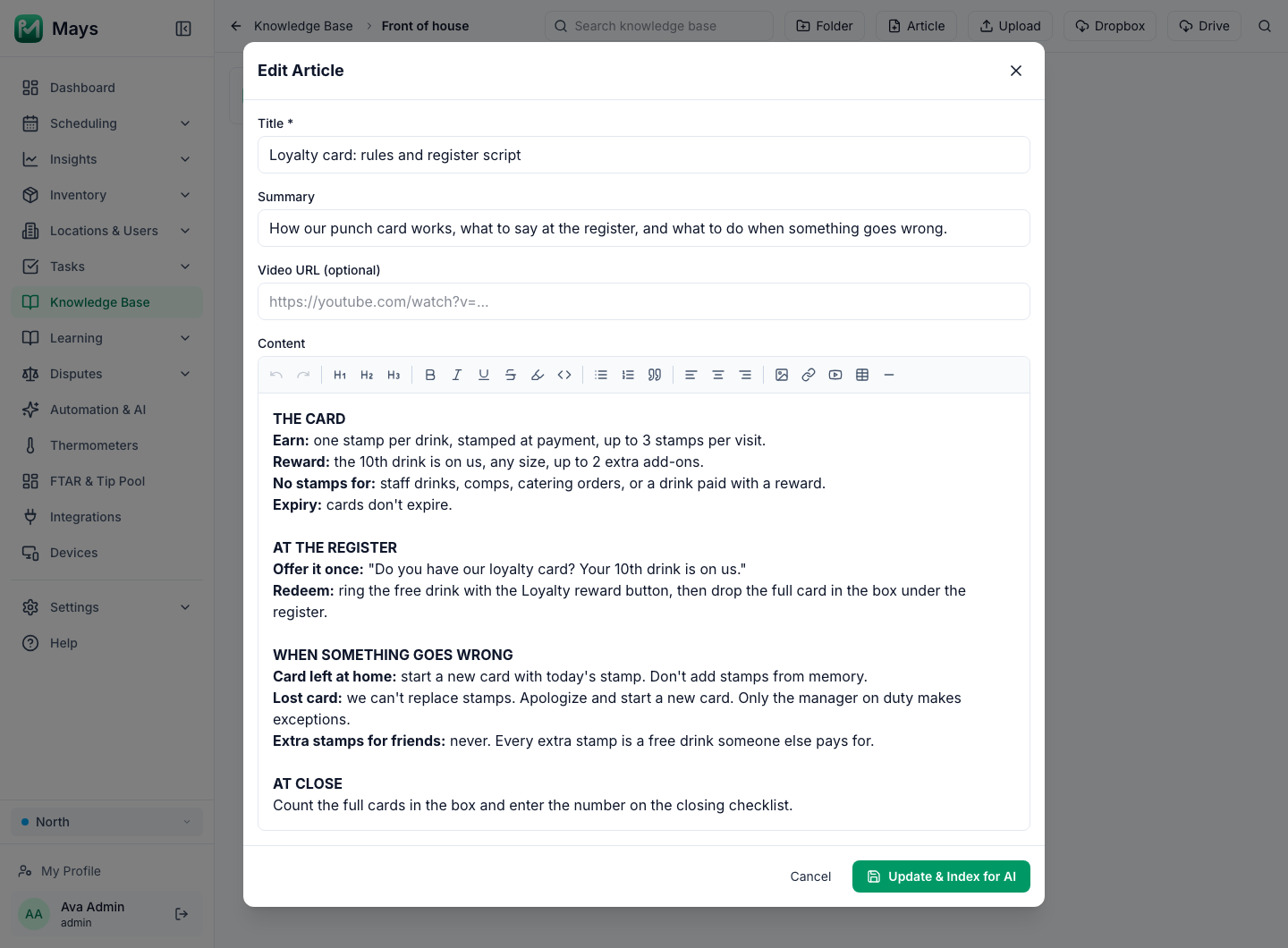
A few months after opening, you know your regulars by name. The oat-milk cortado at 7:40, the laptop crowd on Tuesdays, the family that comes every Saturday. And someone always asks: "Do you have a loyalty card?"
It's a fair question, and there's no single right answer. A loyalty program gives away margin on every reward, costs staff time at the register, and needs rules someone has to enforce. Done well, it gives regulars one more reason to pick you over the place next door. Done badly, it's a discount for people who were coming anyway.
This guide compares the three real options (punch cards, points, or nothing formal), works through the margin math with made-up numbers, and covers the rules, redemption tracking and staff training that decide whether a program works. It ends with a way to test one for 90 days before you commit.
What a loyalty program can and can't do
Be clear about the job before you pick the tool.
A loyalty program rewards people who already come back. It can nudge a twice-a-week customer to a third visit, or keep them from drifting to a new café that opened down the street. It's not a strong way to bring in people who've never tried you. That's what your Google Business Profile, your signage and word of mouth are for (our Google Business Profile guide covers the first).
So the question isn't "do other cafés have one?" It's "do I have enough regulars that a small extra visit from each would matter?" If most of your sales are one-time visitors (a café by a highway exit, or in a tourist area), a program has less to work with.
The three options
Paper punch card | Points (digital) | No formal program | |
|---|---|---|---|
How it works | A stamp per qualifying purchase; the 10th drink free | Points per dollar or per visit, tracked by your POS or an app; rewards at set levels | Regulars get recognized, and the occasional surprise on the house |
Upfront cost | Printing cards and a stamp | Setup time; the software may charge a monthly fee | None |
Running cost | The rewards, plus fraud you can't see | The rewards, plus any software fee | Whatever you choose to give away |
What you learn | Only how many cards come back | Who visits, how often, what they buy (if the POS tracks it) | Nothing you can measure |
Staff effort | A stamp every sale, and the questions about lost cards | Asking for a phone number or scanning, every sale | Knowing regulars |
Watch out for | Stamp copying, extra stamps for friends | Slower lines if sign-up takes too long at the register | Perks given unevenly, which looks like favoritism |
Paper punch cards are cheap and easy to explain, and customers understand them instantly. But you can't see who has one, cards get lost, and a stamp is easy to fake or hand out too freely.
Points through your POS or a loyalty app track every visit and every reward, so you can see whether the program changes anything. They cost more (check what your POS or the app charges on the vendor's own pricing page), and every sign-up adds a few seconds at the register.
No formal program is a real option. Knowing names, remembering orders and the occasional pastry on the house cost less than a program, and nobody feels cheated by a rule. The downside: you can't measure it, and it depends on who's working.
The margin math (made-up numbers)
A reward costs you what it costs to make, not its menu price. But it's still paid for out of the profit on every other sale, so work it out before you print anything.
Every number here is made up. Use your own prices, costs and sales.
The setup: a latte sells for $5.00. With milk, espresso, cup and lid, it costs $1.25 to make. The card: buy 9 drinks, get the 10th free.
The cost of one reward: $1.25, the cost of the free latte.
Spread over the card: a completed card is 9 paid lattes ($45.00 in sales) plus 1 free one. The reward costs $1.25 against $45.00 in sales, or about 2.8% of what that customer spent. At menu price, it looks like a 10% discount ($5.00 of every $50.00 in drinks). Your real cost is lower, because you only pay for the ingredients and the cup, but it's not zero.
The monthly bill: say 150 rewards are redeemed in a month, and you run the program digitally for a made-up $50 a month in software.
Line | Made-up monthly cost |
|---|---|
150 free lattes at $1.25 | $187.50 |
Software | $50.00 |
Total | $237.50 |
With paper cards, the software line becomes a printing bill every few months.
What it has to earn back: each extra paid latte leaves you $5.00 − $1.25 = $3.75 toward your other costs. To cover $237.50, the program needs about 64 extra paid lattes a month that wouldn't have happened without it. That's about 2 a day.
That's the real test. If the people redeeming those 150 rewards were coming in just as often anyway, the program is a $237.50-a-month discount. If it brings 150 people back for one extra paid visit a month, that's $562.50 toward your costs, more than twice what it costs.
Points work the same way. With 1 point per dollar and a $5.00 reward at 100 points, customers get 5% back at menu price. If the reward is a drink that costs $1.25 to make, your cost is $1.25 per $100 in sales, or 1.25%. The more generous the program looks, the more of these rewards you'll give out, so run the numbers at the level you're offering.
Write the rules before the first card
Most loyalty headaches come from rules nobody wrote down. Decide these once, and put them on the card or the sign:
- What earns: any drink? Any purchase over a set amount? Only one stamp per visit, or one per item?
- What the reward is: "any drink," or "any drink up to $6"? A free large with extra shots is a very different cost.
- What doesn't earn: comped items, staff drinks, catering orders, or purchases paid with a reward.
- Expiry: does the card or do the points expire? Say so clearly if they do.
- Lost cards: replaced or not? If it's a paper program, the honest answer is usually "not," said kindly.
- Can it combine with other discounts or specials?
- Who can make exceptions: usually the shift lead or manager only, with a limit.
Keep the reward simple. "Your 10th drink is on us" is easier to say at 8 am than a tiered menu of rewards.
One rule you don't get to choose: don't give stamps or points for Google reviews. Google's policy says businesses may not offer "payment, discounts, free goods and/or services" in exchange for posting a review (Google Maps: prohibited and restricted content). Our Google reviews guide covers the rest of the rules. Updated September 24, 2026: Google's policy wording was re-checked.
Track redemptions from day one
If you can't count it, you can't tell whether the program works. Set up tracking before launch:
- Give the reward its own button in the POS (a discount or comp named "Loyalty reward"), so it shows up on its own line in your sales reports instead of disappearing into "comps."
- With paper cards, keep the completed cards. A box under the register, counted at close, gives you the weekly redemption number.
- Write down the weekly count alongside sales and transactions. Four numbers a week is enough: rewards redeemed, transactions, average ticket and total sales.
- Watch for patterns: one shift with far more redemptions than the others, cards completed in a week, stamps that don't match your stamp. A short conversation fixes most of it.
A digital program does most of this for you. Check what its reports show before you sign up.
Train staff on one script
The program happens at the register, so it's only as good as the person there. Train it like any other procedure:
Offering it: "Do you have our loyalty card? It's your tenth drink free." Say it once per customer, not every visit.
Stamping: one stamp per qualifying purchase, stamped at payment, never later.
Redeeming: ring it through the loyalty reward button, and keep the completed card.
When there's a problem:
- "I left my card at home." Offer a new card for today's stamp. Don't add stamps from memory.
- "I lost my card with 8 stamps." Follow your written rule, apologize, and start a new card. Only a manager makes an exception.
- A friend asks for extra stamps. No. Explain once in training why that's a problem: every extra stamp is a free drink someone else pays for.
Practice it in the pre-shift meeting: one person plays a customer who lost their card, and each new hire answers. Add it to your first-week training, and put the script where staff can find it.
Run a 90-day test
You don't have to decide forever. Launch it as a test:
- Before launch, write down four weeks of baseline numbers: transactions, average ticket and sales per week.
- Launch with written rules, a POS button and a trained team.
- Every week, record rewards redeemed next to the same numbers.
- At 90 days, compare. Did transactions go up? Did the program cost what you expected? Do staff and customers like it?
Seasons, weather and new competitors move sales too, so don't read too much into one week. Look at the trend.
If it isn't working, stop it cleanly: announce an end date, honor every card or balance until then, and thank people for using it. Pulling a program overnight costs more goodwill than it saves.
Where Mays fits
Mays doesn't run a loyalty program: there are no punch cards, points or customer accounts in it. Your POS or a loyalty app does that part. Mays helps with the operating side:
- The rules and the script in one place: write them as a Knowledge Base article (the image at the top of this post) and put it in a folder your team can see. Staff can read it in the phone app at the register.
- Training with a quiz: in Learning, an admin builds a short module from that article, lets the AI write the quiz, sets a passing score and assigns it to a location or role. Staff take it in the app. Learning is switched on for your account by our team, so ask when you start.
- The nightly count as a task: add "Count completed loyalty cards and write the number" to your closing checklist, with a Number answer, so the count happens every night.
- What the reward really costs: in Inventory → Setup → Recipes, build the drink you give away with your vendor prices, and Mays shows its Cost, Cost % and Margin, so the math above uses your numbers, not a guess.
Your loyalty checklist
- A clear reason for the program, and enough regulars to make it worth it
- The option chosen: paper, points, or no formal program
- The margin math done with your own costs, including how many extra visits it needs
- Written rules for earning, rewards, expiry, lost cards and exceptions
- No stamps or points for reviews
- A loyalty reward button in the POS, and a weekly redemption count
- A register script, practiced before launch
- A 90-day test with baseline numbers, and a clean way to stop
Put your loyalty rules where the team can find them
Write the rules and the register script once, train every new hire on them, and count redemptions every night.
Start your free trial: 30 days, every module, no card needed. Working out what your drinks really cost? Start with our guide to plate costing and menu pricing.