Hiring a shift lead: what the role owns, a job description, promotion criteria and a 30-day plan
Most small cafés don't plan their first shift lead. The owner gets tired of opening every day, the most reliable barista gets a key, and the role is whatever that person ends up doing. That works until the second lead is hired, and the two of them run the same close two different ways.
This is the fourth post in our Hiring and training by role series. It's about the hiring side: defining the role, writing the job description, deciding whether to promote or hire, and the interview. If you've already picked someone and want to hand over the keys, read Promoting your first shift lead: what to hand over, and what not to, which covers the role card, cash and keys, the person in charge rules, overtime and tips. This post doesn't repeat it.
This is general information, not legal advice. Updated October 5, 2026: every source below was checked on that date.
What a shift lead owns
Write the role down before you post it. In a small café or restaurant, a shift lead usually owns three things on their shift:
1. Opening or closing. The checklist done properly, in order, with proof for the tasks that matter, and a handoff note for the next shift. See opening and closing checklists your staff will actually follow.
2. The cash. The starting bank, safe drops, the count at close and the deposit prepared for a manager to verify. The routine is in our cash handling guide.
3. Call-outs and problems during the shift. Someone calls out at 6 am: the lead follows your call-out policy, tries to find cover, and tells you what happened. A cooler stops holding temperature: the lead knows what to do and when to call you. Our call-out and no-show guide has the policy to give them.
Everything else (breaks, stations, a remake for an unhappy customer) is the lead running the floor. What they shouldn't own (hiring, pay rates, building the schedule, the safe combination) is listed in the promotion guide.
When you're not in the building, your lead is also the person in charge for food safety. The FDA Food Code's list of the person in charge's duties includes watching that employees wash their hands, that hot and cold food stays at the right temperatures, and that "EMPLOYEES are properly trained in FOOD safety, including FOOD allergy awareness, as it relates to their assigned duties" (2022 FDA Food Code, §2-103.11(D), (I) and (O)). Your state decides which edition applies and whether a certified food protection manager has to be on site.
What shift leads earn
The closest BLS occupation is first-line supervisors of food preparation and serving workers (SOC 35-1012). It's broader than a shift lead: O*NET's sample titles for it include "Kitchen Supervisor", "Food Service Supervisor" and "Restaurant Manager" (O*NET 35-1012.00).
First-line supervisors of food prep and serving workers: restaurants and other eating places, May 2025 | Hourly |
|---|---|
25th percentile | $17.00 |
Median | $19.79 |
75th percentile | $23.94 |
Source: BLS Occupational Employment and Wage Statistics, May 2025 national industry estimates for NAICS 7225 (median series OEUN000000072250035101208; 25th and 75th percentiles: the series ending in 07 and 09). Because the occupation includes managers, a first shift lead in a small café will usually sit toward the lower part of that range. The practical rule: the lead should earn noticeably more than the people they lead, or the promotion isn't one.
A shift lead job description
Shift Lead, [full-time], [pay range] an hour + tips [if your tip policy allows it]
[Your café], [neighborhood]

What you'll own
- Opening or closing the café, with our checklists, at least [number] shifts a week
- The register on your shift: the starting bank, safe drops and the count at close
- The floor: breaks, stations, and keeping the line moving
- First response to problems: a call-out, an upset guest, equipment that stops working
- A short handoff note at the end of every shift

What you need
- [One year] in a café or restaurant, including some opening or closing
- Accurate with cash, and calm with a long line
- Available for early opens (6 am) and closes, including weekends
- A food protection manager certificate, or willing to get one within [days] (we pay)

What we offer
- [Pay range] an hour
- Clear limits in writing: what you decide alone and when to call
- A 30-day plan with the owner before you run shifts alone

To apply, tell us about a shift that went wrong and what you did, at [email].
The certificate line depends on your state and on how many people work at once. Check your health department's rule before you post.
Promote from within, or hire from outside?
Promote when you have someone who already meets the criteria below. Hire from outside when nobody does yet, or when the person who does doesn't want the job. Promoting the wrong person costs you a good barista and gets you a struggling lead.
Promotion criteria. Before you offer the role, the candidate should be able to say yes to each of these, and you should have seen it:
Criterion | How you know |
|---|---|
Signed off on every station they'll supervise | Their training record, not your memory |
Has run the opening or closing checklist correctly, more than once | The checklist history, with the proof photos |
Counts a drawer accurately | Several of their own counts with no unexplained difference |
Stays calm with an upset customer and knows the limits | You've watched it, or a lead has told you |
Reliable: on time, rarely calls out, covers when asked | The attendance record |
Gets asked for help by coworkers | You've noticed |
Wants it | You asked |
If someone meets five of seven, the gaps are your 30-day plan.
Hiring from outside. An outside lead brings experience, but not your recipes, your regulars or your way of closing. Plan for them to learn every station first (the 30-day plan below), and tell your team who's coming and why before the first shift.
Interview questions for a shift lead
Ask the same scenarios of every candidate, inside or outside, and score each answer.
Scenario | Listen for |
|---|---|
It's 6:05 am, you're opening, and the barista texts that they're sick. Walk me through the next 30 minutes. | Opens safely alone or with what they have, follows the call-out policy, tries cover, tells the owner |
At close the drawer is $18 short. What do you do? | Counts again, checks paid-outs and voids, writes it down, doesn't cover it from their own pocket or blame anyone on the spot |
A customer says their child has a nut allergy and asks about the muffins. | Checks the recipe card or label, involves the kitchen, says so honestly if they can't be sure |
The walk-in reads 46°F at 2 pm. | Checks the thermometer, moves food to another cooler, calls whoever fixes it, tells the owner, knows what to throw out |
Two of your team are arguing during the rush. | Separates the work first, talks after the rush, tells the owner if it repeats |
What would you change about how we close? (inside candidates) | A real observation, said constructively |
Leave out the same questions as for any role (family, religion, health). The barista post lists them with the EEOC's guidance.
A 30-day plan for a new shift lead
For an internal promotion, use the four weeks in the promotion guide: shadow, run it with you there, run it alone, and a weekly check-in. For an external hire, add the week they need to learn your café first:
- Week 1: learn the café. They work each station as a team member, with a sign-off on each. They read the recipe cards, the opening and closing checklists and the call-out policy.
- Week 2: shadow the role. They follow you on two opens and two closes, role card in hand, and count the drawer next to you.
- Week 3: run it with you in the building. They open and close, you watch and talk afterwards. First call-out handled with you next to them.
- Week 4: run it alone. You read the checklist, the count and the handoff note the next morning, and meet for 15 minutes at the end of the week.
At day 30, write down what they now decide alone, and what still needs a call.
Where Mays fits
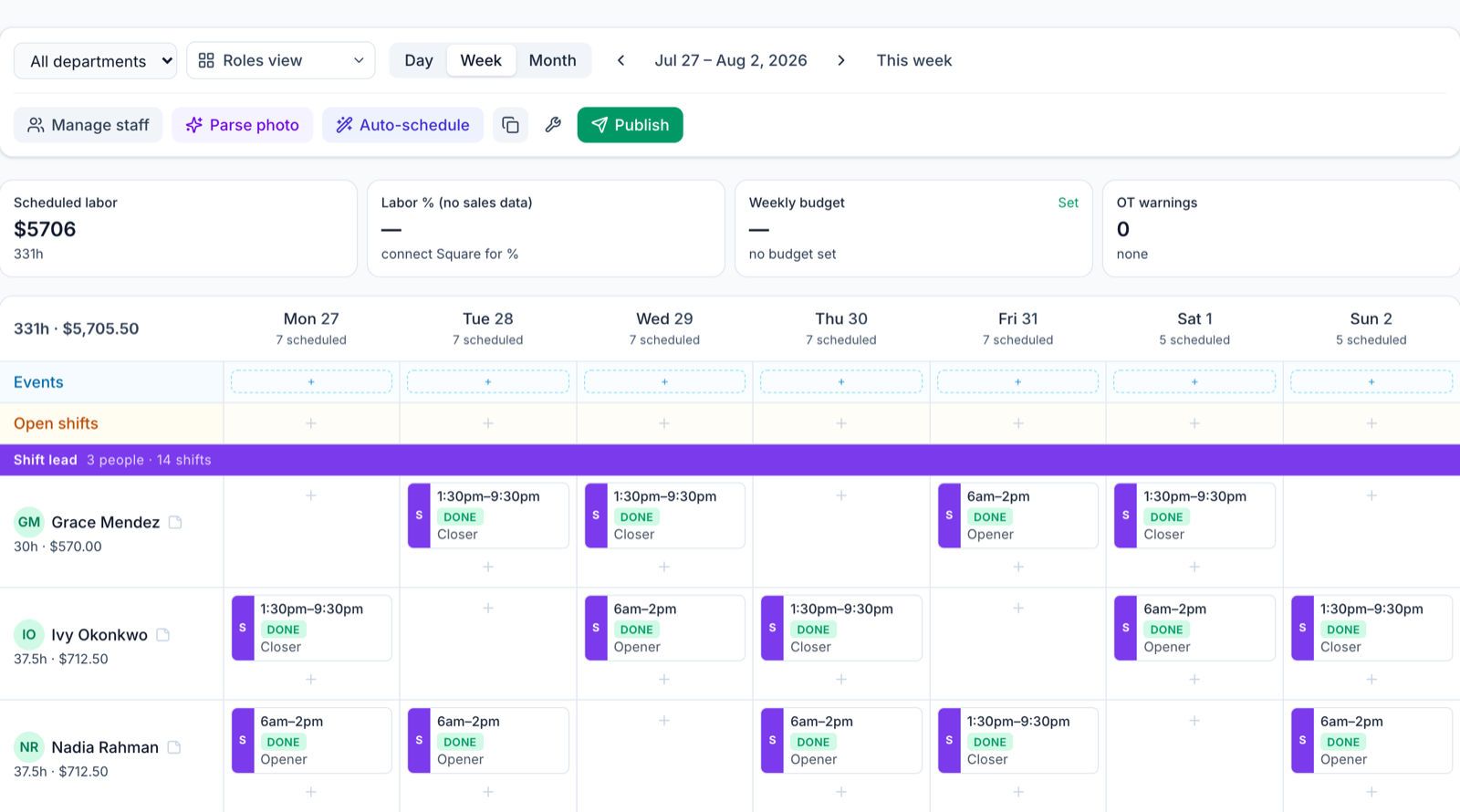
- See every open and close covered. Create a Shift lead position under Scheduling → Positions and switch the schedule to Roles view, which groups the week by position. The image at the top of this post shows three leads covering every opening and closing shift of a week, each shift labeled Opener or Closer with the shift's Label field.
- Checklists, the count and the handoff. The promotion guide covers giving a lead their own copy of the closing checklist, a Register / Cash count form on the close, and the manager Logbook for the handoff note.
- The criteria, from records. The checklist history, each person's cash count submissions under Tasks → Data, their training module scores in Learning, and the attendance report give you most of the promotion criteria above without relying on memory.
- Call-outs. Finding cover in the app (Find cover on a shift, with who's free and three ways to fill it) is in the manager part of the app. A lead on the Employee role can't use it, so they call you or a manager, or you give the lead a manager's access.
- Access. Which role a lead gets (Employee, Manager or a custom role) and what each one can do is in the promotion guide.
Your shift lead hiring checklist
- The role written down: opening or closing, the cash, call-outs and problems
- A job description with the hours, the pay and the certificate requirement for your state
- The seven promotion criteria checked against records, for every internal candidate
- The same scenario questions for every candidate
- A 30-day plan, with an extra week for an outside hire
- At day 30, what they decide alone, in writing
Build your lead team with Mays
See every open and close on one schedule, give your leads their checklists and the cash count, and promote from records instead of memory.
Start your free trial: 30 days, every module, no card needed. Next in the series: hiring servers and cashiers.