Hiring a barista: job description, interview questions and a first-week checklist
The first barista you hire sets the standard for every drink that leaves your bar while you're not behind it. Many new owners hire on charm, then learn on a Saturday morning that charm doesn't pull a consistent shot.
This is the first post in our Hiring and training by role series: a practical page per job, with a job description you can copy, interview questions, and a training checklist. For the general process (where to post, structured interviews, paid trials and the new-hire paperwork), start with Hiring your first restaurant team. This post is the barista-specific layer on top.
This is general information, not legal advice. Updated October 5, 2026: every source below was checked on that date.
What the job actually is
A barista in a small café does more than make drinks. On a typical shift they:
- dial in the espresso at opening and check it again during the day;
- build every drink to your recipe card, in your order, at your speed;
- steam and texture milk, including the alternative milks;
- take orders and payments when the line is long;
- keep the bar clean between drinks, not just at close;
- restock cups, lids, milk and beans before they run out;
- follow the opening or closing checklist when they're on it.
Write the job description around that list. A candidate who reads it should know what a Tuesday looks like.
What baristas earn
The Bureau of Labor Statistics doesn't publish a separate wage for baristas. It counts them under fast food and counter workers (SOC 35-3023), the occupation that the Department of Labor's O*NET database lists baristas under (O*NET 35-3023.01, Baristas).
In restaurants and other eating places, the May 2025 national estimates from the BLS Occupational Employment and Wage Statistics program show:
Fast food and counter workers, restaurants and other eating places | Hourly |
|---|---|
25th percentile | $13.23 |
Median | $14.67 |
75th percentile | $17.14 |
Source: BLS OEWS, May 2025, national industry estimates for NAICS 7225 (median series OEUN000000072250035302308; 25th and 75th percentiles: series ending in 07 and 09). These figures include tips: the BLS technical notes list "tips" among the pay that OEWS wages include (OEWS technical notes, May 2025).
A national median is a reference point, not a price. Your state or city minimum wage is the floor, and what cafés near you pay is the real market. Put a range in the post.
A barista job description you can copy
Barista, [full-time / part-time], [pay range] an hour + tips
[Your café], [neighborhood]

What you'll do
- Make espresso drinks, brewed coffee and tea to our recipes
- Dial in the espresso at opening and keep it on recipe all day
- Steam milk, including oat and almond, for latte art and flat whites
- Take orders and payments at the counter when the line is long
- Keep the bar clean and stocked during the shift, not only at close
- Open or close the café with our checklists once you're trained

What you need
- Available [days and times, including at least one weekend morning]
- Able to stand for a full shift and lift a 20 lb box of milk
- Comfortable with a fast line and a lot of small tasks at once
- Experience on an espresso machine helps; we train, and training is paid

What we offer
- [Pay range] an hour plus a share of tips
- A schedule published [how far] ahead, on your phone
- A written first-week plan and a named trainer

To apply, send your availability to [email]. We reply to everyone within 3 days.
Keep "what you need" to real must-haves. If you'd hire someone with no experience who learns fast, say so.
Interview questions that predict a good bar shift
Ask every candidate the same questions in the same order, and score each answer right after (the hiring guide has the scoring method).
Question | Listen for |
|---|---|
Walk me through how you'd make a latte, from grinding to handing it over. | An order of steps, cleaning the wand and portafilter, tasting or checking the shot |
The shots are running fast this morning. What do you change first? | One change at a time, usually the grind, then test again |
Eight drinks on the screen and a customer asks you a long question. What do you do? | Acknowledges the customer, keeps the line moving, doesn't ignore either |
What does a clean bar look like at 2 pm on a busy day? | Specifics: wiped steam wand, knock box emptied, milk put back in the cooler |
Tell me about a drink you had to remake. What happened? | Owns it, fixes it, doesn't blame the customer |
Which days and hours can you work, every week? | A real match with your schedule |
Questions to leave out
The EEOC's guidance is that pre-employment questions "should be limited to those essential for determining if a person is qualified for the job; whereas, information regarding race, sex, national origin, age, and religion are irrelevant in such determinations" (EEOC: prohibited practices). For a barista, the common slips are:
- Family and children. The EEOC lists "Number and age of children or future child bearing plans" and "Child care arrangements" among the questions that "may be regarded as evidence of intent to discriminate when asked in the pre-employment context" (EEOC: marital status and children). Ask "Can you work Saturday and Sunday mornings?" instead.
- Religion and weekends. Employers "should avoid questions about an applicant's religious affiliation, such as place of worship, days of worship, and religious holidays" (EEOC: religious affiliation). The availability question covers what you need to know.
- Health and lifting. "An employer may not ask a job applicant, for example, if he or she has a disability", but "may ask a job applicant whether they can perform the job and how they would perform the job" (EEOC: medical questions). "Can you lift a 20 lb box of milk to the top shelf?" is a job question; "Do you have back problems?" isn't.
A short, paid bar test
For a barista, ten minutes on the machine tells you more than the interview. Keep it short, schedule it, and pay for it: the hiring guide explains why a trial shift is paid work under the Fair Labor Standards Act.
A simple bar test:
- Pull two shots and taste them together. Ask what they'd change.
- Make a latte and a cappuccino from your recipe card.
- Steam a pitcher of oat milk.
- Clean the wand, the portafilter and the drip tray as if the next drink were waiting.
Watch the habits more than the latte art: reading the card, wiping the wand, working clean.
Hiring teens for the bar
Many cafés hire 16- and 17-year-olds, and some hire 14- and 15-year-olds. Federal law lists the kitchen work younger teens may do, and it names coffee equipment: the permitted machines "include, but are not limited to, dishwashers, toasters, dumbwaiters, popcorn poppers, milk shake blenders, coffee grinders, automatic coffee machines" (29 CFR 570.34(i)). The same rule allows 14- and 15-year-olds to clean equipment and handle hot oil only when the equipment and liquids "do not exceed a temperature of 100 °F". A commercial espresso machine with a steam wand isn't named, so check with the Wage and Hour Division before you put a 14- or 15-year-old on it. Hours limits for teens are in the hiring guide, and your state may be stricter.
The first-week barista training checklist
The one-week training plan covers the structure of a new hire's first week. This is the barista version: what they should be able to do, with a sign-off from the trainer for each line.
Day 1: safety and the station
- Handwashing sink, glove use and when to wash between tasks
- Where the milk, beans, syrups and backups live, and how stock is rotated
- Steam wand and hot water: where the burns happen and how to avoid them
- The recipe cards: where they are and that they're followed every time
Days 2 and 3: espresso and milk, supervised
- Dial in the grinder with the trainer and log the morning shot
- Pull shots to recipe (dose, yield, time) and explain a fast or slow shot
- Steam dairy and oat milk to the right texture and temperature
- Purge and wipe the steam wand after every pitcher, without being reminded
Day 4: the full menu and the line
- Build every drink on the menu from the card
- Call out and hand off drinks the way your café does it
- Take orders and payments during a rush (the register basics)
- Keep the bar clean between drinks during the rush
Day 5: close the bar
- Backflush the group heads and clean the portafilters
- Empty and clean the grinder hopper if your close includes it
- Label, date and put away the milk and cold brew
- Work through the closing checklist with the trainer
Sign-off. The trainer confirms each line; the first solo shift comes after.
Where Mays fits
- A Barista position. Under Scheduling → Positions, create a Barista position with a color and a default hourly wage, and add it to each barista. Mays uses the wage to cost the schedule.
- Training shifts on the schedule. A shift has a Label field, so the first week's shifts can say Training, next to a named trainer on the same hours.
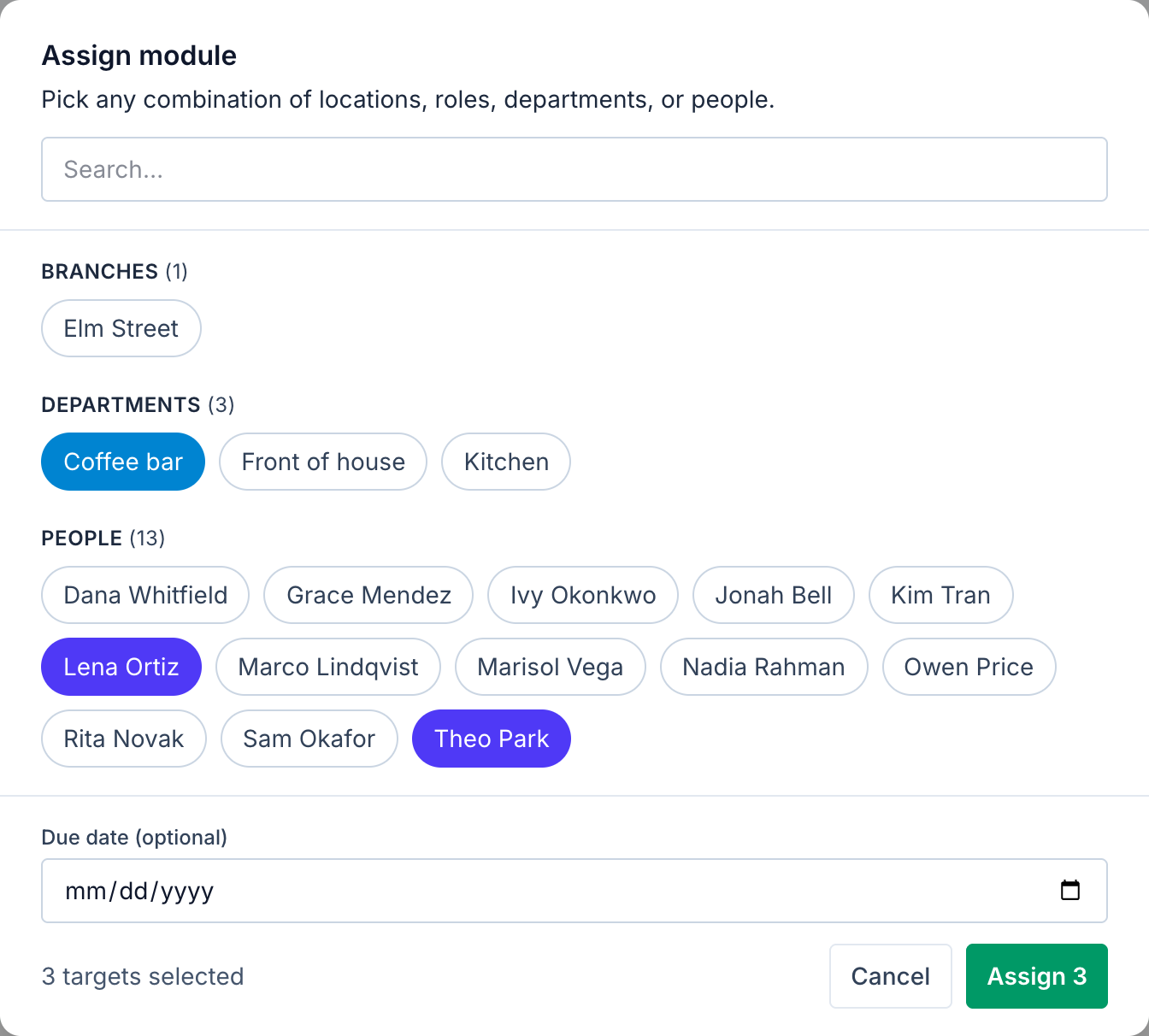
- The bar standards as a short quiz. In Learning, an admin builds a module from your knowledge base articles and documents. The AI drafts up to 15 multiple-choice or true/false questions from your own text, you review and edit every one, set the passing score (80% to start with) and publish. Then Assign sends it to any mix of locations, roles, departments and people, with an optional due date. The image at the top of this post shows an "Espresso bar: week one" module going to the Coffee bar department and two new baristas. Assignments work like a rule: someone who joins that department later gets the module too.
- The sign-off list. Build the checklist above as a template under Tasks → Templates and leave its locations empty, so it never runs on its own. On day one, Tasks → Create Task → From Template gives it to the new barista or their trainer, for that day.
- Teen baristas. With Labor law compliance on, a position can carry a Minimum age and the tasks it involves, and at a location with minors' rules turned on, Mays warns you when someone younger is scheduled on it.
Learning is switched on for your account by our team, and only admins build and assign modules. Mays doesn't send reminders before a module's due date, so follow up yourself.
Your barista hiring checklist
- A job description with the pay range, the schedule and the real duties
- The same six interview questions for everyone, and none about family, religion or health
- A short, paid bar test with your recipe cards
- Teen hires checked against the equipment rules and your state's hours limits
- A first-week checklist with a sign-off for every line
- The first solo shift after the sign-offs, not on a fixed date
Train your next barista with Mays
Put the recipe cards in the knowledge base, turn them into a short quiz, and give every new barista the same first week.
Start your free trial: 30 days, every module, no card needed. Next in the series: hiring a line cook.