Tip-out sheet template: cash tips and card tips by shift, tip-outs and what each person keeps
Every tipped shift ends with the same questions: how much came in on cards, how much is in the jar, who tips out to whom, and how much does each person take home. When the answers live in someone's head or on a napkin, the first dispute has no paper behind it. A tip-out sheet, filled in at close and initialed by everyone on it, is that paper.
Who may share in tips at all, and how a tip credit changes that, is in our guide to tip pooling for new restaurant owners. This post is the nightly sheet that puts your written policy into numbers.
This is general information, not legal or tax advice. Tip rules depend on your state and on whether you take a tip credit. Have an employment lawyer review your written tip policy.
The rules the sheet has to respect
From the Department of Labor's Fact Sheet #15:
- With a tip credit, only tipped occupations. "An employer that takes a tip credit can require tipped employees to contribute tips only to a tip pool which is limited to employees in occupations in which they customarily and regularly receive tips, such as waiters, bellhops, counter personnel (who serve customers), bussers, and service bartenders."
- Without one, the kitchen can be included. "When an employer pays its employees a cash wage of at least the federal minimum wage (currently $7.25) per hour, the employer may impose a mandatory tip pooling arrangement that includes employees who are not employed in an occupation in which employees customarily and regularly receive tips."
- Never managers, supervisors or the business. "An employer may not receive tips from such a tip pool and may not allow managers and supervisors to receive tips from the pool."
- Pay it out on time. "When an employer collects tips to administer a tip pool, the employer must fully distribute any collected tips at the regular payday for the workweek, or, for pay periods of more than one workweek, at the regular payday for the period in which the particular workweek ends."
- Card fees. In the fact sheet's example of a 3% card fee, "The employer may pay the tipped employee 97 percent of the tips without violating the FLSA." Never more than the actual fee, and some states don't allow it. How processors charge you is in card processing fees for a café.
States add their own rules on tip credits, pools and card fees. See your state's page, for example Florida, California, New York, Texas or Washington (coming Oct 21).
The IRS side matters to your staff. Employees who share tips "report only the tips you receive and retain. Don't report to your employer any portion of the tips you receive that you pass on to other employees." Their daily tip record should include "The amount of tips you paid out to other employees through tip pools or tip splitting, or other arrangements, and the names of the employees to whom you paid the tips." And "Give your report for each month to your employer by the 10th of the next month" (IRS Publication 531). A signed tip-out sheet gives everyone those numbers.
Part 1: the sheet, one row per person
This example uses a made-up policy: servers tip out 15% of their tips to the busser and 10% to the bartender. Yours may split by hours, by points or by a share of sales; write the rule at the top of the sheet.
Policy: servers tip out 15% of their tips to the bussers and 10% to the bar, each split by hours worked.
Name | Position | Hours | Card tips | Cash tips | Tip-out given | Tip-out received | Tips kept | Initials |
|---|---|---|---|---|---|---|---|---|
Ana | Server | 6 | $184.00 | $36.00 | $55.00 | — | $165.00 | |
Ben | Server | 6 | $152.00 | $28.00 | $45.00 | — | $135.00 | |
Cal | Bartender | 6 | $96.00 | $14.00 | — | $40.00 | $150.00 | |
Dee | Busser | 5 | — | — | — | $60.00 | $60.00 | |
Total | $432.00 | $78.00 | $100.00 | $100.00 | $510.00 |
How the numbers work: Ana's tips are $220.00; 15% is $33.00 for the busser and 10% is $22.00 for the bar, $55.00 in all. Ben's are $180.00: $27.00 and $18.00, $45.00 in all. The busser gets $33.00 + $27.00 = $60.00 and the bar $22.00 + $18.00 = $40.00.
Two checks before anyone signs: tip-outs given = tip-outs received, and tips kept = card tips + cash tips. Here both hold: $100.00 = $100.00, and $510.00 = $432.00 + $78.00.
Part 2: shift totals
Line | Amount |
|---|---|
Card tips, from the POS tip report | $432.00 |
Card fee deducted, if your policy does (actual rate only) | |
Cash tips, counted by two people | $78.00 |
Total tips for the shift | $510.00 |
Paid out in cash tonight | |
Paid on the next paycheck | |
Counted by / witnessed by | |
Manager's signature (managers sign, never share) |
Card tips should match the POS's tip report for the shift. Cash tips get counted with a witness, the same way you'd count a drawer in our cash handling guide.
Part 3: the weekly summary for payroll
Each week, total the sheets per person and send it to payroll with the sheets attached:
Name | Card tips kept | Cash tips kept | Tip-outs received | Total tips | Paid in cash | Owed on paycheck |
|---|---|---|---|---|---|---|
How tips show on paychecks, and how they connect to a tip credit, is covered in the payroll section of setting up your first payroll.
Five habits that prevent disputes
- Fill it in before anyone leaves, and get every initial.
- Keep the written policy at the top of the sheet, so the math is never a judgment call at 11 pm.
- Keep managers and owners off the receiving side, including on nights they work the floor.
- File every sheet. A photo of the signed sheet is the easiest backup.
- Change the policy in writing, before the shift it applies to, never after the money is counted.
Where Mays fits
Mays's tip handling is a tip pool, set per location on its Scheduling tab: split by hours worked, equally or by FTAR score, per pay period or day by day, with managers and admins left out by default. The tips it splits are the card tips from your connected POS (Square or Union), or tips on time punches synced from 7shifts. Each person's share shows in the Tip Payouts report and goes into the payroll export, and a card fee deduction is available when Labor law compliance is on.
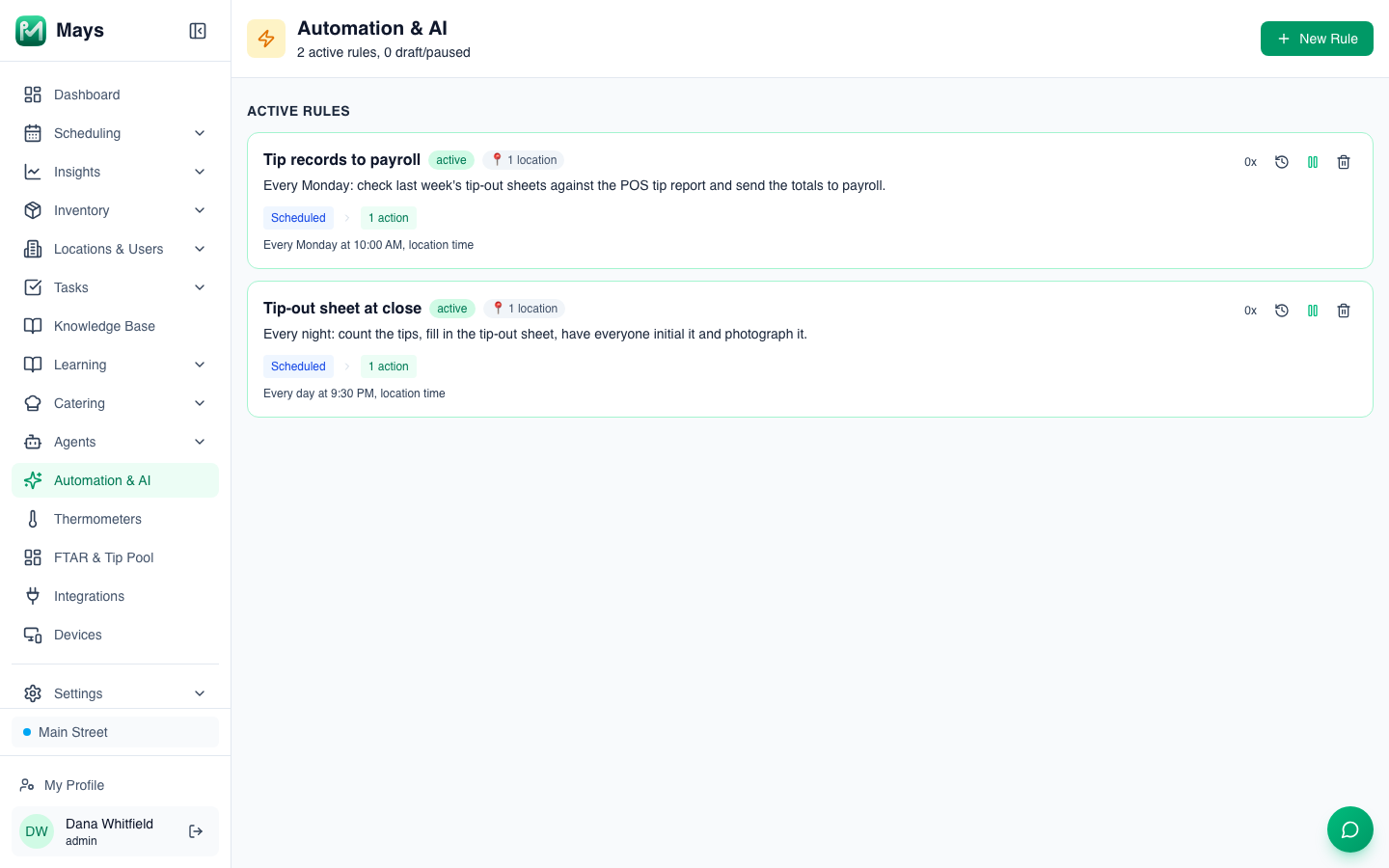
For a nightly sheet like the one above, Mays makes sure it happens (the image at the top of this post):
- A task at close, every night. Under Automation & AI, a Scheduled rule runs every day at the time you pick, at the location's own time, and its Create Task action adds a task at the location, with a Photo answer for the signed sheet, and notifies whoever is on shift.
- A weekly payroll reminder. A second rule every Monday gives the location's managers a task to total the sheets and send them to payroll.
- Ask your AI assistant. If you've connected Mays to ChatGPT or Claude, you can ask how the tip pool was split for up to 31 days. Amounts are included only if you can see pay in Mays and ticked Include wages, labor cost and tips when you connected.
Know the limits: Mays doesn't calculate a tip-out by percentage between positions, and cash tips from a jar can't be entered in Mays by hand (only tips on punches synced from 7shifts or card tips from your POS reach the pool). Keep the sheet as your record.
Count it, split it, sign it
A sheet per shift, initialed by everyone, with the policy printed on top: that's what makes a tip-out fair and provable.
Start your free trial: 30 days, every module, no card needed. Or book a walkthrough and we'll set up your tip pool and closing reminders with you.