Hiring servers and cashiers: job description, POS and cash training, and the allergen questions to always ask
The person at your counter or on your floor is the one most guests will remember. They're also the one who handles the money, takes the allergy question and decides, in the moment, whether a problem becomes a complaint. Front-of-house training usually gets ten minutes on the register and "you'll pick it up." It deserves a plan.
This is the fifth post in our Hiring and training by role series. It covers the job description, pay, POS and cash training, and the allergen questions to always ask. The general hiring process is in Hiring your first restaurant team, and the first 30 minutes of any new hire's first shift are in our 30-minute onboarding plan.
This is general information, not legal advice. Updated October 5, 2026: every source below was checked on that date.
Server, cashier, or both?
A counter cashier takes orders and payments, hands off to the bar or kitchen, runs food and keeps the front clean. A server does the same at the table, plus the pace of the meal: greeting, recommendations, checking back, the check. In many small cafés one person does both, depending on the day. Write the job description for the job you actually have.
What servers and cashiers earn
Restaurants and other eating places, May 2025 | 25th percentile | Median | 75th percentile |
|---|---|---|---|
Waiters and waitresses (SOC 35-3031) | $13.07 | $16.87 | $22.76 |
Cashiers (SOC 41-2011) | $13.00 | $15.00 | $16.73 |
Source: BLS Occupational Employment and Wage Statistics, May 2025 national industry estimates for NAICS 7225 (median series OEUN000000072250035303108 for waiters and waitresses and OEUN000000072250041201108 for cashiers; the percentiles are the series ending in 07 and 09). The BLS counts tips in these figures: its technical notes list "tips" among the pay that OEWS wages include (OEWS technical notes, May 2025). That's why the server range is so wide.
What you pay in cash per hour depends on whether your state allows a tip credit, and on the tip pooling rules. Our tip pooling guide covers both.
A front-of-house job description
Server / Cashier, [full-time / part-time], [pay] an hour + tips
[Your café], [neighborhood]

What you'll do
- Greet guests, take orders at the counter or at the table, and enter them on our POS
- Answer menu questions, including allergy questions, using our allergen chart
- Take payments, handle cash and close out your drawer with a count
- Run food and drinks, check back, and clear and reset tables
- Keep the front clean and stocked: napkins, lids, condiments, the pastry case

What you need
- Available [days and times, including weekends]
- Friendly with guests, accurate with orders and money, calm with a line
- Able to stand for a full shift and carry a tray of drinks

What we offer
- [Pay] an hour plus tips, [how tips are shared]
- Paid training on the POS, cash and our menu before your first solo shift
- A schedule on your phone, published [how far] ahead

To apply, send your availability to [email].
Say how tips work in the post. It's the first question most candidates will ask.
POS and cash training checklist
Teach the POS and the drawer on a slow shift, with a trainer next to them, before their first rush.
The POS
- Signing in with their own login, never someone else's
- Ringing up every menu item, with modifiers (milk, size, extra shot, no onion)
- Adding an allergy note to a ticket so it reaches the bar or kitchen
- Splitting a check, applying a discount you allow, and what needs a lead
- Voids and refunds: who can approve them, and the limit
- Gift cards and loyalty, if you use them
- What to do when the POS or the card reader is down
The drawer
- Counting the starting bank before the shift and signing for it
- Taking cash: count the change back, keep the bill on the drawer until the change is given
- Safe drops when the drawer goes over your limit
- Paid-outs only with a receipt and a lead's approval
- The blind count at close, then compare and record the difference
The full routine, a sample count sheet and why you shouldn't take shortages out of anyone's pay are in our cash handling guide.
The allergen questions to always ask
Allergies are where a front-of-house mistake can put someone in the hospital. The FDA Food Code defines the major food allergens as "Milk, EGG, FISH (such as bass, flounder, cod, and including crustacean shellfish such as crab, lobster, or shrimp), tree nuts (such as almonds, pecans, or walnuts), wheat, peanuts, soybeans and sesame" (2022 FDA Food Code, §1-201.10(B)). It makes the person in charge responsible for training staff in "FOOD allergy awareness", which "includes describing FOODS identified as MAJOR FOOD ALLERGENS and the symptoms that a MAJOR FOOD ALLERGEN could cause in a sensitive individual who has an allergic reaction" (§2-103.11(O)).
The 2022 edition also says the permit holder "shall notify CONSUMERS by written notification of the presence of MAJOR FOOD ALLERGENS as an ingredient in unPACKAGED FOOD items that are served or sold to the CONSUMER" (§3-602.12(C)). That paragraph isn't in the 2017 edition, and states enforce different editions, so ask your health department which one applies to you. Either way, an allergen chart for your menu is the tool your front of house needs.
The questions, every time someone mentions an allergy:
- "Is that an allergy?" (Treat any allergy as serious. Don't guess which ones are.)
- "Which foods, exactly?" (Write them on the ticket in the allergy field, not in a free-text note that gets missed.)
- "Is a small amount, or something cooked on the same equipment, a problem for you?" (Shared fryers, grills, steam wands and blenders matter.)
- "Can I check with the kitchen and come right back?" (Then actually check the recipe card or the label, with the cook or the lead.)
And the rules behind them:
- Never say "it's safe" from memory. Check the chart, the recipe card or the label.
- If you can't be sure, say so, and suggest something you can be sure about.
- Tell the kitchen or the bar out loud as well as on the ticket.
- Hand-deliver the order, and confirm the allergy when you set it down.
- Get the lead for anything you're unsure about.
And for raw or undercooked food: if your menu has items like eggs cooked to order, rare burgers or raw fish, the Food Code expects a consumer advisory, "using brochures, deli case or menu advisories, label statements, table tents" and similar (§3-603.11(A)). Servers should know which items carry it.
Dress codes
A uniform or a dress code is normal in front of house. The EEOC's guidance: "In general, an employer may establish a dress code which applies to all employees or employees within certain job categories." But a dress code "must not treat some employees less favorably because of their national origin", and if it conflicts with an employee's religious practices and they ask for an accommodation, "the employer must modify the dress code or permit an exception to the dress code unless doing so would result in undue hardship" (EEOC: prohibited practices). Write it down, apply it to everyone in the role, and handle requests case by case.
Where Mays fits
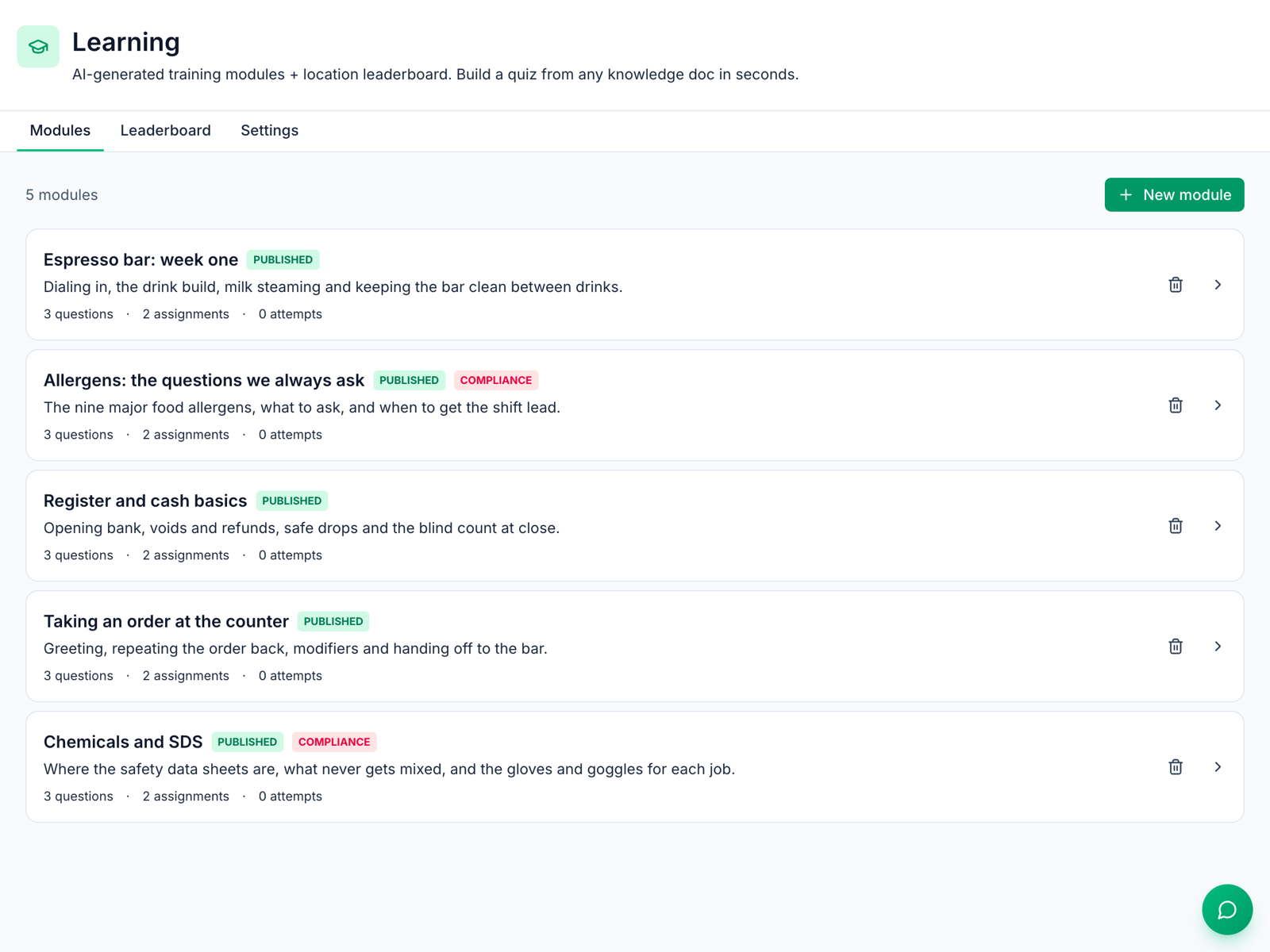
- A front-of-house training library. In Learning, admins build short modules from your own knowledge base articles: the allergen questions, the register, taking an order. The image at the top of this post shows a café's library of five. The AI drafts the questions from your text and you review each one before publishing.
- Allergen training with a certificate. Mark the allergen module compliance-critical, and everyone who passes gets a PDF certificate they can download in the app. A compliance module also limits retakes: after a failed attempt, someone waits before trying again (30 minutes to start with).
- Outside certificates. With Labor law compliance on, a team member's Certificates tab keeps certificates you get elsewhere, with Allergen training and Alcohol server among the types, and Mays reminds people before one expires.
- The cash count. An admin builds a count form from the Register / Cash count preset under Tasks → Types: coins and bills total themselves, with paid-outs and the expected amount. Add it to the closing checklist.
- Tipped positions. Mark Server as a Tipped position under Scheduling → Positions. A location's tip pool that doesn't name its own positions shares tips among the tipped positions.
Mays doesn't keep an allergen chart for your menu items on the web: recipes don't have an allergen field you can edit. Keep the chart as a knowledge base article, where staff can read it in the app, and update it when the menu changes.
Your front-of-house hiring checklist
- A job description that says how tips work
- POS and drawer training on a slow shift, before the first rush
- An allergen chart for the menu, and the four questions every time
- The consumer advisory items known by every server
- A written dress code, applied to everyone in the role
- A short quiz on allergens and the register, retaken until passed
Train your front of house with Mays
Put your allergen chart and register basics in the knowledge base, turn them into short quizzes, and give every server and cashier the same training.
Start your free trial: 30 days, every module, no card needed. Next in the series: hiring a prep cook.