Hiring a prep cook: job description, knife and labeling training, and a prep list template
A good prep cook makes the line look fast. Everything the cooks reach for at noon was diced, portioned, labeled and dated at 7 am, in the right amount. A weak one leaves you with three quarts of onions nobody needed, no pico at the lunch rush, and an unlabeled container the inspector picks up first.
This is the last post in our Hiring and training by role series. It covers the prep cook job description, pay, knife and slicer safety, labeling and date marking, and a prep list template. The general hiring process is in Hiring your first restaurant team; the working interview in the line cook post works for prep cooks too, with more knife work and less service.
This is general information, not legal advice. Updated October 5, 2026: every source below was checked on that date. Since this post was first published, the FDA has issued a 2026 edition of the Food Code; its date marking section, §3-501.17, keeps the same 7-day rule.
What the job is
A prep cook gets the kitchen ready for service and keeps it stocked. On a typical shift they:
- work from the day's prep list, in the order it's written;
- wash, peel, cut and portion produce and proteins to your specs;
- make sauces, dressings and batch recipes from the recipe cards;
- label and date everything they make or open;
- rotate stock: first in, first out;
- cool cooked food safely and log the temperatures if you do;
- clean as they go, and leave the prep area ready for the next shift.
What prep cooks earn
The BLS occupation closest to prep work is food preparation workers (SOC 35-2021) (O*NET 35-2021.00). O*NET also lists "Prep Cook" among the sample titles of restaurant cooks (O*NET 35-2014.00), so a prep cook who also cooks is closer to the line cook figures in our line cook post.
Food preparation workers: restaurants and other eating places, May 2025 | Hourly |
|---|---|
25th percentile | $13.75 |
Median | $16.50 |
75th percentile | $18.27 |
Source: BLS Occupational Employment and Wage Statistics, May 2025 national industry estimates for NAICS 7225 (median series OEUN000000072250035202108; 25th and 75th percentiles: the series ending in 07 and 09). Across all industries the median was $16.98. Your state's minimum wage is the floor.
A prep cook job description
Prep Cook, [full-time / part-time], [pay range] an hour
[Your restaurant], [neighborhood]

What you'll do
- Prep produce, proteins, sauces and dressings from our prep list and recipe cards
- Cut and portion to our specs, with consistent sizes
- Label and date everything you make or open, and rotate stock first in, first out
- Cool cooked food safely and record the temperatures
- Keep the prep area and walk-in clean and organized
- Help on the line or with dishes when prep is done

What you need
- Available [early mornings, days]
- Comfortable with a chef's knife, or ready to learn our way
- Organized: you finish the list, in order, and say what you couldn't
- Able to stand for a full shift and lift 40 lb

What we offer
- [Pay range] an hour
- Knife and food safety training on day one, paid
- A path to the line

To apply, send your availability to [email].
Knife and slicer training
Train knives before speed. OSHA's restaurant guide for young workers lists the habits that prevent most cuts (OSHA eTool: food preparation), and they apply at any age:
- Use the right knife for the job, and keep knives sharp (a dull knife slips).
- Cut away from the body, keeping fingers and thumbs out of the cutting line.
- Let a falling knife fall. Don't try to catch it.
- Carry a knife with the tip pointed down and the edge angled away; set it down for someone instead of handing it over.
- Never leave knives in a sink.
- Wear a cut-resistant glove where your procedure calls for one.
Slicers, grinders and mixers. Train every adult on your slicer before they use it: guard on, the food pusher, unplugged before cleaning. And keep teens off it. Nobody under 18 may operate, feed, set up, adjust, repair or clean power-driven meat slicers, including "the slicing in a retail delicatessen of meat, poultry, seafood, bread, vegetables, or cheese" (29 CFR 570.61(a)(4)). For 14- and 15-year-olds the federal list goes further: "food slicers, food grinders, food choppers, food processors, food cutters, and food mixers" (29 CFR 570.33(e)).
Labeling and date marking
This is the part of prep that inspectors check on the shelf. The rules below are from the 2022 FDA Food Code, the edition current when this post was written. Your state may enforce a different edition; the 7-day rule is the same in the 2017 and 2026 editions.
Label every working container. A container of food taken out of its original package (flour, sugar, oil, spices) has to be labeled with the common name of the food, unless it's something nobody could mistake, like dry pasta (§3-302.12).
Date-mark ready-to-eat TCS food. Refrigerated, ready-to-eat, time/temperature control for safety food that you prepare and hold for more than 24 hours has to be marked with the day or date it must be used or thrown out, and can be held at 41°F or below "for a maximum of 7 days. The day of preparation shall be counted as Day 1." (§3-501.17(A)).
- Made Monday, out by Sunday. Monday is day 1, so the last day is Sunday.
- Opened from a package: the day you open it is day 1, and your date can't go past a manufacturer's use-by date set for food safety (§3-501.17(B)).
- Combined with other ingredients: the mix keeps the date of its earliest-prepared ingredient (§3-501.17(C)). Chicken salad made Wednesday from chicken cooked Monday is dated from Monday.
- Your system: calendar dates, days of the week or color-coded labels all work, as long as you can explain the system to the inspector (§3-501.17(D)).
- Out of date or unmarked means out. Food past its date, or in a container with no date, has to be thrown away (§3-501.18(A)).
A label that works has four things: the food, the date made or opened, the discard date, and the prep cook's initials.
Storage, cooling and thawing
- Storage order. Raw animal food is kept apart from ready-to-eat food and produce, and different raw meats are separated by type (§3-302.11(A)). The common walk-in practice is ready-to-eat on top and raw poultry at the bottom.
- Cooling. Cooked TCS food goes from 135°F to 70°F within 2 hours, and to 41°F or below within 6 hours in total (§3-501.14(A)). Shallow pans and ice baths do the work; our hot holding and cooling guide has the methods and a cooling log.
- Thawing. In the walk-in at 41°F or below, under cold running water at 70°F or below, in the microwave if it's cooked right after, or as part of cooking (§3-501.13).
A prep list template
Write the list the night before, from the pars and what's left. Copy this:
Item | Par | On hand | Make | Unit | Label date | Done (initials) |
|---|---|---|---|---|---|---|
Diced onion | 4 | qt | ||||
Pico de gallo | 3 | qt | ||||
Sliced tomatoes | 4 | 1/6 pans | ||||
Shredded lettuce | 2 | 1/3 pans | ||||
Chicken salad | 2 | qt | ||||
House vinaigrette | 1 | qt |
- Make = par minus on hand, never below zero.
- Order matters: things that need cooling first, then sauces and dressings, then produce, then garnishes.
- Initials and the label date on each line, so the closer knows what's fresh.
- Unfinished lines get passed to the lead, not left blank.
Pars come from what you actually use. Our inventory and par levels guide shows how to set them, and a waste log tells you when a par is too high.
Where Mays fits
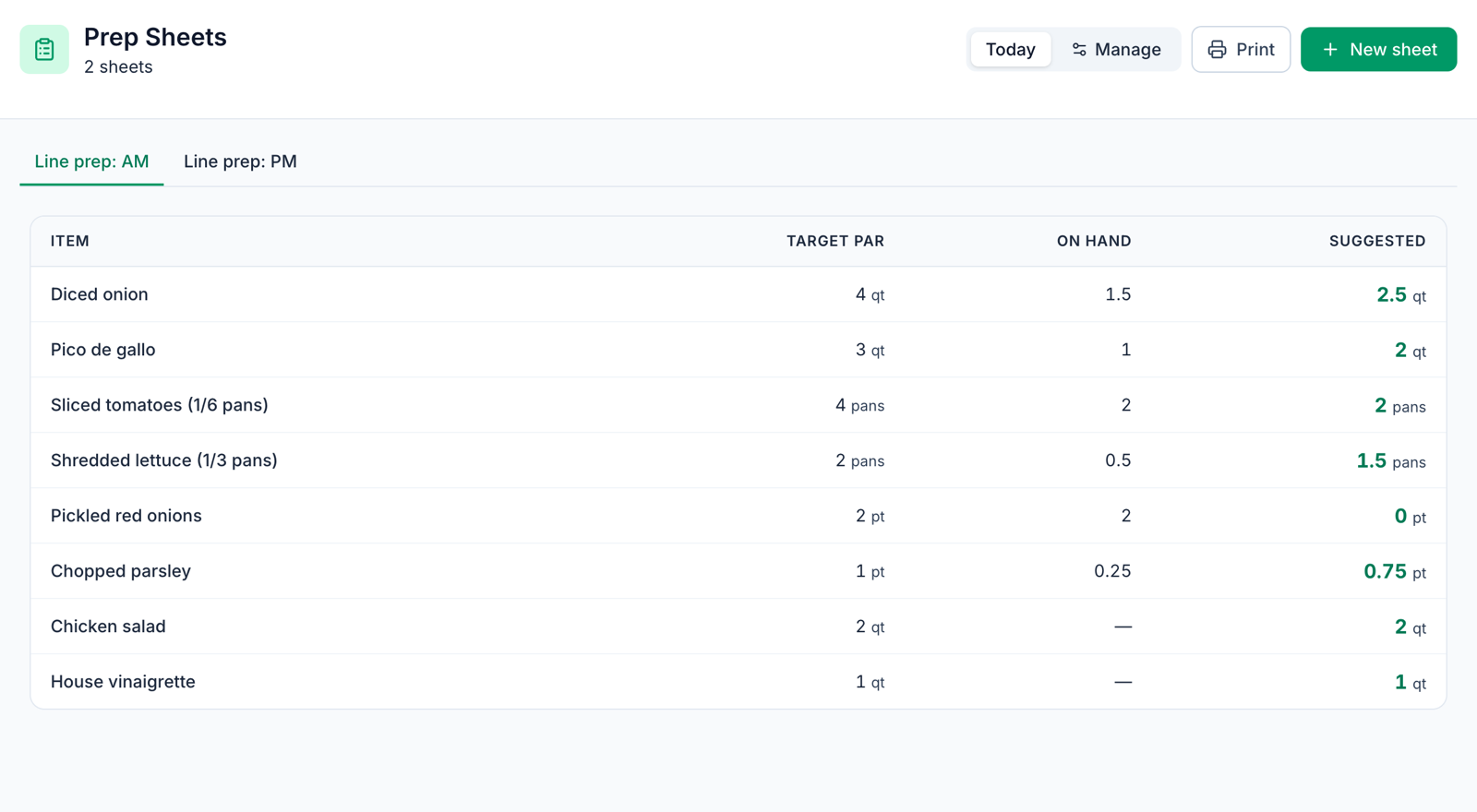
- Prep sheets. Under Inventory → Prep, build a sheet such as Line prep: AM with a target for each line. On Today, Mays compares each item line's target with what's on hand at the location and suggests how much to make: the target minus what's on hand, never below zero. The image at the top of this post shows one. A line for a recipe, like chicken salad, has no stock to compare, so it always suggests the full target. Print gives the cook a paper copy with the sheet's name and the date.
- The suggestions are only as good as the last count. On hand comes from your stock counts, deliveries, waste and sales, so count before you prep.
- A Prep cook position. With Labor law compliance on, tick tasks such as a meat or deli slicer or power-driven food processors and mixers on the position, with a Minimum age, and at a location with minors' rules on, Mays warns you when someone too young is scheduled on it.
- The opening prep checklist. Put the label check ("every container labeled and dated, nothing past its date") on the morning checklist under Tasks → Templates, with a Photo task for the walk-in shelf.
What Mays doesn't do yet: it doesn't print food labels or keep discard dates, prepping from a sheet doesn't change stock, and there's nothing on a sheet to tick off in Mays. Prep sheets are on the web only. Keep the labels and the done column on paper for now.
Your prep cook hiring checklist
- A job description that says prep list, labels and dates
- A working interview with real knife work
- Knife training on day one, and nobody under 18 on the slicer
- Every container labeled, every ready-to-eat item date-marked, 7 days with day 1 as the day it's made
- Storage order, cooling and thawing taught with the numbers
- A prep list written from pars, with initials and label dates
Prep to par with Mays
Set your prep pars once, and let Mays tell the morning cook how much of each item to make.
Start your free trial: 30 days, every module, no card needed. Missed the start of the series? Begin with hiring a barista.