Hot-holding and cooling: the two food safety steps new cafés get wrong
Soup is a great addition to a café menu, and something your inspector will check with a probe. The soup well is set to "high" and reads 128°F by lunch. Or last night's pot of chili went into the walk-in with the lid on, and at 6 am the middle is still warm.
Hot holding and cooling are two steps where the food looks fine and isn't. This guide covers the rules for both, common mistakes in small cafés, how to cool a big batch, and the logs that show your inspector it's under control. For the temperature basics and cooler logs, start with our guide to food temperature logs.
This is general information, not legal advice. Your inspector and your local rules have the final word. Florida enforces the 2017 edition of the FDA Food Code: the current Florida rule, effective March 17, 2026, still adopts that edition (Rule 61C-1.001, F.A.C.), so the section numbers here are from the 2017 FDA Food Code. Updated September 24, 2026: the FDA, DBPR and Florida rule pages cited below were re-checked.
Why inspectors care about these two
In Florida, restaurants are inspected by the Department of Business and Professional Regulation (DBPR). Its list of high priority violations, the ones that "could contribute directly to a foodborne illness or injury," includes "Receiving and holding PH/TCS foods hot" (03b), "Cooling PH/TCS foods; proper cooling methods" (03d) and "Reheating PH/TCS foods for hot holding" (03e) (DBPR: inspections).
The Food Code also puts both on the person in charge, who must make sure employees keep hot food hot and cool food properly "through daily oversight of the employees' routine monitoring" of food temperatures (§2-103.11(H) and (I)).
Hot holding: the rules
These apply to time/temperature control for safety (TCS) food, such as soup, cooked rice, beans, eggs and meat.
Rule | 2017 Food Code |
|---|---|
Hold hot food at 135°F or above (certain roasts may be held at 130°F) | §3-501.16(A)(1) |
Food cooked, cooled and then reheated for hot holding reaches 165°F for 15 seconds in all parts | §3-403.11(A) |
In a microwave: 165°F in all parts, then rotate or stir, cover, and let stand covered for 2 minutes | §3-403.11(B) |
Commercially processed, packaged ready-to-eat food, like canned soup, is heated to at least 135°F | §3-403.11(C) |
Reheating is done rapidly: no more than 2 hours between 41°F and the target temperature | §3-403.11(D) |
Enough hot-holding and cooling equipment to keep food at these temperatures | §4-301.11 |
A food thermometer provided and within reach, calibrated to the manufacturer's specifications | §4-302.12(A), §4-502.11(B) |
Five hot-holding mistakes, and the fixes
- Reheating in the soup well. A well is built to keep hot food hot. Cold soup brought up slowly in it can miss the 2-hour reheating limit. Reheat on the stove or in the oven to 165°F, then move it to the well.
- Trusting the dial. The setting on the unit isn't the food's temperature. Probe the food itself, in the middle, after stirring.
- Checking once a day. A reading at close only tells you what went wrong. Check at set times, so a drop is caught while you can still act.
- Lids off and water low. A covered insert in a well with the right water level holds heat better than an open one. Stir when you check.
- No written plan for a low reading. A new hire at 11 am needs to know exactly what to do when the soup reads 128°F. Write your corrective actions with your certified food manager, or ask your inspector, and put them where the checks happen.
Time instead of temperature. For food you'd rather serve out of temperature control, like a pastry case of egg sandwiches, the Food Code allows up to 4 hours without temperature control, if the food starts at 135°F or above (or 41°F or below), you have written procedures, the food is marked with the time 4 hours later, and it's served or discarded by then (§3-501.19(A)–(B)). Florida offers DBPR form HR 5022-090 as a guide for those written procedures, but "the division will accept written procedures in another format" (Rule 61C-4.010(1)(a)1., F.A.C.).
Cooling: the two-stage rule
Cooling is where good food goes bad slowly, overnight, in the dark. The rule has two checkpoints:
Stage | Rule | 2017 Food Code |
|---|---|---|
1 | From 135°F to 70°F within 2 hours | §3-501.14(A)(1) |
2 | From 135°F to 41°F or below within 6 hours in total | §3-501.14(A)(2) |
Room-temperature ingredients (like reconstituted foods or canned tuna) | To 41°F or below within 4 hours | §3-501.14(B) |
The first stage is where a deep pot gets stuck. A big, lidded stockpot in a walk-in cools from the outside in, and the middle can stay warm for hours.
Cooling methods that work
The Food Code lists the methods, and you use one or more depending on the food (§3-501.15(A)):
- Shallow pans instead of a deep pot
- Smaller or thinner portions
- Rapid cooling equipment, such as a blast chiller
- An ice-water bath, stirring the food in its container
- Containers that transfer heat well
- Ice as an ingredient, in a recipe that allows it
In the cooler, arrange the containers so air can move around them, and leave them loosely covered, or uncovered if they're protected from anything falling in (§3-501.15(B)). Stacking hot pans tight together, lids on, is the classic mistake.
Check your equipment too. A reach-in built to hold cold food isn't built to pull down a hot 3-gallon batch, and loading one with hot pans can warm everything else inside (§4-301.11 asks for enough capacity for both).
A worked cooling log (made-up numbers)
Time | Reading | Check |
|---|---|---|
2:10 pm | 158°F: soup off the stove, split into shallow pans in an ice-water bath, stirred | Cooling starts |
4:10 pm | 64°F | Stage 1: 70°F or below by 4:10 pm. Passed |
8:10 pm | 39°F | Stage 2: 41°F or below by 8:10 pm. Passed |
Counting from the moment you start cooling, even though the soup was still above 135°F, is stricter than the rule and easier to log. If a checkpoint is missed, follow the corrective action you wrote down in advance. Discarding the batch is always a safe answer.
Logs that show it's under control
The Food Code sets the temperatures and the monitoring duty, but not a log form. A log is the simplest way to show the monitoring happens. Keep two:
- A hot-holding log: the time, the item, the reading, who checked, and what was done if it was low.
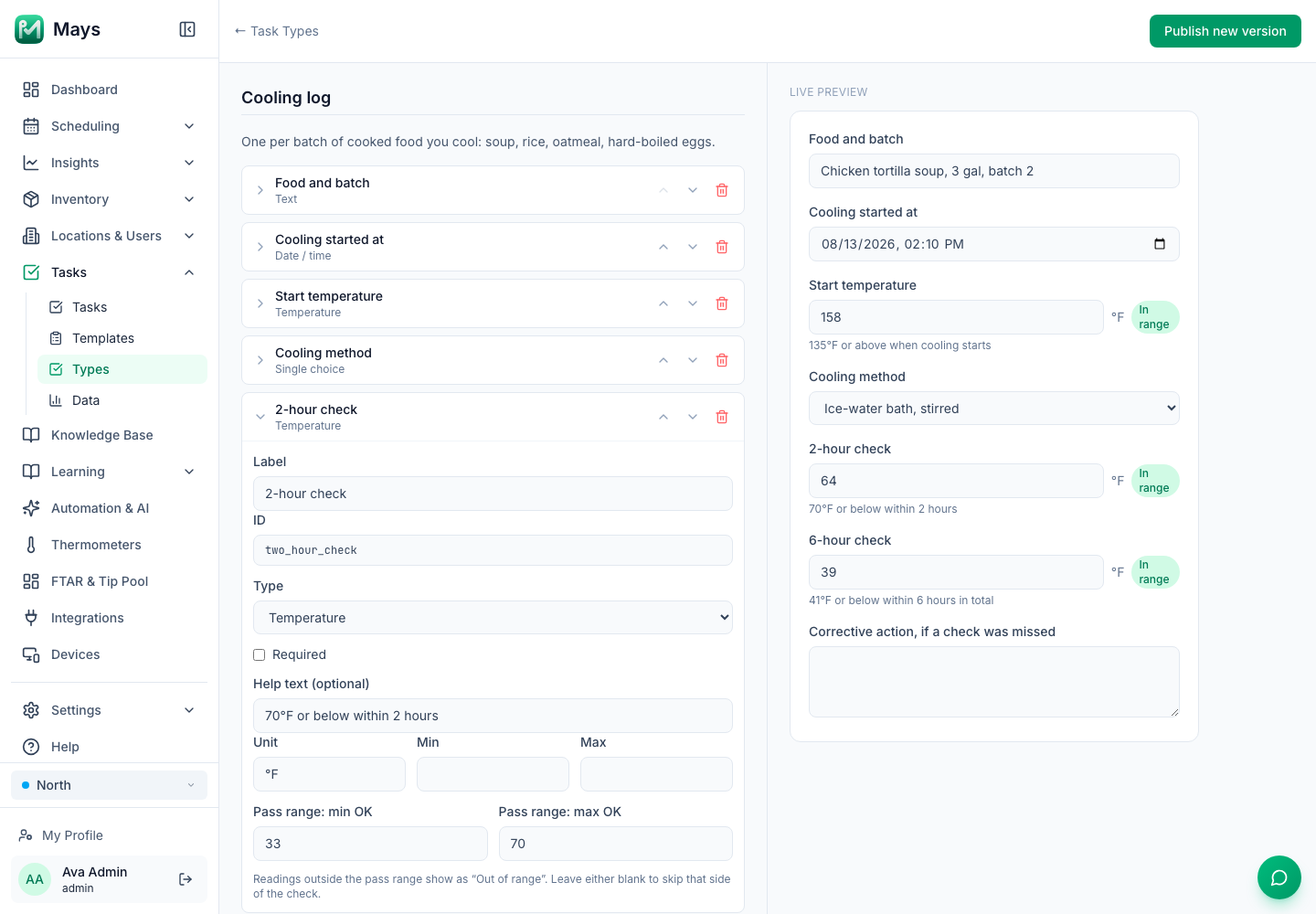
- A cooling log, one per batch: the food and batch, when cooling started and at what temperature, the method, the 2-hour and 6-hour readings, who checked, and the corrective action if a check was missed.
And check your probe thermometer on a schedule, the way its manufacturer recommends: the Food Code asks for calibration "in accordance with manufacturer's specifications" (§4-502.11(B)).
Where Mays fits
- A cooling log on the phone. An admin builds a custom form under Tasks → Types, like the Cooling log at the top of this post: a text field for the batch, a Date / time for the start, Temperature fields for each reading, and a choice of cooling method. Each temperature can have a pass range, so a reading outside it shows Out of range as it's entered. Staff fill it in the app, and every submission lands in Tasks → Data with who submitted it and when, with Export CSV. Custom forms are part of every plan.
- Hot-holding checks on the checklist. Add a task with a Number answer, like "Soup well at 11 am," to the opening or midday checklist, with a Visibility Window so it appears when it's due. A Number answer doesn't flag a low reading, so use a custom form Temperature field where you want the pass range.
- Sensors for the coolers. Mays works with Govee smart thermometers (bought separately). It records a reading from each sensor every five minutes. When a unit stays outside its safe range longer than its alert delay (15 minutes unless you change it), Mays creates a task for whoever is on shift and sends them a push notification, at most once an hour per thermometer.
- The inspection export. The Health-department log export on each thermometer creates a PDF or CSV for a date range, with one row per hour, every four hours or every reading, and the location's license number in the header. The header currently cites FDACS (Rule 5K-4), the agriculture department's rule, which isn't the one DBPR-licensed cafés are inspected under.
Sensors read the air in coolers and freezers, not the food, so hot holding and cooling still need a probe and a person. The thermometer export covers sensor readings only, so keep your cooling and hot-holding logs in Task Data. Thermometers are part of the Pro plan.
Your hot-holding and cooling checklist
- Hot food held at 135°F or above, probed in the food, at set times
- Reheating on the stove or in the oven to 165°F before it goes in the well
- Written corrective actions for a low hot-holding reading and a missed cooling checkpoint
- Shallow pans, ice baths and smaller batches for anything you cool
- Two cooling checkpoints logged for every batch: 70°F by 2 hours, 41°F by 6
- Loosely covered pans with space around them in the cooler
- Written procedures if you use time instead of temperature
- A calibrated probe thermometer where staff can reach it
Put your cooling log on the phone
Build the cooling log once, add the hot-holding checks to your checklist, and let sensors watch the coolers.
Start your free trial: 30 days, every module, no card needed. Or book a walkthrough and we'll set up your first checklist and thermometers with you.