Hiring a line cook: job description, a working interview plan and a station checklist
A line cook is the hire you can't judge in a chair. Two people can describe a Friday rush the same way, and only one of them can run a grill through it. That's why kitchens hire with a working interview, a stage, and why the best ones train new cooks station by station instead of "follow Sam for a week."
This is the second post in our Hiring and training by role series. It covers the line cook job description, pay data, a stage plan with a scoring sheet, and a station training checklist. For the general hiring process and the new-hire paperwork, see Hiring your first restaurant team.
This is general information, not legal advice. Updated October 5, 2026: every source below was checked on that date.
What the job is
A line cook owns a station during service: the grill, the fryer, the sauté pans or the flat-top. On a typical shift they:
- set up the station before service: equipment on, the lowboy stocked, the tools ready;
- cook to your recipes, portions and plating, at ticket speed;
- check cooking and holding temperatures with a probe thermometer;
- keep raw and ready-to-eat food apart on the station;
- communicate with the expo or the lead ("two burgers, all day");
- break down and clean the station at close, and leave it ready for the morning.
What restaurant cooks earn
The BLS occupation is cooks, restaurant (SOC 35-2014). O*NET's sample titles for it include "Line Cook", "Grill Cook" and "Fry Cook" (O*NET 35-2014.00).
Cooks, restaurant: restaurants and other eating places, May 2025 | Hourly |
|---|---|
25th percentile | $15.89 |
Median | $17.85 |
75th percentile | $21.21 |
Source: BLS Occupational Employment and Wage Statistics, May 2025 national industry estimates for NAICS 7225 (median series OEUN000000072250035201408; 25th and 75th percentiles: the series ending in 07 and 09). Across all industries the median was $17.98 an hour. A national median is a reference point; your state's minimum wage is the floor and the kitchens near you set the market.
A line cook job description you can adapt
Line Cook, [full-time / part-time], [pay range] an hour
[Your restaurant], [neighborhood]

What you'll do
- Run a station (grill, fry or sauté) during breakfast and lunch service
- Set up your station before service and break it down at close
- Cook to our recipes, portions and plating, at ticket speed
- Check cooking and holding temperatures and record them on our checklists
- Keep the line clean, organized and stocked during service
- Help with prep when service is slow

What you need
- Available [days and times, including weekends]
- [Six months / one year] on a line, or the drive to learn fast
- Able to stand for a full shift, work near hot equipment and lift 40 lb
- A food handler card within [your state's deadline], or willing to get one (we pay for it)

What we offer
- [Pay range] an hour, paid weekly / every two weeks
- A paid working interview before you decide
- Station-by-station training with a named trainer

To apply, send a short note about your kitchen experience to [email].
The food handler line depends on your state. Some states require a card within a set number of days of hire, and some leave it to the county or don't require one at all; check with your health department.
The working interview: a two-hour paid stage
A stage is work. If the candidate cooks, preps or cleans, it's paid time, for the reasons in the hiring guide. Put it on the schedule, keep it short, and pay at least minimum wage.
Before: tell them what to bring (non-slip shoes, their knives if they want), when to arrive and how long it is. Have their paperwork ready, since a paid stage makes them your employee for those two hours.
The two hours:
Time | What they do | What you watch |
|---|---|---|
0:00–0:15 | Tour, handwashing, set up a station from a list | Do they wash hands without being told? Do they read the list? |
0:15–0:45 | Knife work: dice an onion, slice tomatoes, portion a protein | Safe grip, consistent cuts, a clean board |
0:45–1:30 | Cook three menu items from your recipe cards, twice each | Following the card, temperatures checked, plates matching each other |
1:30–1:45 | A short "rush": six tickets at once | Do they organize, call back, keep raw and cooked apart? |
1:45–2:00 | Clean the station and talk | Do they clean as if the next shift depended on it? |
Score it the same way every time, 1 to 3 on each line, right after:
- Followed the recipe cards
- Checked temperatures without being reminded
- Kept raw and ready-to-eat food apart
- Stayed organized when tickets stacked
- Cleaned as they went
- Took feedback and changed something
Keep the paid stage for the final one or two candidates, after a short interview. The interview questions in the barista post, including the ones to leave out, apply to cooks too.
Teens on the line
Federal rules limit what 14- and 15-year-olds may cook: "Cooking with electric or gas grills which does not involve cooking over an open flame", and "deep fryers that are equipped with and utilize a device which automatically lowers the baskets into the hot oil or grease and automatically raises the baskets" (29 CFR 570.34(c)). Broilers, rotisseries and pressure fryers are excluded. Nobody under 18 may operate or clean power-driven meat slicers, grinders or patty formers (29 CFR 570.61). Your state may add more.
The station training checklist
Train one station at a time. A new cook should be signed off on one station before they start the next.
Every station
- Handwashing: when, where, and not at the prep sink
- The probe thermometer: where it is, cleaned between uses, checked in ice water
- Raw animal food stored below and away from ready-to-eat food
- Sanitizer bucket and wiping cloths: how to mix, test and change them
- Burns: hot pans handled with dry towels, oil never near water, a clear path behind the line
- What to do when a temperature is off: tell the lead, don't serve it
The temperatures every cook should know
The FDA Food Code is the model most state and local health codes are based on, and each state decides which edition it enforces. In the 2022 edition:
Food | Cook to | Section |
|---|---|---|
Poultry, stuffed meats or pasta | 165°F, instantaneous | §3-401.11(A)(3) |
Ground and other non-intact meat, ground fish, raw eggs not cooked to order | 155°F for 17 seconds | §3-401.11(A)(2) |
Fish and intact meat, raw eggs cooked to order for immediate service | 145°F for 15 seconds | §3-401.11(A)(1) |
Hold hot food at 135°F or above and cold food at 41°F or below (§3-501.16(A)). The Food Code also makes the person in charge responsible for checking that "EMPLOYEES are properly trained in FOOD safety, including FOOD allergy awareness, as it relates to their assigned duties" (§2-103.11(O)), so this list is part of the job, not a nice extra.
Grill
- Set up from the grill's opening checklist, lowboy at 41°F or below
- Burgers and chicken cooked to the card and probed in the thickest part
- Separate tongs or spatulas for raw and cooked
- Scrape and oil the grill between rushes
Fryer
- Oil level and quality checked at opening
- Baskets dry before they go in; nothing frozen dropped in with ice on it
- Know where the Class K extinguisher is, and never put water on a grease fire
- Filtering and changing oil only after training, with the oil cooled as your procedure says
Sauté and flat-top
- Mise en place labeled and dated in the lowboy
- Pans and ladles organized, a dry towel at hand
- Sauces held hot at 135°F or above, or cooled and stored
Close
- Leftovers cooled, covered, labeled and dated
- Station broken down, cleaned and restocked for the morning
- Floor mats out, floor dry
Sign off each station, date it, and keep it with the cook's training record.
Where Mays fits
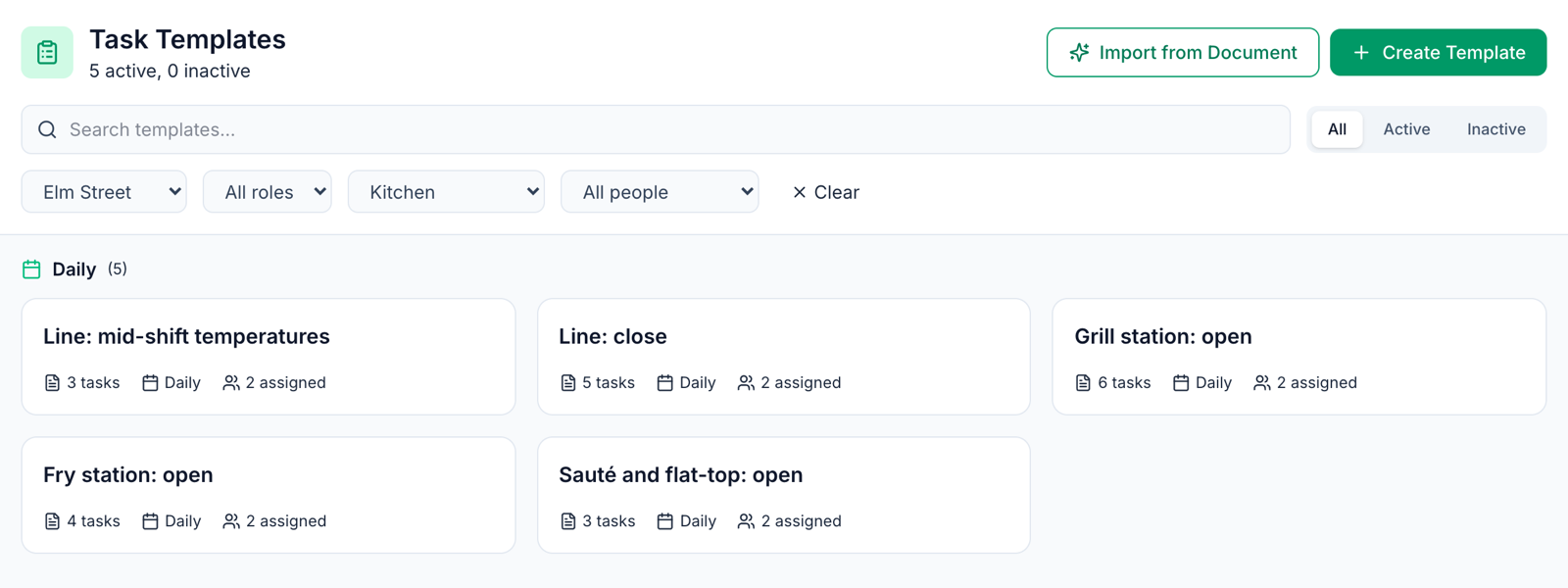
- One checklist per station. Build a template for each station under Tasks → Templates and assign it to the Kitchen department. The image at the top of this post shows a line's five daily templates: three station openings, a mid-shift temperature check and the close. A Visibility Window keeps the opening checklist on the line's phones only in the morning.
- Temperatures as numbers, photos as proof. A task can ask for a Number, such as the lowboy temperature, or a Photo, such as the finished station. You can set a minimum and maximum on a Number task, but Mays doesn't check answers against them yet, so put the safe range in the task's name. For readings that should flag themselves, build a Temperature log form under Tasks → Types: its temperature fields have a pass range and show In range or Out of range.
- A Line cook position. Create it under Scheduling → Positions with a default wage. With Labor law compliance on, tick the tasks it involves, such as cooking on equipment other than a grill or an automatic fryer, and a Minimum age, and Mays warns you when a younger cook is scheduled on it at a location with minors' rules on.
- Food handler cards. With Labor law compliance on, record each cook's card on the Certificates tab of their team member page. Where Mays knows the state's rule, the location shows who is missing a card or due, and Mays reminds people before a card expires.
Mays doesn't schedule or score working interviews. Put the stage on the schedule like any other shift once the candidate is set up as a team member, and keep the scoring sheet in your own files.
Your line cook hiring checklist
- A job description with the stations, the hours and the pay range
- A short interview first, then a two-hour paid stage for the finalists
- The same scoring sheet for every stage
- Teen cooks checked against the cooking and equipment rules
- A food handler card on the calendar for your state's deadline
- One station at a time, signed off and dated
Run your line with Mays
Give every station its own checklist, record the temperatures, and see who's signed off where.
Start your free trial: 30 days, every module, no card needed. Next in the series: hiring a dishwasher or porter.