Handling customer complaints in person and online
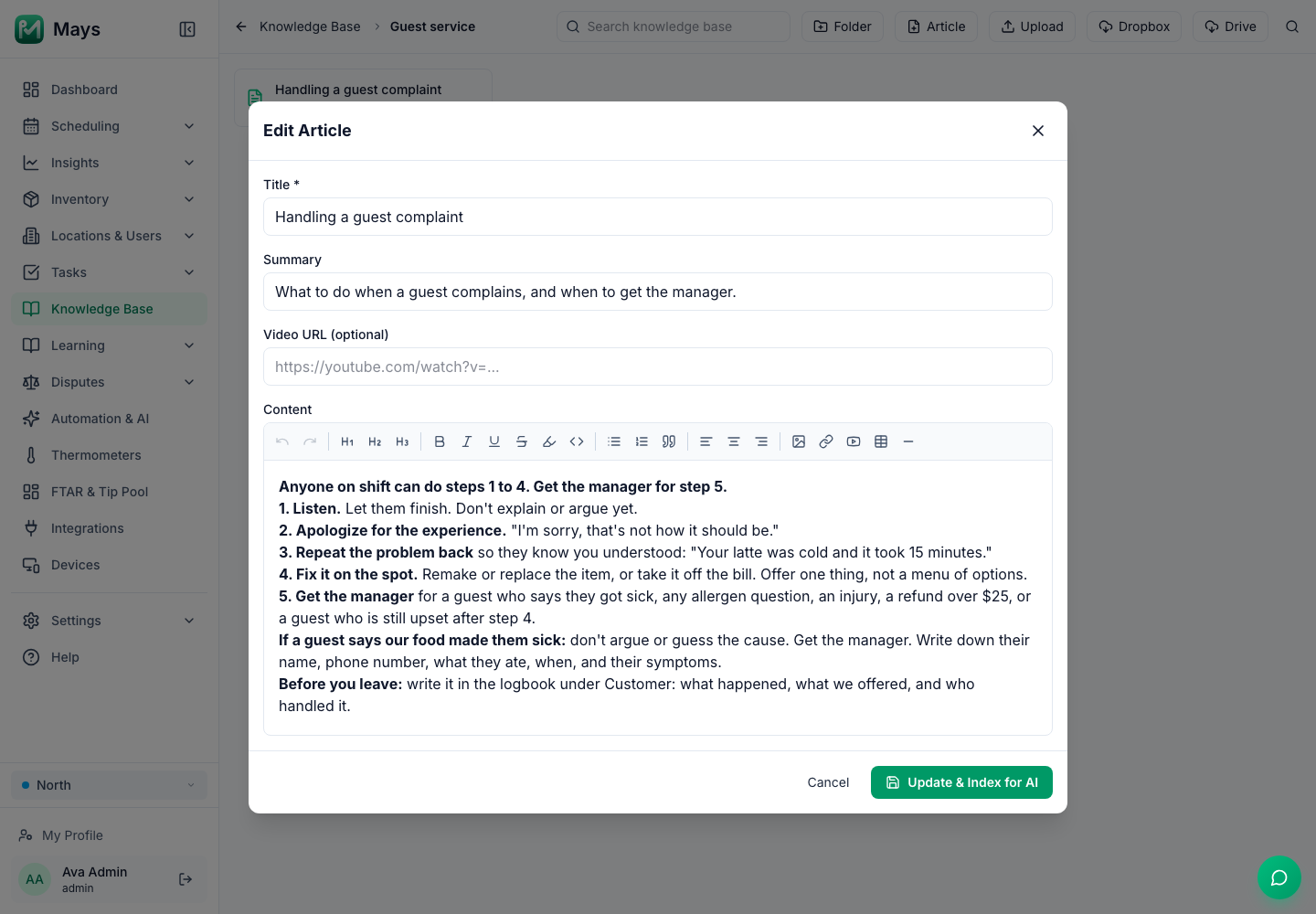
A complaint is a guest telling you what went wrong while there's still time to fix it. Guests who don't complain often just don't come back, or tell everyone except you.
Many complaints in a small café are simple: a cold latte, a wrong order, a long wait. They're handled well when everyone on shift knows the same few steps and what they're allowed to offer. A few are serious, like a guest who says your food made them sick, and those need a different response. This guide covers both, plus how to log complaints so they turn into fixes, and how to answer them online.
This is general information, not legal advice. Updated September 24, 2026: the DBPR, FDA Food Code, Florida Statutes and Google pages cited here were re-checked.
Five steps anyone on shift can follow
Teach these on the first day (our one-week training plan has a slot for it), and keep them where staff can find them:
Step | What to do | What to say | What not to say |
|---|---|---|---|
1. Listen | Let them finish. Stop what you're doing. | Nothing yet | "Well, actually…" |
2. Apologize for the experience | You're sorry it happened, even if you don't know whose fault it was. | "I'm sorry, that's not how it should be." | "Nobody else has complained." |
3. Repeat the problem back | Show you understood. | "So your latte was cold, and it took 15 minutes." | "That's just how we make it." |
4. Fix it on the spot | Offer one clear fix. | "Let me make you a fresh one right now." | "I'll see what I can do." |
5. Get the manager | For anything outside your limits (below). | "I'm getting my manager so we can sort this out." | "There's nothing I can do." |
Offer one fix, not a list of options. A guest who's already annoyed doesn't want to negotiate; they want the problem gone.
What staff can offer without a manager
Decide this in advance and write it down, so a new barista doesn't have to guess at 8 am:
Problem | Anyone on shift can | Get the manager for |
|---|---|---|
Wrong or badly made item | Remake it right away | A second remake for the same guest |
Long wait | Apologize, and remake or take the item off the bill | A pattern: the same wait every morning is a staffing problem |
Missing item in a to-go order | Replace it or refund that item | An order the guest can't come back for |
Something in the food (hair, plastic) | Remove the plate, remake it, take it off the bill, keep the object | Anything that could have caused an injury |
Overcharged | Correct the charge | Refunds above your set limit |
The guest says they got sick, has an allergic reaction, or is hurt | Get the manager immediately | Always the manager |
Set a dollar limit per role, for example a shift lead can refund up to $25 without asking. Then back up the people who use it.
When a guest won't calm down
- Move the conversation away from the line, and lower your voice rather than raising it.
- Don't argue about the facts in front of other guests. You can look at the camera or the ticket later.
- Repeat the fix, and get the manager if the guest is still upset.
- Put safety first. If a guest threatens someone or becomes violent, call 911.
In Florida, a restaurant can refuse service to "any person who is objectionable or undesirable to the operator," but "such refusal may not be based upon race, creed, color, sex, pregnancy, physical disability, or national origin" (s. 509.092, F.S.). Base it on behavior, and write down what happened.
When a guest says your food made them sick
This is the complaint that matters most, and the one where a defensive answer does the most damage.
- Take it seriously and stay calm. Don't argue, don't guess the cause, and don't promise anything about what caused it.
- Get the manager or owner to handle it personally.
- Write down the details: the guest's name and phone number, what they ate, the date and time, their symptoms and when they started, and whether others in their party got sick.
- Check your own records for that day: temperature logs, deliveries, and whether any employee reported symptoms. Under the 2017 FDA Food Code, which Florida's Division of Hotels and Restaurants enforces (DBPR), food employees must report symptoms such as vomiting, diarrhea and jaundice to the person in charge (§2-201.11). Our temperature log guide covers the logs.
- Keep anything left of the product, and note the batch or delivery.
- Follow up when you said you would.
Guests can report it. In Florida, DBPR's Division of Hotels and Restaurants takes foodborne illness complaints about restaurants, with a foodborne illness complaint form (DBPR HR 7004), and lists what it can and can't enforce (DBPR: complaints). Additional inspections "may be conducted in response to a complaint" (DBPR inspections). Don't try to talk anyone out of reporting; keep your records ready instead. Our health inspection guide covers what happens in an inspection.
What DBPR's page says it can and can't enforce for food service includes:
DBPR can enforce | DBPR can't enforce |
|---|---|
Foodborne illness complaints | Customer service |
Restaurant cleanliness, pests, food storage and handling | Menu items or prices |
Handwashing and glove use | Meat not cooked to the guest's preferred doneness |
Misrepresentation of a food product | Credit card charges or refunds |
So a complaint about a rude cashier is yours to fix. A complaint about food safety may also become the state's business.
Log every complaint
A complaint that isn't written down gets fixed once, by whoever was on shift, and then happens again. Log each one the same way:
Field | Example |
|---|---|
Date and time | Tuesday, 8:40 am |
What happened | Latte served cold, 15-minute wait during the rush |
Who handled it | Dee, shift lead |
What we offered | Remade the latte, took it off the bill |
Follow-up needed | Check the steam wand; look at morning staffing |
Then read the log in your weekly manager meeting. One cold latte is a mistake. Five in a week are a broken steam wand or a short-staffed morning.
Complaints online
A review is a complaint made in public, and your reply is read by everyone who reads the review. The basics:
- Reply within a day to a 1- or 2-star review, and keep it short.
- Thank them, own what went wrong, and say what you changed, without arguing about details.
- Take it offline: give a name and a way to reach you.
- Don't offer anything to change or remove a review. Google's policy doesn't allow businesses to offer "incentives – such as payment, discounts, free goods and/or services - in exchange for posting any review or revision or removal of a negative review" (Google Maps content policy). Fix the problem because it's a problem.
- If a review describes an illness, reply with concern, ask them to contact you directly, and follow the steps above.
Our guide to replying to your first 50 Google reviews has reply templates for 5-, 3- and 1-star reviews, plus what the FTC's review rule prohibits.
Where Mays fits
- Your complaint steps, in one place: write them as a Knowledge Base article (the image at the top of this post) and put it in a folder your team can see. Staff can read it in the app.
- The logbook (Scheduling → Logbook): managers write each complaint under Customer (or Health & Safety for an illness report), tick Needs follow-up, and find every flagged entry on the Follow-ups tab. The location's other managers get a notification for each new entry, and managers can write entries from the phone app too. Entries are text only, so keep photos of a foreign object or a receipt somewhere else, and reply to the entry when the follow-up is done.
- Follow-ups as tasks: Tasks → Create Task → Custom Task, assigned to one person, who gets a push notification. Choose Photo as the response type if you want proof, such as a photo of the cleaned steam wand. On the web, a task is due the same day; in the phone apps you can pick a due date.
- Google reviews: once your Google Business Profile is linked to your locations, the Reviews page lists reviews for every store, with filters for ≤ 3 stars and Unanswered, and your replies post to Google. You write each reply yourself. Linking each location to its Google listing is done with our team today, so book a walkthrough and we'll connect it with you.
- Refunds: with Square connected, a refund creates a "Refund issued — explain why" task at that location, so every refund gets a reason. While one of those tasks is still open at a location, later refunds don't create another, so close it the same day.
Mays doesn't collect complaints from guests directly (there's no feedback form or complaint line), so what your team hears at the counter is what gets logged.
Your complaint checklist
- Five steps every staff member knows, in writing and in training
- A list of what each role can offer, with a dollar limit
- A plan for guests who won't calm down, and a line you don't cross
- Illness complaints handled by a manager, with the details written down
- Records ready: temperature logs, deliveries, employee illness reports
- Every complaint logged the same way, and reviewed weekly
- Reviews answered within a day, without incentives
Handle complaints with Mays
Put the steps in your knowledge base, log every complaint, and turn the fixes into tasks.
Start your free trial: 30 days, every module, no card needed. Want your Google reviews in Mays too? Book a walkthrough and we'll connect your Google Business Profile with you.