Consistency in coffee and food: recipe specs, dial-in routines and spot checks
A regular orders the same drink three days in a row. On Monday it's great. On Tuesday it's sour. On Wednesday it's milky and lukewarm. Nothing was "wrong" enough to send back, but by Thursday they're trying the place down the street.
Consistency is what turns a good first visit into a habit. It's also money: a shot pulled at 22 grams instead of 18, or a sandwich with an extra slice of cheese, costs you on every single sale. And it's the part of the guest experience that depends least on talent and most on routine.
This is the fourth post in our series on the guest experience at a new café. The order accuracy post covered drinks that come out wrong. This one covers drinks and plates that come out right, but differently every time.
Write a spec for every item
A spec (or build card) is the recipe the way the station uses it: amounts, order, tools, temperatures and how it should look. If two people would make it differently, it needs a spec.
For a drink:
Line | Example: 12 oz latte |
|---|---|
Espresso | Double shot to your dial-in recipe (dose, yield and time) |
Milk | Whole milk, steamed to your target temperature range, about 1 cm of foam |
Cup | 12 oz cup, lid pressed down, sleeve |
Build | Shot in the cup first, then milk, then latte art if you offer it |
Looks like | Photo of the finished drink |
For food:
Line | Example: turkey sandwich |
|---|---|
Bread | 2 slices, toasted to a set time |
Fillings | Each by weight or count: turkey by weight, two tomato slices, a measured scoop of spread |
Assembly | Order of layers, cut, plate or wrap |
Hold | How long it can sit before it's thrown out |
Looks like | Photo of the finished plate |
Write the numbers you want, not ranges you'll argue about later. Keep each spec to one card, and put a copy at the station where it's made.
The spec also drives your costs. The amounts on the card are what your plate cost should be built from; our post on plate costing and menu pricing shows how.
Measure, don't eyeball
Most consistency problems come from guessing. Give each station the tool that takes the guessing out:
- A scale at the grinder and one at the cup, so dose and yield are weighed, not judged by color.
- A shot timer, or the machine's own timer, used every time.
- A thermometer in the milk pitcher, or pitchers marked with fill lines for each size.
- Pumps with a set amount for syrups, and the number of pumps on the spec.
- Portion scoops and a scale on the line for food, and a ruler or template for cuts.
- Timers on the oven and toaster, not the cook's sense of "about done".
A station without its tool will drift, however good the person is.
Dial in at open and after every change
Espresso changes during the day. The coffee ages, the room warms up, a new bag gets opened. Dialing in means pulling a test shot, measuring it against your recipe and adjusting the grind until it matches.
Make it a routine, not a judgment call:
- At open, before the first guest, pull shots until dose, yield and time all match the spec, and taste the last one.
- After any change: a new bag, a grinder adjustment, a cleaning, or a noticeable change in temperature or humidity.
- When a shot runs outside the range during service, stop and dial in again before the next drink.
- Write it down: time, dose, yield, shot time, grind setting and "tastes right: yes or no".
A written dial-in log tells you whether the grinder is drifting or the burrs need attention. Our coffee bar opening and closing checklist has the dial-in step in the opening routine, and our equipment maintenance log covers burr changes and service visits.
Dial-in shots use coffee that no guest pays for. Count them as waste so they don't hide in your usage.
Batch items need specs too
Cold brew, syrups, dressings, baked goods and anything else made ahead should have a batch spec: amounts, method, time, yield and how long it keeps.
- Label every batch with what it is, when it was made and when it must be used or thrown out.
- Write the yield. If a batch should make 8 liters and it makes 6, something changed.
- Keep the hold time on the spec and stick to it. Our food waste log post covers tracking what gets thrown out.
Make the plate match the photo
Guests see your menu photos before they see your food. If the croissant on Instagram is golden and the one on the plate is pale, that's a consistency problem too.
Use the photo on the spec card as the standard for the station. Our post on menu photography with a phone ends with keeping the plate matching the photo.
Spot-check a few items every week
Specs drift slowly, and nobody notices until a guest does. A short weekly spot check catches it early.
Pick a few items each week, on different days and shifts, and check them against the spec:
Check | How | Example result |
|---|---|---|
Espresso | Weigh dose and yield, time the shot | Dose and time on spec, yield 4 g heavy |
Milk | Thermometer in a finished latte | In range |
Syrup | Count pumps in a flavored drink | Three pumps instead of two |
Sandwich | Weigh the filling | On spec |
Pastry | Compare with the spec photo | Bake slightly light |
Then coach the result the same day, privately and specifically: "Two pumps on the 12 oz, it's on the card." If the same check fails for everyone, the spec or the tool is the problem, not the people.
Train on the specs, then check they stuck
New hires learn the specs during training, but everyone forgets the less common items. Two habits help:
- Short quizzes on the specs, especially after a menu change. Our one-week training plan explains why short quizzes beat long tests.
- A sign-off per station. Someone isn't "trained on bar" until a shift lead has watched them make the full menu to spec.
When you change a recipe, change the card, the cost and the quiz on the same day. Our seasonal menu post has a checklist for rolling out menu changes.
Where Mays fits
- Recipes with costs: a recipe in Mays holds the ingredients, quantities and yields, and costs every line from your vendor prices. Keep the method (temperatures, times, build order, photo) in a Knowledge Base article, where staff can read it on the web or in the phone app.
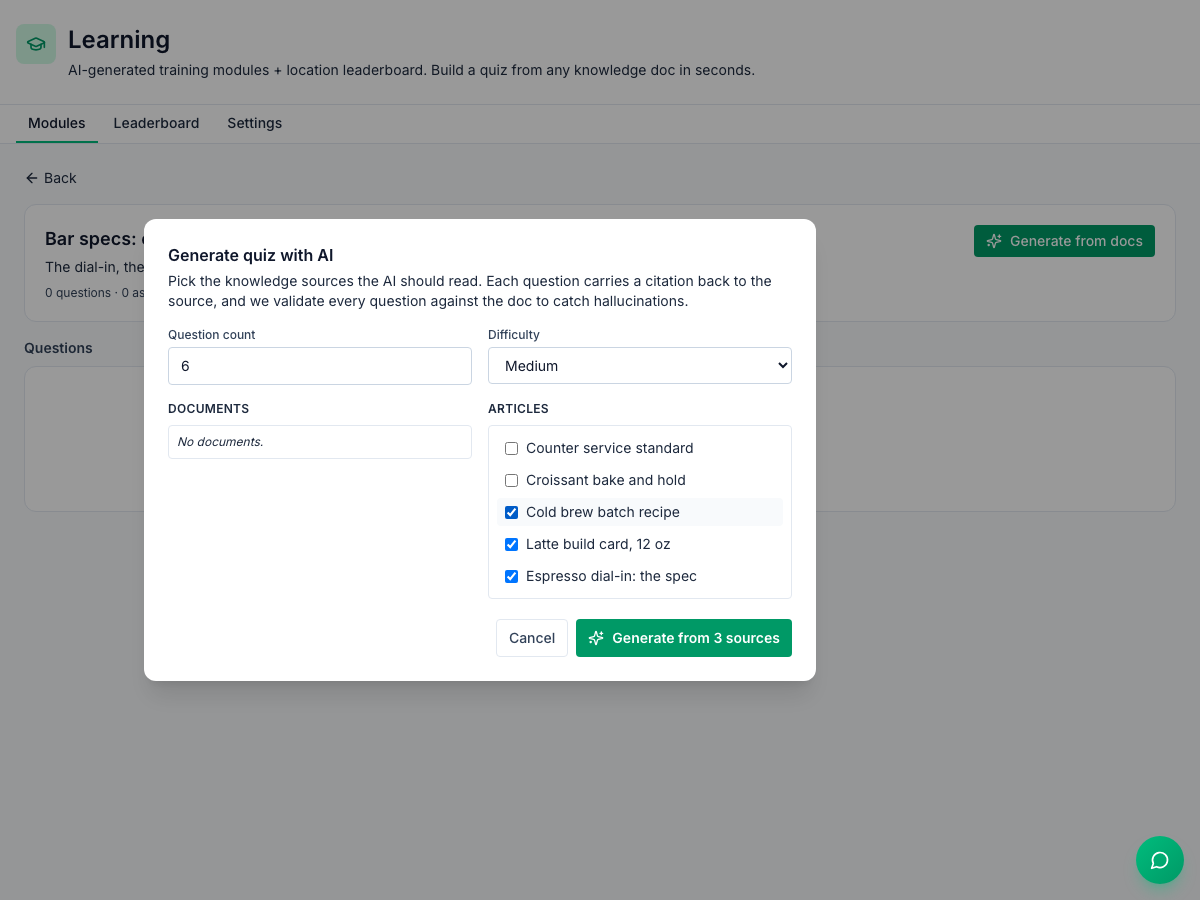
- Quizzes from your specs: in Learning, Generate from docs reads the Knowledge Base articles you pick and drafts a quiz with AI, with 1 to 15 questions at the difficulty you choose (the image at the top of this post). Each drafted question carries a quote from its source, and questions the source doesn't support are dropped. Review them before you publish.
- Dial-in at open, on the checklist: a checklist task can ask for a Number, with a minimum and maximum you set, or a Photo. Use a number for shot time and a photo for the finished drink.
- A dial-in log: with Task Types, build a custom form with dose, yield, time and grind setting. Staff fill it in from the phone app.
- Waste: log dial-in shots and expired batches in the Waste Log, so they don't vanish into usage.
Your consistency checklist
- A one-card spec for every drink, plate and batch, with a photo
- A scale, timer, thermometer or scoop at every station that needs one
- Dial-in at open and after every change, written down
- Batches labeled with time and use-by, and hold times kept
- A weekly spot check of a few items, coached the same day
- Card, cost and quiz updated together when a recipe changes
Make it the same every day with Mays
Keep the specs, the costs and the training in one place, and check the bar at open.
Start your free trial: 30 days, every module, no card needed. Next in this series: Wi-Fi, laptops and seating policies, with sign wording and what staff can say.