Equipment maintenance log and schedule: espresso machine, ice machine, hoods and refrigeration
Equipment in a small restaurant doesn't fail politely. The walk-in quits on the Friday before a holiday, the espresso machine loses pressure during the morning rush, the ice machine grows something pink in the bin. Most of those failures give warnings first: a coil caked with dust, a gasket that doesn't seal, a filter six months past its date. A maintenance log is how you catch the warning instead of the breakdown.
This template has three parts: an equipment register (what you own and who services it), a preventive maintenance schedule (what gets done how often), and a repair log (what broke and what it cost). Daily and weekly cleaning is on our cleaning schedule; this post is about keeping the machines working.
This is general information, not legal or technical advice. Your equipment manuals, your service technicians and your local codes have the final word, and the manufacturer's schedule wins over any interval below.
What the rules say
Section numbers are from the 2022 FDA Food Code. The FDA has since published a 2026 edition; the rules quoted here haven't changed in substance in it.
- Equipment in good repair. "EQUIPMENT shall be maintained in a state of repair and condition that meets the requirements" of the Food Code, and "EQUIPMENT components such as doors, seals, hinges, fasteners, and kick plates shall be kept intact, tight, and adjusted in accordance with manufacturer's specifications" (§4-501.11(A), (B)).
- Enough cold and hot capacity. Equipment for cooling, heating and holding food "shall be sufficient in number and capacity to provide FOOD temperatures" as the Food Code requires (§4-301.11). A cooler that can't hold 41°F on a hot afternoon is a capacity problem, not just a repair.
- Water filters and backflow preventers, with records. "A device such as a water treatment device or backflow preventer shall be scheduled for inspection and service, in accordance with manufacturer's instructions and as necessary to prevent device failure based on local water conditions, and records demonstrating inspection and service shall be maintained by the PERSON IN CHARGE" (§5-205.13). The filter on your espresso machine or ice machine counts.
- Ice machines, grinders and beverage lines. Cleaned "At a frequency specified by the manufacturer", or without instructions, often enough "to preclude accumulation of soil or mold" (§4-602.11(E)(4)).
- Dish machines. Cleaned before use, through the day as needed, and "If used, at least every 24 hours" (§4-501.14).
Two more agencies matter when you service equipment:
- OSHA lockout/tagout. OSHA's standard "covers the servicing and maintenance of machines and equipment in which the unexpected energization or start up of the machines or equipment, or release of stored energy could cause injury to employees" (29 CFR 1910.147(a)(1)(i)). It doesn't cover cord-and-plug equipment when unplugging it removes the hazard and "the plug being under the exclusive control of the employee performing the servicing or maintenance" (1910.147(a)(2)(iii)(A)). Unplug the slicer before you clean it, and keep the plug where you can see it; anything hard-wired or gas-fired is a job for a technician.
- EPA refrigerant rules. EPA regulations "require that technicians who maintain, service, repair, or dispose of equipment that could release ozone depleting refrigerants into the atmosphere must be certified" (EPA, Section 608 technician certification). Cleaning condenser coils is yours; anything that opens the refrigerant circuit is for a certified technician. Ask to see the card.
Part 1: the equipment register
One row per machine. Fill it in once, and update it when something is replaced.
Equipment | Make, model, serial | Where | Installed | Warranty ends | Service company and phone | Manual |
|---|---|---|---|---|---|---|
Espresso machine | (from the plate on the machine) | Bar | 2026-03 | 2027-03 | Espresso tech | Shared folder |
Ice machine | Back hall | 2026-03 | 2029-03 (compressor) | Refrigeration company | Shared folder | |
Walk-in cooler and freezer | Back | 2026-02 | 2027-02 | Refrigeration company | Shared folder | |
Reach-ins and lowboys | Line, bar | 2026-02 | 2027-02 | Refrigeration company | Shared folder | |
Hood, filters and fire suppression | Line | 2026-02 | Hood cleaning and fire suppression contractors | Shared folder | ||
Dish machine | Dish | 2026-02 | Leased | Chemical and dish machine supplier | Shared folder |
The dates are examples. Photograph each data plate and keep the photos with the manuals; the serial number is the first thing a technician asks for.
Part 2: the preventive maintenance schedule
Who is a role. The intervals are typical starting points, not rules; replace them with the ones in your manuals.
Equipment | Task | How often | Who |
|---|---|---|---|
Espresso machine | Backflush with cleaner; soak baskets and portafilters | Daily, at close | Barista |
Espresso machine | Group gaskets and shower screens checked, replaced when worn | Monthly check | Shift lead |
Espresso machine | Water filter changed (date written on the filter) | Per filter maker, based on water use | Shift lead |
Espresso machine | Preventive service: pressure, temperature, valves, descaling as needed | Per manufacturer or technician | Espresso tech |
Grinders | Burrs cleaned; burr wear checked | Weekly clean, burrs per manufacturer | Barista |
Ice machine | Bin and ice-contact parts cleaned and sanitized | Per manufacturer | Shift lead or technician |
Ice machine | Water filter changed; air filter and condenser cleaned | Per manufacturer | Shift lead |
Hood | Grease filters cleaned | Weekly, or more with heavy frying | Closing cook |
Hood | Hood and ducts professionally cleaned; fire suppression inspected | On your fire marshal's and contractor's schedule | Owner |
Refrigeration | Condenser coils brushed or vacuumed (unplugged) | Quarterly, monthly near a fryer or flour | Owner or technician |
Refrigeration | Door gaskets checked with a dollar-bill test; hinges and closers | Monthly | Manager |
Refrigeration | Thermometer in each unit checked against a calibrated probe | Monthly | Manager |
Dish machine | Wash and rinse temperatures, or sanitizer level, logged | Daily | Dishwasher |
Dish machine | Service by the supplier: arms, curtains, chemical pumps | Per supplier | Supplier |
Backflow preventers | Tested and certified | Per your water utility or local code | Licensed tester |
The monthly self-inspection checks that this schedule is being followed, and the line check catches a unit running warm before service.
Part 3: the repair log
Date | Equipment | Problem | Who came | What was done | Cost | Warranty? | Down for |
|---|---|---|---|---|---|---|---|
Oct 2 | Line lowboy (grill) | Running at 45°F; coils matted with grease | Refrigeration company | Coils cleaned, fan motor replaced | $286 | No | 5 hours |
Oct 9 | Espresso machine | Group 2 dripping, slow shots | Espresso tech | Gasket and shower screen replaced; filter changed | $140 | No | 1 hour |
The entries are examples. Over a year, this log answers the question every owner eventually asks: repair it again, or replace it?
When something breaks
- Protect the food first. Move TCS food from a failing cooler to one that's holding 41°F or below, and write down the temperatures and times.
- Stop using it safely. Unplug or shut it off if it's unsafe, and put a sign on it so the next shift doesn't turn it back on.
- Call the right company, from the register, with the serial number in hand.
- Write it down: what happened, what you did with the food, who's coming and when.
- If power, water or sewage fails, the Food Code says to "immediately discontinue operations and notify the REGULATORY AUTHORITY" if an imminent health hazard may exist because of an emergency such as an "extended interruption of electrical or water service, SEWAGE backup" (§8-404.11(A)). Call your health department before you decide to stay open.
Where Mays fits
Mays has no equipment register, so keep that part in a spreadsheet or in the Knowledge Base. The schedule and the repair log fit in Mays:
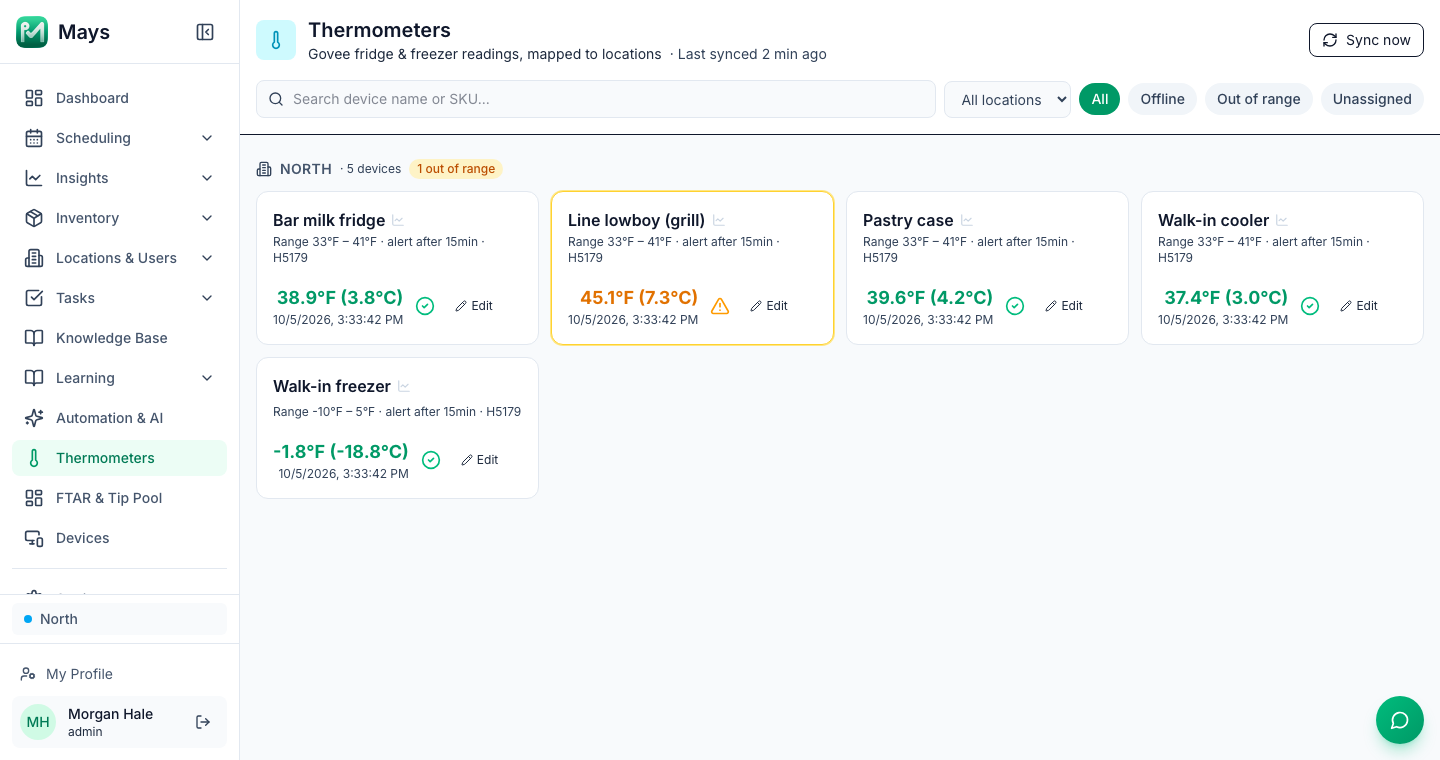
- Sensors on the refrigeration. Wireless thermometers (Govee, bought separately) report each cooler and freezer every five minutes. The Thermometers page shows every unit's latest reading and range and flags any that are out of range, like the lowboy in the image at the top of this post, and your team is alerted when a unit stays out of range. A unit that keeps creeping up is often a coil or gasket problem, caught before it fails.
- The schedule as checklists. Put the monthly checks on a Monthly template and the coil cleaning on a Quarterly one (the day of the month plus a Starting quarter, such as Jan / Apr / Jul / Oct), assigned to the manager or owner. Photo answers prove the filter date or the clean coil; a manager can Reject & Resend a task with a reason.
- A repair log you can export. Under Tasks → Types, an admin builds an Equipment repair form (equipment and serial number, problem, who came, what was done, a Money amount ($) for the cost, a Yes / No for warranty and a Photo of the service ticket). Put it in a template with Frequency set to Custom, and a manager starts it from Tasks → Create Task → From Template whenever something is repaired; it's filled in in the iPhone or Android app. Tasks → Data lists every repair, and Export CSV downloads the log.
- Manuals where the team can find them. Upload the manuals and data-plate photos to a Knowledge Base folder (PDF, Word, images and more, up to 50 MB a file). The AI Assistant in the app's chat answers from what's shared with each person, so "how do I backflush group 2?" gets an answer from your manual (the assistant uses AI credits).
- The handover. The manager Logbook has a Maintenance category, so "lowboy running warm, tech coming at 9" is there for the next shift.
Not in Mays today: an equipment list with serial numbers and warranty dates, and reminders tied to a machine rather than to a checklist.
Fix it before it breaks
Write down what you own, put the maintenance on a schedule, and log every repair.
Start your free trial: 30 days, every module, no card needed. Or book a walkthrough and we'll set up your maintenance schedule with you.