Coffee bar opening and closing checklist: espresso machine, grinders and milk
Our café opening, closing and cleaning checklists cover the whole store in one pass: the walk-in, the pastry case, the floor, the drawer. This post zooms in on one station, the espresso bar, for the barista who opens it and the one who closes it. It's the station where small habits show up in every cup: a group head that wasn't backflushed tastes like yesterday, and a steam wand that wasn't purged after almond milk is an allergen problem.
It's written for a two-group espresso machine, two grinders (house and decaf), an under-counter milk fridge, a dipper well or pitcher rinser, and a batch brewer. Adjust the steps to your machine's manual.
This is general information, not legal advice. Your equipment manuals and your health inspector have the final word.
The rules behind the bar
Section numbers are from the 2022 FDA Food Code. The FDA has since published a 2026 edition; the rules quoted here haven't changed in substance in it.
- Milk stays cold. Milk is a time/temperature control for safety (TCS) food, held at 41°F or below (§3-501.16(A)(2)). Opened cartons kept more than 24 hours are date-marked, with the day opened as Day 1 (§3-501.17(B)). The café checklist post covers both in detail.
- Pitchers and steam wands that touch milk. Equipment and utensils used with TCS food are cleaned "throughout the day at least every 4 hours" (§4-602.11(C)). A pitcher rinser rinses; it doesn't count as washing.
- Dipper wells. Spoons and scoops can be held between uses "In a container of water if the water is maintained at a temperature of at least 57°C (135°F)" (§3-304.12(F)), and the utensils and container are cleaned "at least every 24 hours or at a frequency necessary to preclude accumulation of soil residues" (§4-602.11(D)(7)). A cold dipper well of standing water doesn't meet that.
- Grinders, ice and beverage nozzles. The Food Code names "coffee bean grinders", ice makers, ice bins and beverage nozzles, cleaned "At a frequency specified by the manufacturer", or without instructions, often enough "to preclude accumulation of soil or mold" (§4-602.11(E)(4)).
- The water filter, with records. A water treatment device is serviced on the maker's schedule, and "records demonstrating inspection and service shall be maintained by the PERSON IN CHARGE" (§5-205.13). Our equipment maintenance log has a place for it.
- Pastries and garnishes without bare hands. Ready-to-eat food is handled with "deli tissue, spatulas, tongs, single-use gloves, or dispensing EQUIPMENT" (§3-301.11(B)).
- Allergens. The FDA says "The major food allergens are milk, eggs, fish, Crustacean shellfish, tree nuts, peanuts, wheat, soybeans, and sesame" (FDA, Food Allergies). On a coffee bar that's milk, soy milk, almond and other nut milks, and anything in the pastry case. Oat milk isn't on the list, but a guest who orders oat because of a milk allergy needs a clean wand and pitcher all the same. Our allergen matrix template covers the menu side.
Opening the bar
Proof is a photo where seeing is the proof, a number for readings, and a checkbox for the rest.
Step | Check | Proof |
|---|---|---|
1 | Machine on and at pressure and temperature (gauge in its normal range) | Checkbox |
2 | Each group flushed for a few seconds; portafilters in the groups to heat | Checkbox |
3 | Steam wands purged; tips clear | Checkbox |
4 | Milk fridge reading at 41°F or below | Number |
5 | Milk dated; any carton past its date or past Day 7 thrown out | Checkbox |
6 | Separate pitchers out for dairy and for each plant milk, labeled or color-coded | Photo |
7 | Grinder hoppers filled; first shots pulled, timed, tasted; grind adjusted | Checkbox |
8 | Dial-in recorded: dose, yield and time for the house espresso | Number |
9 | Dipper well running hot, or spoons on a clean, dry surface | Checkbox |
10 | Ice bin full; scoop stored outside the ice | Checkbox |
11 | Batch brew brewed; timer set | Checkbox |
12 | Syrups, sauces and toppings labeled; pumps clean | Checkbox |
13 | Cups, lids, sleeves and straws stocked | Checkbox |
During service
When | Check | Proof |
|---|---|---|
After every drink | Wand purged before and after steaming, and wiped with a clean, damp cloth used only for the wand | Checkbox |
After a plant milk | Pitcher swapped, wand purged twice and wiped before the next dairy or other milk drink | Checkbox |
Every 4 hours | Milk pitchers, steam wand cloths and dairy tools washed (not just rinsed) | Checkbox |
Mid-shift | Milk fridge reading | Number |
As needed | Knock box emptied; drip tray wiped | Checkbox |
Closing the bar
The backflush is the step most often skipped. Here's the sequence for a typical machine with a three-way valve; follow your manual if it differs.
- Water backflush: blind basket in, run the group for about ten seconds, stop, repeat five times.
- Cleaner backflush: add the dose of espresso machine cleaner your manual names to the blind basket, then run, stop and repeat the cycle the manual gives.
- Rinse: swap to a clean blind basket and run water cycles until no cleaner foams out.
- Scrub the gasket and screen with a group brush, and run a shot of water through each group to rinse.
- Soak baskets and portafilters (without the handles) in cleaner solution for the time on the label, then rinse well.
Step | Check | Proof |
|---|---|---|
1 | Each group backflushed with cleaner and rinsed; gaskets and screens brushed | Photo |
2 | Baskets and portafilters soaked and rinsed | Checkbox |
3 | Steam wands soaked or wiped per manual; tips clear | Checkbox |
4 | Grinder: hopper emptied or beans sealed, chute and burr area brushed out | Checkbox |
5 | Milk pitchers, thermometers and wand cloths washed | Checkbox |
6 | Opened milk dated and in the fridge; milk fridge reading at close | Number |
7 | Dipper well and pitcher rinser cleaned and drained | Checkbox |
8 | Drip trays, knock box and batch brewer washed | Checkbox |
9 | Closing count of milk, beans and cups for tomorrow's order | Number |
10 | Water filter date checked against the label | Checkbox |
Weekly jobs like grinder burrs, shower screens and descaling stay on the café's weekly deep clean.
Where Mays fits
Each list above is a checklist template in Mays: Tasks → Templates → Create Template, one task group per section, and each task's answer set to Photo, Number or Checkbox to match the Proof column.
- Show each list only when it matters. On the template's Settings tab, set Frequency to Daily and a Visibility Window, say 5:45 to 7:15 am for the opening list and from 3:15 pm for the close, so the closer isn't looking at opening tasks at noon.
- Give it to the bar. On the Assignments tab, pick the location and choose A role or department (a Coffee bar department, for example) so whoever is on bar sees it, or Specific people.
- Photos from the app's camera, so the clean group heads are from tonight, not from the camera roll. A manager can Reject & Resend a task with a reason, and it goes back on the closer's list.
- The closing count, without a separate sheet. Make step 9 an Inventory Count task: list the milks, beans and cups with a Min Stock for each. Anything counted under its minimum creates a Restock Order task for the managers, with how much to order, and notifies them.
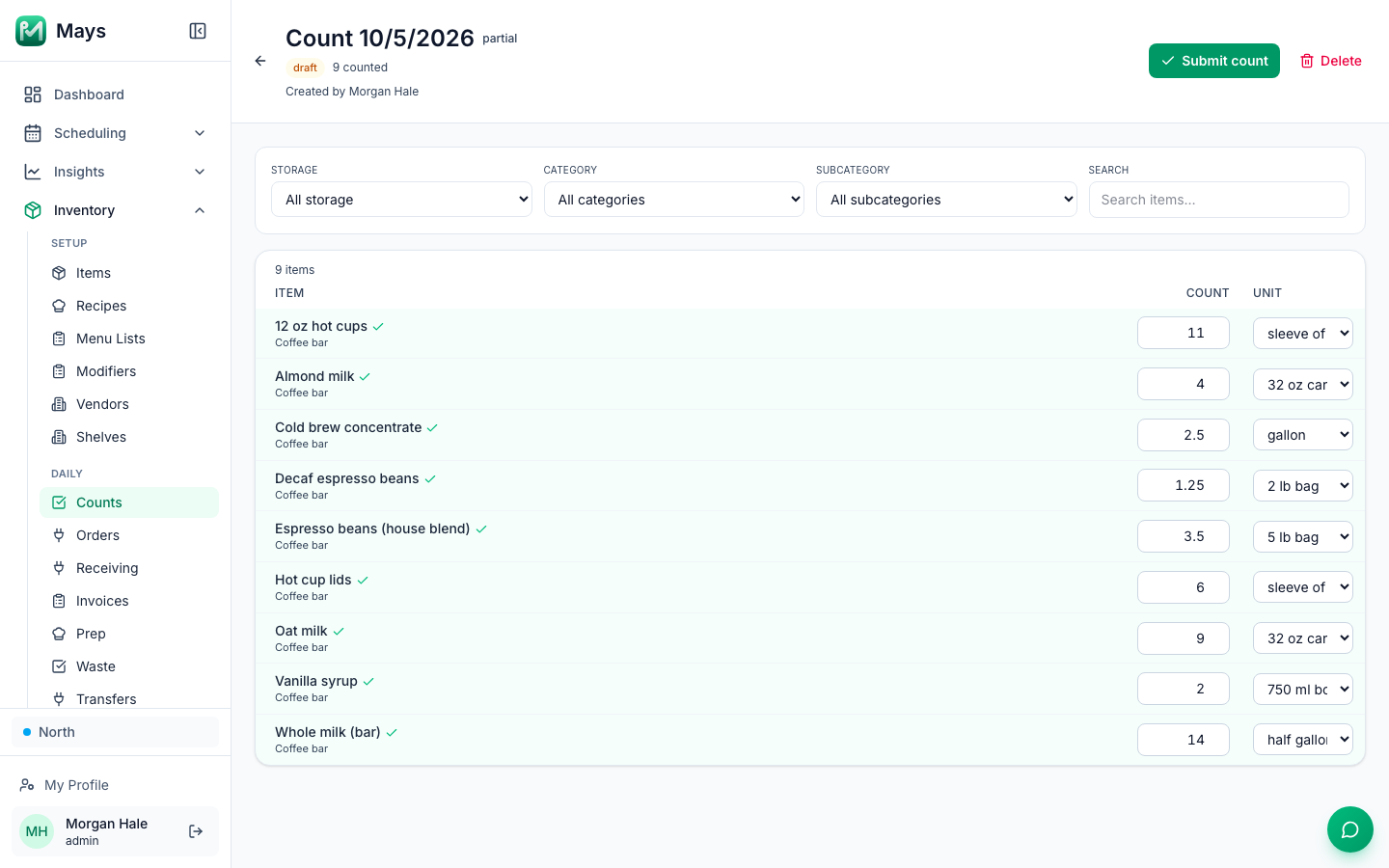
- A full count of the bar when you order. Managers and admins can count just the coffee bar under Inventory → Counts with a Partial audit of one category (the image at the top of this post), and Submit count updates what's on hand before they Order to par.
- The milk fridge between checks. A wireless thermometer (bought separately) in the milk fridge reports every five minutes and alerts your team if it stays out of range. See temperature alerts.
One thing to know: an Inventory Count task's items are typed into the task, so its counts don't change your stock on hand in Inventory. Use the partial audit for that.
Open and close it the same way every day
Put the bar on its own checklists, and the closing count turns into tomorrow's order.
Start your free trial: 30 days, every module, no card needed. Or book a walkthrough and we'll load your bar checklists with you.