Service standards for a small café: greeting, order taking and the handoff
Most of what a guest remembers about a café visit happens in about two minutes at the counter. Someone noticed them or didn't. Their order was right or it wasn't. Their drink came with their name on it, or it sat on a shelf until it went cold.
A new café usually leaves this to whoever is working. The owner is friendly, the first hires copy the owner, and it works until the owner isn't there. A service standard is the fix: a short, written description of what every guest should get, in a form you can train, watch and coach.
This is the first post in our series on the guest experience at a new café. It covers the counter. The rest of the series covers the morning rush, order accuracy and remakes, consistency, seating and Wi-Fi, accessibility, and music.
What a service standard is, and what it isn't
A standard describes things you can see or hear. "Be friendly" isn't a standard, because two people can disagree on whether it happened. "Greet every guest before they reach the register, even if you're busy" is a standard: either it happened or it didn't.
Good standards have three parts:
- The behavior: what the person does.
- The words: a few phrases that sound like your café. Not a script to recite, just a starting point.
- The never: the one or two things that undo the whole visit.
Keep it to one page. A long manual gets read once, during onboarding, and never again. One page can be printed, taped inside the bar and checked during a shift.
Moment 1: The greeting
The greeting tells the guest they've been seen. It matters most when you're busy, because that's when guests are most likely to feel ignored.
- Acknowledge everyone, fast. Pick a number that works for your room, such as "within a few seconds of walking in or joining the line", and write it down. If you're mid-drink, look up and say so: "Hi, I'll be right with you."
- Look up from the screen. Eye contact and a normal "good morning" do more than any phrase.
- Use names you know. Regulars notice when you remember them. Don't fake it: if you're not sure, don't guess.
- Don't greet from the back. A shout from behind the espresso machine isn't a greeting. Whoever is closest to the door owns it.
The never: a guest standing at the counter while two staff members finish a conversation.
Moment 2: Taking the order
This is where most wrong orders start, and it's the cheapest place to stop them.
- Let them finish. Don't start pressing buttons halfway through a sentence.
- Ask the questions the menu leaves open. Size, hot or iced, milk, and "for here or to go" if your cups differ. Ask them in the same order every time so nothing gets skipped.
- Take allergies seriously. If a guest mentions an allergy, the standard is to check, not guess. Our allergen matrix template gives the counter one place to look, and our front-of-house hiring post has the questions to always ask.
- Suggest one thing, once. "Would you like a croissant with that? They're still warm" is service. A list of add-ons is a sales pitch. If they say no, drop it.
- Read the order back before you take payment. Size, drink, milk, extras and the name for the cup. It takes a few seconds and catches what the guest misspoke or what you misheard.
- Fix changes on the ticket, not on the cup. If a guest asks for oat milk after you've rung up the order, fix the ticket so the bar makes what the ticket says. Shouting a change to the bar is how the wrong drink gets made.
The never: charging the guest before they've heard their order back.
Moment 3: The handoff
The handoff is the last thing the guest sees, and the moment most cafés get least right.
- Call the drink and the name. "Oat milk latte for Sam." Both, every time, so the right guest picks up the right cup.
- Check it against the ticket before it leaves your hand. Lid on and pressed down, sleeve if it's hot, the right size.
- Hand it over when you can. If the guest is there, put it in their hand. If they're not, put it on the pickup shelf with the name facing out.
- Keep the pickup shelf clean. Mobile and online orders sit there too. A shelf full of unclaimed drinks makes everything harder to find.
- Close the loop. "Enjoy, have a good one" is enough. If something went wrong earlier, this is where you say so and fix it.
The never: a drink set down without a word, at the wrong end of the counter.
The one-page standard
Here's a template to adapt. Change the words to sound like your café, then print it.
Moment | Our standard | Words we use | Never |
|---|---|---|---|
Greeting | Every guest is acknowledged before they reach the register, even when we're busy | "Good morning, I'll be right with you." | Ignore a guest to finish a conversation |
Questions | Size, hot or iced, milk and "here or to go", in that order | "Any milk preference?" | Assume the default |
Allergies | Check the allergen matrix or ask the shift lead | "Let me check that for you." | Guess |
Suggestion | One relevant suggestion, once | "The banana bread is fresh today." | Push after a no |
Read-back | Size, drink, milk, extras and name, before payment | "So that's a large iced oat latte for Sam?" | Charge before the read-back |
Changes | Fix the ticket, then read it back again | "Let me fix that on the order." | Shout changes to the bar |
Handoff | Call the drink and the name, check it against the ticket | "Oat latte for Sam." | Put a drink down without a word |
Problems | Follow the complaint steps | "I'm sorry, let me make you a fresh one." | Argue |
The last row matters. When something goes wrong, the standard hands over to your complaint steps. Our post on handling customer complaints has five steps anyone on shift can follow and what each role can offer without a manager.
How to train it
A standard nobody practices is just a sign on the wall. Train it the same way you train the bar.
- Show it. Walk a new hire through the page on their first shift. Our one-week training plan has a slot for it, and our barista hiring guide covers the bar side.
- Shadow it. They watch someone who does it well for a few rushes, then take the register while that person watches.
- Quiz it. Short quizzes after the shadow shifts beat a long test on day one. Use real situations: "A guest asks for oat milk after you've rung up the order. What do you do?"
- Sign it off. A shift lead watches them run the counter through a rush and signs off when every row on the page happens without prompting.
- Coach it in the moment. Quietly, after the guest has left: "Next time, read the order back before you take the card." Praise in public, correct in private.
Then check it. Once a week, a manager or shift lead watches the counter for ten minutes during a busy stretch and notes which rows slipped. Patterns tell you what to retrain, and they're more useful than a single bad visit. Our post on the weekly manager meeting has a place for it on the agenda.
When guests tell you how you're doing
Reviews are feedback on your standard, in public. When a review mentions a cold drink, a long wait or a name that was never called, it usually points at one row of the page. Our guide to replying to your first 50 Google reviews covers how to answer them; the standard is how you stop them from repeating.
Where Mays fits
- The standard, in one place: write it as a Knowledge Base article. Staff can read Knowledge Base articles in the Mays phone app as well as on the web, so the page is with them during the shift, not only on the wall.
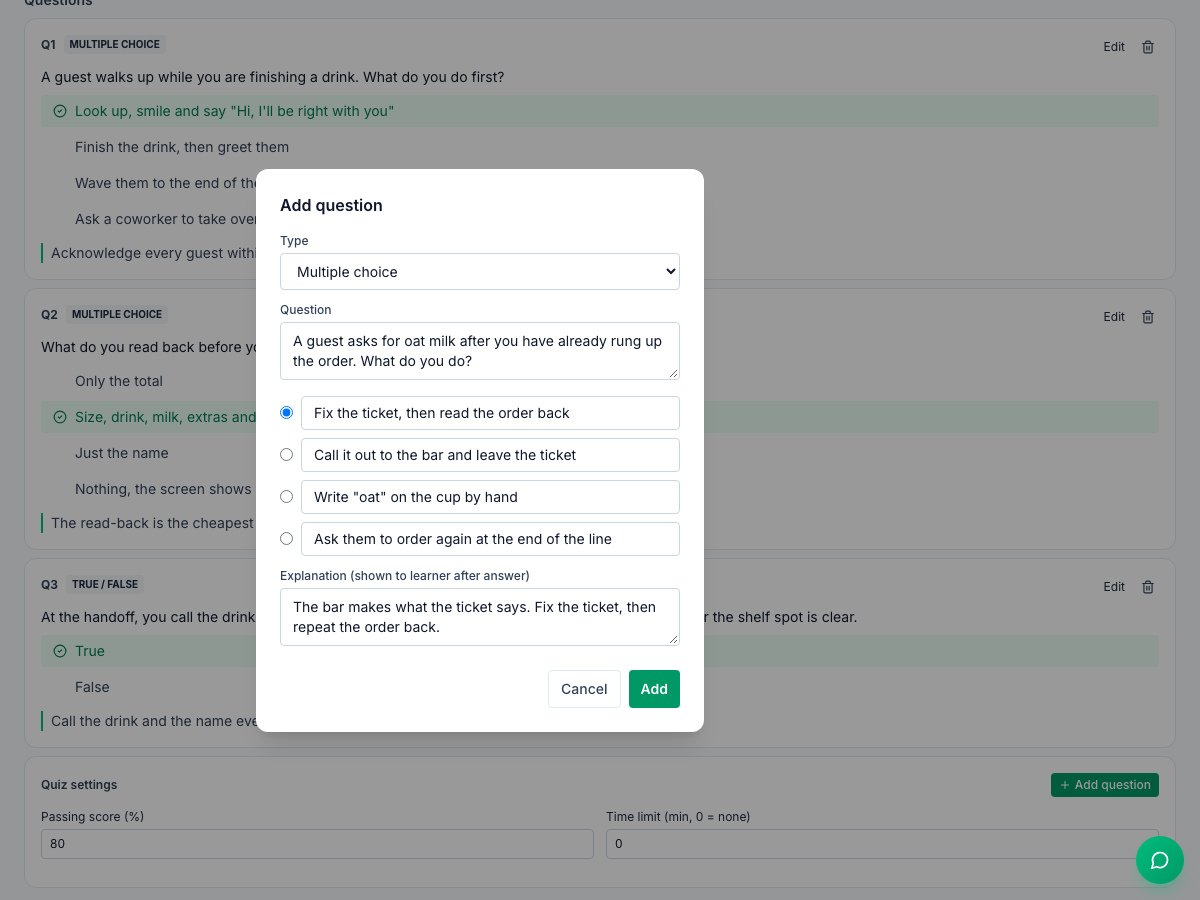
- A quiz built from your own situations: in Learning, create a module and add your own questions with Add question (the image at the top of this post). Each question is multiple choice or true/false, and you can write an explanation that the learner sees after answering. Set the passing score on the module.
- Or draft it from the article: Generate from docs picks one or more Knowledge Base articles or documents and drafts a quiz from them with AI. Each drafted question carries a quote from the source, and questions that the source doesn't support are dropped. Read every question before you publish.
- Assign it: a published module can be assigned by location, role, department or person, and Who's taken it shows each person's attempts and best score, so you know who still needs the sign-off.
Mays doesn't watch your counter for you. The sign-off and the weekly ten minutes are still a person's job.
Your service standard checklist
- One page, three moments: greeting, order and handoff
- Behaviors you can see, in your café's own words, with one "never" each
- A read-back before every payment, and changes fixed on the ticket
- Drink and name called at every handoff
- Trained by showing, shadowing, quizzing and signing off
- Ten minutes of watching the counter every week, and coaching after the guest has left
Train your standard with Mays
Write the page once, turn it into a short quiz, and see who has passed it before they run the counter alone.
Start your free trial: 30 days, every module, no card needed. Next in this series: handling the morning rush, from line flow and station setup to how many people you need on the floor.