Allergen matrix template for a small restaurant (all 9 major US allergens)
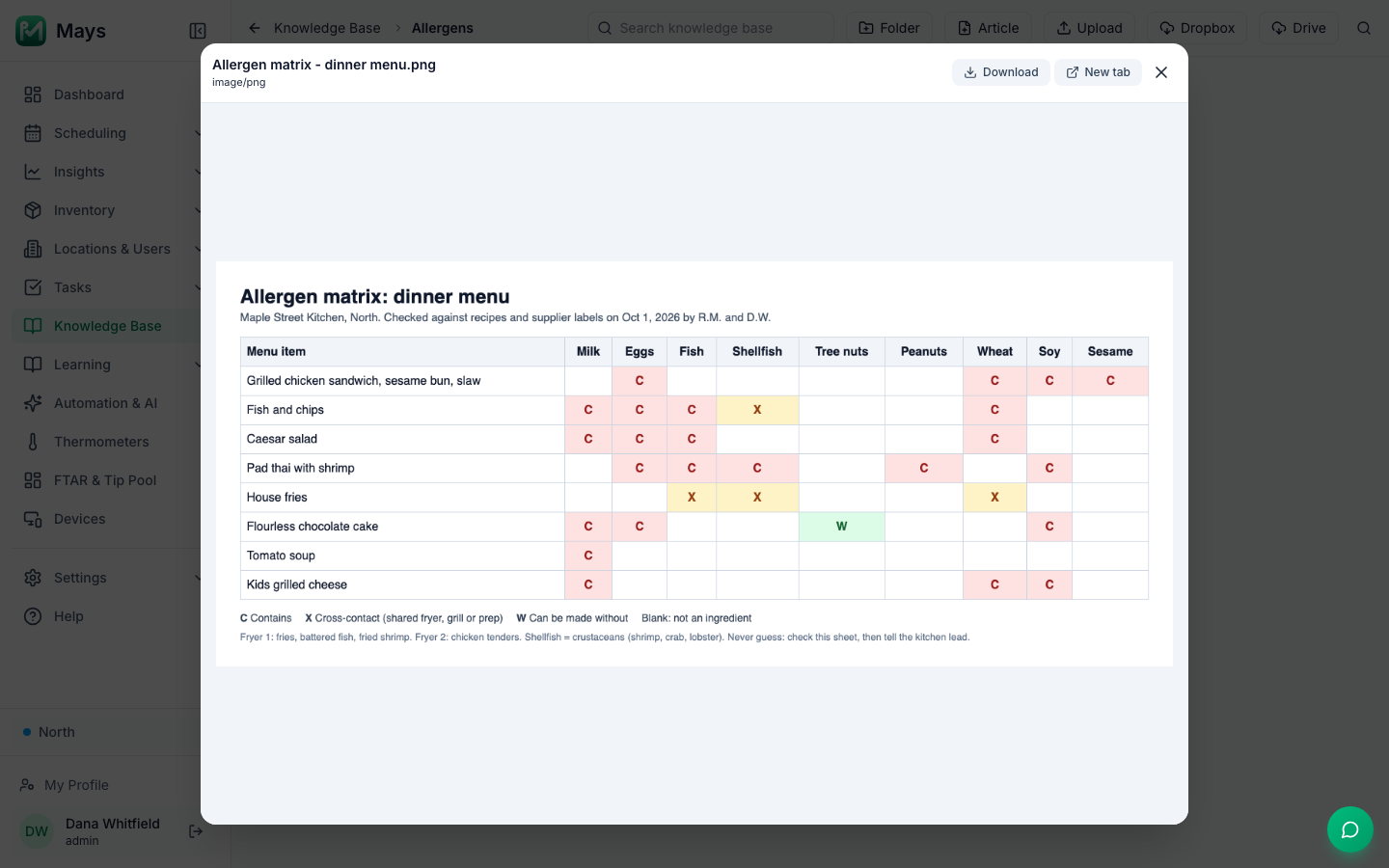
A guest asks whether the chicken sandwich has sesame. The server doesn't know, the cook thinks the bun is plain, and nobody remembers that the slaw dressing has tahini in it. An allergen matrix is the one page that settles it: every menu item down the side, every major allergen across the top, filled in from the recipes and the supplier labels, not from memory.
This post gives you the template, a way to fill it in that catches the hidden ingredients, and a routine for keeping it true after the menu and the suppliers change.
This is general information, not legal or medical advice. Your health department may have its own allergen rules, and your staff should never promise a guest that a dish is safe beyond what your process can deliver.
The nine major allergens
The FDA's list: "milk, eggs, fish, Crustacean shellfish, tree nuts, peanuts, wheat, soybeans, and sesame." The 2004 labeling law (FALCPA) "identified eight foods as major food allergens", and "On April 23, 2021, the Food Allergy Safety, Treatment, Education, and Research (FASTER) Act was signed into law, declaring sesame as the 9th major food allergen recognized by the United States. The change was effective on January 1, 2023." (FDA, Food Allergies). An allergen chart printed before 2023 probably has eight columns. Add sesame.
The shellfish on the list are crustaceans: shrimp, crab, lobster. Mollusks such as clams, oysters, mussels and squid aren't on the federal list, but some guests are allergic to them too, so if you serve them, say so in the item's name or add a note under the grid.
Two details from the same page and the Food Code matter for a restaurant:
- Packaged labels don't cover made-to-order food. "FALCPA's labeling requirements do not apply to foods that are placed in a wrapper or container (such as paper or a box for a sandwich) following a customer's order at the point of purchase." The burger you wrap at the pass has no allergen label, so your staff are the label.
- Highly refined oils are out. The Food Code's definition of a major food allergen "does not include: (a) Any highly refined oil derived from a FOOD specified in Subparagraph (1)(a) of this definition and any ingredient derived from such highly refined oil" (2022 FDA Food Code, Chapter 1 definitions). Refined peanut or soybean oil isn't marked. Cold-pressed, expeller-pressed or unrefined oils are a different product: check the supplier's specification sheet before you leave the cell empty.
What the Food Code expects
Section numbers are from the 2022 FDA Food Code; check which edition your state enforces (Florida, for example, enforces the 2017 edition). The FDA has since published a 2026 edition; the rules quoted below haven't changed in substance in it.
- Telling guests in writing (2022 edition). "The PERMIT HOLDER shall notify CONSUMERS by written notification of the presence of MAJOR FOOD ALLERGENS as an ingredient in unPACKAGED FOOD items that are served or sold to the CONSUMER" (§3-602.12(C)). This paragraph is new in the 2022 edition, so it applies where your state has adopted that edition. A menu note, a table tent or a printed matrix at the counter are the usual ways.
- Training. The person in charge ensures "EMPLOYEES are properly trained in FOOD safety, including FOOD allergy awareness, as it relates to their assigned duties" (§2-103.11(O)).
- The person in charge knows it. When the person in charge shows their knowledge by answering the inspector's questions, one of the areas is "Describing FOODS identified as MAJOR FOOD ALLERGENS and the symptoms that a MAJOR FOOD ALLERGEN could cause in a sensitive individual who has an allergic reaction" (§2-102.11(C)(9)).
The template
Use one of four marks in each cell. The fourth column most matrices leave out is the one that hurts people: the item doesn't contain the allergen, but it's cooked in the same fryer or on the same grill as something that does.
Mark | Means |
|---|---|
C | Contains: the allergen is an ingredient, including in a sauce, dressing, bun or marinade |
X | Cross-contact: not an ingredient, but shares a fryer, grill, slicer or prep surface with one that is |
W | Can be made without: the kitchen can leave out the ingredient, and a manager has confirmed how |
blank | Not an ingredient, and no shared equipment you know of |
Menu item | Milk | Eggs | Fish | Shellfish | Tree nuts | Peanuts | Wheat | Soy | Sesame |
|---|---|---|---|---|---|---|---|---|---|
Under the grid, write the date it was last checked, who checked it, and the fryers and grills shared by more than one item (for example: Fryer 1: fries, battered fish, fried shrimp. Fryer 2: chicken tenders.).
A filled-in example (made-up menu)
Menu item | Milk | Eggs | Fish | Shellfish | Tree nuts | Peanuts | Wheat | Soy | Sesame |
|---|---|---|---|---|---|---|---|---|---|
Grilled chicken sandwich, sesame bun, slaw | C | C | C | C | |||||
Fish and chips | C | C | C | X | C | ||||
Caesar salad | C | C | C | C | |||||
Pad thai with shrimp | C | C | C | C | C | ||||
House fries | X | X | X | ||||||
Flourless chocolate cake | C | C | W | C |
Why those marks:
- The chicken sandwich has sesame in the bun, egg and soy in the slaw's mayonnaise, and wheat in the bun.
- Fish and chips has milk and egg in the batter. It's an X for shellfish because the same fryer also cooks the fried shrimp.
- The Caesar is a C for fish because classic Caesar dressing contains anchovy, and the croutons are wheat.
- Pad thai has fish sauce, egg, peanuts, soy sauce and shrimp.
- House fries look allergen-free, but they share the fryer with battered fish, so they're X for fish, shellfish and wheat. Moving fries to their own fryer clears all three.
- The cake is W for tree nuts: the recipe uses almond flour, but the kitchen keeps a nut-free batch, and a manager has confirmed how it's stored and served.
How to fill it in
- Start from the recipe, not the menu description. List every component: the bun, the sauce, the marinade, the garnish, the oil.
- Open every sub-recipe. Dressings, sauces, spice blends and batters are where allergens hide. Worcestershire sauce typically contains anchovy, many pestos contain tree nuts or cheese, and some barbecue rubs contain sesame or soy.
- Read the supplier's label or specification sheet for every bought-in item: bread, sauces, sausages, desserts. Keep a copy.
- Walk the line for cross-contact. Which fryer, which grill, which slicer, which cutting board. Write it under the grid.
- Have a second person check it. The kitchen manager fills it in; someone else checks each row against the recipe.
Keep it true
A matrix is wrong the day a supplier changes a bun. Update it when:
- A supplier substitutes a product. Check the label on delivery; a "same item, different brand" substitution is the classic way an allergen sneaks in.
- The menu changes, including a seasonal special or a new sauce.
- A recipe changes on the line, such as a cook swapping butter for oil.
- Once a month anyway, with the date and initials updated, so a stale matrix is easy to spot.
Put it to work at the table
The matrix only helps if servers use it every time a guest mentions an allergy. The questions to ask, and the rules for answering (never from memory, check with the kitchen, hand-deliver the plate), are in hiring servers and cashiers. The matrix is what they check. In the kitchen, the plate for an allergy order gets clean utensils, a clean surface and fresh gloves, and a manager or kitchen lead checks it before it goes out. For first-week training around this, see training your first hires in one week.
Where Mays fits
- Keep the matrix in the knowledge base. Upload it to a folder as a PDF, image or CSV (up to 50 MB per file), or write it as an article with a table. Share the folder with your location so every server and cook can open it in the Mays app.
- Staff can ask the AI Assistant. In the app's Chat tab, the AI Assistant answers from what's shared with that person, including the matrix (it uses AI credits). Treat its answer as a pointer to the right row, not as the check itself: step 2 above still applies.
- Turn it into a quiz. On the Pro plan, admins can have the AI write a short quiz from the matrix and the allergen routine under Learning → Modules, then assign it to new hires.
- Track allergen certificates. A team member's certificates can include Allergen training, with an expiry date, next to their food handler card.
- Put the monthly check on a list. Add Allergen matrix checked against current recipes and labels to a Monthly checklist template for the kitchen manager.
What Mays doesn't do yet: there are no allergen fields on menu items or recipes in Mays, so the matrix is a document you maintain, not something Mays builds from your recipes.
Put the matrix where staff can find it
Fill in the grid, have someone check it, and put it in one shared folder your whole team can open on their phone.
Start your free trial: 30 days, every module, no card needed. Or book a walkthrough and we'll set up your knowledge base with you.