Daily sales and cash report template: the Z-report summary, deposits and overs and shorts on one page
At close, your POS prints a Z-report, every drawer gets counted, and a deposit goes in a bag. Most small restaurants keep those three things in three places, and nobody sees them side by side until the accountant asks why March's deposits don't match March's sales. The daily sales and cash report puts them on one page, signed by the person who closed.
This post is that page. How to count a drawer, run a blind count and handle safe drops is in our cash handling guide; this report sits on top of it and covers the whole day.
This is general information, not tax or legal advice. Your accountant decides how these numbers go into your books.
The daily report
Fill it in at close, from the POS's end-of-day report (the Z-report) and the drawer counts. Made-up numbers:
1. Sales, from the Z-report
Line | Amount |
|---|---|
Gross sales | $2,486.50 |
Discounts and comps | −$61.25 |
Refunds | −$18.00 |
Net sales | $2,407.25 |
Sales tax collected | $168.51 |
Tips (card) | $312.40 |
Gift cards sold | $50.00 |
Gift cards redeemed | $24.00 |
Voids (count and amount) | 4, $37.75 |
Guest or ticket count | 312 |
Average ticket (net sales ÷ tickets) | $7.72 |
Write voids even though they aren't in net sales. A day with twice the usual voids is worth a look at the POS's void report, by employee.
2. Payments by tender
Tender | Amount |
|---|---|
Cash | $596.30 |
Card (sales and tax, without tips) | $1,821.46 |
Delivery apps (paid out by the platform later) | $134.00 |
Gift card redemptions | $24.00 |
Total collected | $2,575.76 |
Total collected should equal net sales + sales tax: here $2,407.25 + $168.51 = $2,575.76. Card tips go to staff, so they're tracked under sales and paid out through payroll or your tip-out sheet, not counted as sales. If the totals don't tie, find the difference before you sign: usually a refund rung on the wrong tender or a gift card counted twice. What the card tender costs you is a separate question, covered in card processing fees for a café.
3. Cash, drawer by drawer
Drawer | Counted by | Cash sales (POS) | Cash accounted for | Over / short |
|---|---|---|---|---|
1 (front) | Shift lead | $408.40 | $404.00 | −$4.40 |
2 (drive-up) | Closer | $187.90 | $188.15 | +$0.25 |
Total | $596.30 | $592.15 | −$4.15 |
Cash accounted for is the drawer's counted cash minus its starting bank, plus its paid-outs (with receipts) and safe drops, from each drawer's count sheet in the cash handling guide. Record every drawer every day, even when it's exact.
4. The deposit
Line | Fill in |
|---|---|
Cash for deposit (counted cash − tomorrow's starting banks) | |
Bag or slip number | |
Prepared by, verified by | Two signatures |
Taken to the bank by, and when | |
On the bank statement (checked weekly) |
5. The day
Line | Fill in |
|---|---|
Labor hours and labor % (from the time clock) | |
Weather, events, anything unusual | Rain all morning; school holiday |
86'd items | Oat milk at 1 pm |
Closed by | Name and signature |
The weekly roll-up
Each Monday, put last week's daily reports side by side:
Mon | Tue | Wed | Thu | Fri | Sat | Sun | Week | |
|---|---|---|---|---|---|---|---|---|
Net sales | ||||||||
Tickets | ||||||||
Average ticket | ||||||||
Over / short (all drawers) | ||||||||
Deposits on the bank statement | ||||||||
Labor % |
Look for patterns, not single days: shorts on the same weekday, an average ticket that slides for three weeks, a deposit that isn't on the statement. Then take the week's net sales into your weekly prime cost and your labor review. Sales tax collected goes to your return; Florida's rules are in Florida sales tax for restaurants and cafés.
What to keep, and for how long
The IRS says to keep supporting documents for the money coming in: "Gross receipts are the income you receive from your business. You should keep supporting documents that show the amounts and sources of your gross receipts." Its list starts with "Cash register tapes" and "Deposit information (cash and credit sales)" (IRS, What kind of records should I keep). So staple or scan the Z-report and the deposit slip with each day's report.
How long: "Keep records for 3 years if situations (4), (5), and (6) below do not apply to you", and longer in the cases the IRS lists, such as unreported income. For payroll, "Keep employment tax records for at least 4 years after the date that the tax becomes due or is paid, whichever is later" (IRS, How long should I keep records). Ask your accountant whether your state wants longer.
Where Mays fits
Mays isn't a POS, and your Z-report stays in your POS. Mays makes sure the report gets filled in every night and keeps every one of them:
- The report as a form. An admin builds a custom form under Tasks → Types with Money amount ($) fields for the Z-report lines and tenders, a Computed (formula) field for the over or short, a Photo of the Z-report and deposit slip, and a Signature for the closer.
- Part of closing. Add it to the closing checklist under Tasks → Templates as a Custom form task, so it shows up on the closer's phone every night.
- The log. Tasks → Data lists every submitted report for a location and date range, and Export CSV gives your bookkeeper a column per amount.
- An alert on shorts. Under Insights → Alerts & Reports, a Task Form Field Threshold alert on the over/short field notifies the people you pick when it crosses your limit.
- Sales next to the plan. With Square or Union POS connected, the Forecast shows each day's actual sales next to its projection.
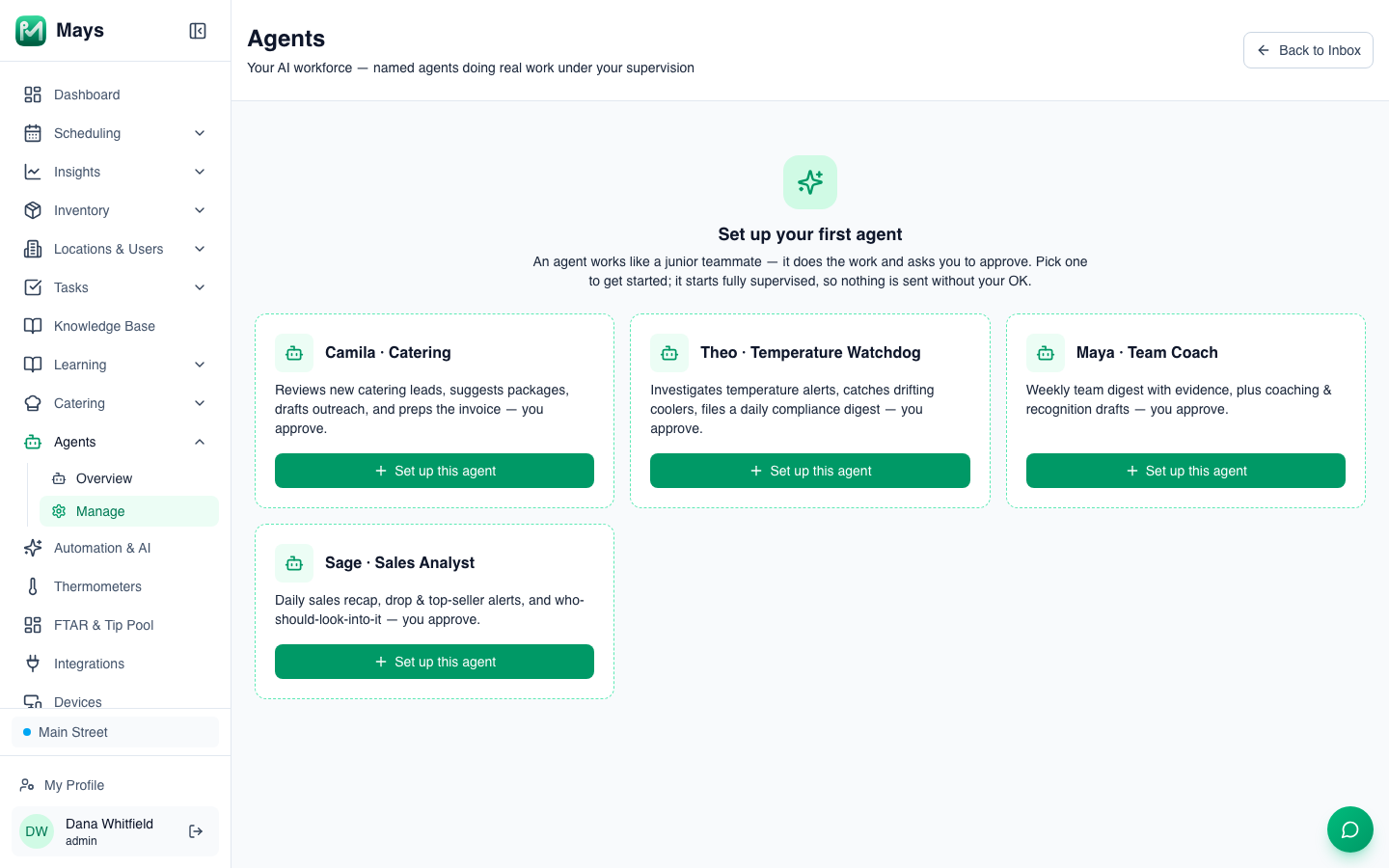
- A daily recap from your POS. Sage, the Sales Analyst among Mays's AI agents (the image at the top of this post), reads your POS sales and files a daily recap for each location, with revenue drops and top and worst sellers. What it proposes waits for your approval, and it uses AI credits.
What Mays doesn't do: it doesn't read your Z-report into the form for you, and it doesn't match deposits to your bank statement. Keep the weekly bank check on your list.
One page, every night
Sales, tenders, drawers and the deposit, side by side and signed. When something's off, you'll see it the next morning, not at year-end.
Start your free trial: 30 days, every module, no card needed. Or book a walkthrough and we'll build your daily report form with you.