Music, sound and atmosphere at a café: playlists, volume and music licensing basics
Guests feel a room before they think about it. Music that fits the hour, a volume where people can talk, and a grinder that doesn't drown out the order all shape whether a café feels calm, busy or chaotic.
Sound is also where many new cafés trip over the law without knowing it. Playing music to the public is a use of someone's copyright, and the app on the manager's phone usually doesn't cover it.
This is the last post in our series on the guest experience at a new café. It covers sound in the room first, then the licensing basics.
This is general information, not legal advice. Licensing terms change, and your situation depends on your space and how you play music. Check with the licensing organizations or a lawyer. Sources checked October 5, 2026.
Plan the sound by part of the day
Most cafés need more than one mood. Plan a playlist and a volume for each part of the day, the same way you plan staffing for the morning rush.
Part of the day | What the room needs | Sound |
|---|---|---|
Opening and morning rush | Energy, quick turnover, orders heard at the register | Upbeat, moderate volume |
Mid-morning | Meetings, reading, laptops | Calmer, lower |
Lunch | Conversation at full tables | Steady, below talking level |
Afternoon | Study and work | Quiet, few vocals |
Events | The event itself | Set by the event |
A few rules make it work:
- The house picks the music, not whoever is on shift. Build the playlists in advance. Personal playlists drift by mood and by person.
- Set the volume from a seat, not from behind the bar. The bar is loud. Sit at a table and adjust until you can talk normally.
- Mark the volume. A strip of tape at the right level on the amplifier or a note on the opening checklist keeps it the same every day.
- Check the lyrics. If families come in, keep explicit tracks off the playlists.
- Turn it down when someone's on the phone or ordering. The register must hear the order. Our service standards post covers the read-back.
The rest of the noise
Music is only part of the sound. The rest comes from the bar and the room:
- Equipment: grinders, blenders, steam wands and dishwashers. If you can, put the loudest machines away from the seating, and run the blender between orders being taken, not during them.
- Hard surfaces: concrete, glass and tile bounce sound around. Rugs, upholstered seats, curtains and acoustic panels absorb it. Even a few soft surfaces help.
- Calls and videos: our post on Wi-Fi, laptops and seating has polite sign wording for headphones.
- Accessibility: a quieter room helps guests with hearing loss and anyone who finds noise hard. The accessibility post covers the rest of the basics.
Why a personal streaming account isn't enough
Copyright gives the owner of a song "the exclusive rights to do and to authorize" several things, including "to perform the copyrighted work publicly" (17 U.S.C. § 106). The law defines performing "publicly" as performing "at a place open to the public" (17 U.S.C. § 101). A café is a place open to the public.
Personal streaming accounts don't include that right:
- Spotify's terms give "permission to make personal, non-commercial use of the Spotify Service and the Content" (Spotify Terms of Use).
- Apple's terms say "You may use the Services and Content only for personal, noncommercial purposes" (Apple Media Services Terms).
- SESAC puts it plainly: "Personal streaming accounts with the above services, including paid accounts, do not grant public performance rights for use in a business" (SESAC).
Buying the music doesn't cover it either. ASCAP's licensing FAQ: "Rental or purchase of sheet music or the purchase of a record does not authorize its public performance" (ASCAP licensing FAQ).
Performing rights organizations: ASCAP, BMI, SESAC and GMR
Songwriters and publishers license public performances through performing rights organizations (PROs). The Copyright Act names three as examples: "the American Society of Composers, Authors and Publishers (ASCAP), Broadcast Music, Inc. (BMI), and SESAC, Inc." (17 U.S.C. § 101). A fourth, Global Music Rights (GMR), also licenses businesses.
What they say about their licenses:
- ASCAP: "ASCAP licenses the public performances of its members' musical works." It adds: "Whether your music is live, broadcast or played via streaming services or CDs, your ASCAP license covers your performances" (ASCAP licensing FAQ).
- SESAC: "A SESAC blanket license authorizes you to publicly perform any and all of the songs in the vast SESAC repertory" (SESAC FAQ).
- GMR: a license lets you play "the music controlled by Global Music Rights' writer, composer and publisher clients in your place of business" (GMR FAQ).
- BMI: BMI's licensing pages couldn't be checked for this post. Ask BMI directly what its license covers.
The key point: each license covers only that organization's songs. GMR says licenses with ASCAP, BMI and SESAC "do not grant you authorization to publicly perform the copyrighted music of Global Music Rights’ songwriters, composers, and publishers and vice versa." SESAC says a license with ASCAP or BMI "does not grant authorization to publicly perform songs in the SESAC repertory". Many songs have several writers who belong to different organizations.
Fees. None of the pages above publishes a price for a café. ASCAP says rates for restaurants and similar businesses "depend on whether the music is live or recorded, whether it's audio only or audio visual, the number of nights per week music is offered, whether admission is charged and several other factors." Ask each organization for a quote.
Background music services. Some businesses use a commercial background music service instead of a streaming app. Ask the provider in writing which licenses its price includes. GMR notes that most such providers have a GMR license, but that it "extends only to the music they supply" to businesses without an admission charge. Anything you play another way, including live music, needs its own license.
The § 110(5) exemption for radio and TV
Copyright law has a narrow exemption for businesses that play the radio or TV. It doesn't cover streaming, CDs, MP3s or live music. ASCAP's FAQ says the same: those other means "require permission obtained either from the copyright owners or from their performing rights licensing organizations."
Under 17 U.S.C. § 110(5)(B), a "food service or drinking establishment" can play a transmission "originated by a radio or television broadcast station licensed as such by the Federal Communications Commission, or, if an audiovisual transmission, by a cable system or satellite carrier", if:
Condition | What the statute says |
|---|---|
Size | "less than 3,750 gross square feet of space (excluding space used for customer parking and for no other purpose)", or larger with the limits below |
Larger, audio | "not more than 6 loudspeakers, of which not more than 4 loudspeakers are located in any 1 room or adjoining outdoor space" |
Larger, TV | "not more than 4 audiovisual devices, of which not more than one audiovisual device is located in any 1 room, and no such audiovisual device has a diagonal screen size greater than 55 inches", plus the same speaker limits |
No charge | "no direct charge is made to see or hear the transmission or retransmission" |
Stays inside | "not further transmitted beyond the establishment where it is received" |
Licensed broadcast | "the transmission or retransmission is licensed by the copyright owner of the work so publicly performed or displayed" |
Two details trip people up. The square footage counts patio seating: "gross square feet of space" includes "any adjoining outdoor space used to serve patrons, whether on a seasonal basis or otherwise" (§ 101). And "radio" means a broadcast station, not an internet radio app.
Live music, events and social media
- Live music: a band or open mic playing covers is still a public performance of those songs. ASCAP's license covers live performances of its repertory, and GMR says "It is the responsibility of the venue/place of business to obtain licenses for all music played within the premises, whether live or recorded." If you plan events, see our posts on local partnerships and events and the grand opening.
- Social media: music in your Reels and Stories has its own rules. Our Instagram post covers Meta's Sound Collection for businesses.
Where Mays fits
Mays doesn't play music or handle music licenses. It helps with the rest of the atmosphere:
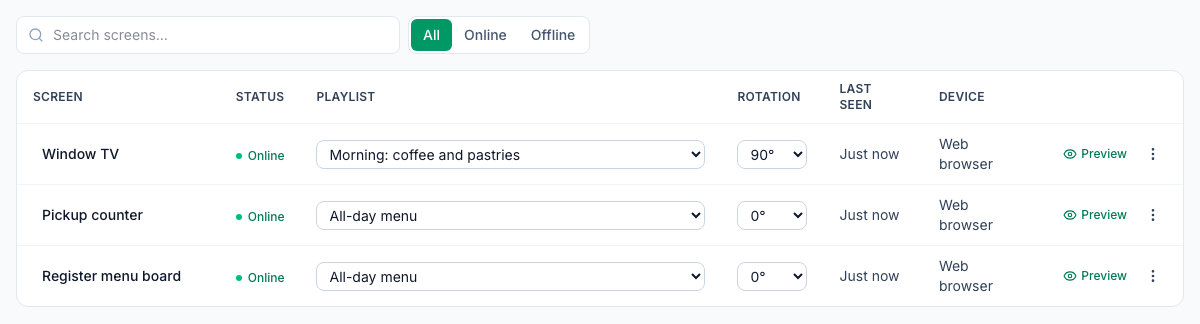
- Screens that fit the hour: with the digital signage add-on, Signage → Screens lists each screen at a location with its playlist, rotation and when it was last seen (the image at the top of this post). Schedules switch a screen's playlist by time of day, like your music.
- Screens that stay quiet: the Mays signage player plays videos muted, so menu boards and window screens don't add their own sound to your music.
- The same sound every day: add "music on, morning playlist, volume at the mark" to your opening checklist.
- The paperwork, findable: keep your license confirmations and renewal dates in a Knowledge Base folder shared only with the Managers role (new folders start private).
Your sound and music checklist
- A playlist and volume for each part of the day, set by the house
- Volume set from a seat and marked on the amplifier
- Loud equipment and hard surfaces dealt with where you can
- No personal streaming accounts playing to the room
- Licenses from the organizations whose music you play, or a background music service whose licenses you've confirmed in writing
- If you rely on § 110(5), your square footage (including the patio), speakers and screens checked against the statute
Set the mood with Mays
Keep the screens, the opening checklist and the paperwork in one place, and the room will sound the same every morning.
Start your free trial: 30 days, no card needed. That's the end of our series on the guest experience at a new café. Start from the beginning with service standards for the counter.