Community partnerships for a new café: schools, gyms, offices and farmers markets
Ads find strangers. Partnerships find neighbors: the gym across the street whose members want a smoothie after class, the office upstairs that orders lunch every Friday, the school whose parents walk past your door twice a day. A café that becomes part of those routines gets customers who come back every week.
This guide covers the four partners most cafés start with (schools, gyms, offices and farmers markets), what to offer each one, the rules that come with them, and how to follow up without becoming a nuisance.
It's the fifth post in our Marketing a new café series.
This is general information, not legal advice. Florida rules are noted where they apply; check your own state and county.
Start with a map, not a pitch
Draw a 10-minute walking circle around your café and list who's in it:
Partner | What they want | What you can offer |
|---|---|---|
Offices and coworking spaces | Easy meetings and lunches | Catering trays, a coffee service for meetings, a staff discount day |
Gyms and studios | Something for members after class | A post-class drink or snack, a member offer, a table at their events |
Schools and PTAs | Fundraisers and thank-yous | Teacher appreciation coffee, a fundraiser night, event catering |
Farmers markets and fairs | Vendors who draw a crowd | Coffee and pastries for the morning crowd |
Neighbors and nonprofits | Help with their events | Donated pastries, a hosted meetup |
Pick two to start. A partnership needs someone to follow up, so don't start ten.
Offices: the steadiest customers
Offices order on a schedule: Monday meetings, Friday lunches, monthly all-hands. One office manager who trusts you can mean an order every week.
- Lead with something easy to say yes to: a coffee and pastry tray for one meeting, with a menu and your contact details.
- Make ordering simple: a short catering menu with per-person prices and minimums, and one phone number or email. Our guide to catering as a side business covers the pricing and packaging.
- Follow up once, a week later. Then leave it.
If you email offices, CAN-SPAM applies. The FTC says "The law makes no exception for business-to-business email." Every email must identify itself as an ad, include "your valid physical postal address", tell people how to opt out, and honor opt-outs within 10 business days (FTC: CAN-SPAM compliance guide). Our post on building an email and text list has the full list.
Gyms and studios
Gym members are already building a routine; you want to be in it.
- A member offer: a discount on a post-workout drink with a member card, for a set period.
- A table at their events: a 5K, a member appreciation day, a class launch.
- Cross-promotion: they mention you, you mention them. Keep it honest.
If an instructor or owner promotes you in exchange for something, it needs disclosing. The FTC's rule of thumb: "if there's a connection between an endorser and the marketer that a significant minority of consumers wouldn't expect and it would affect how they evaluate the endorsement, that connection should be disclosed clearly and conspicuously" (FTC: Endorsement Guides, what people are asking). Free smoothies for the staff in return for posts is exactly that kind of connection. Our Instagram guide covers the paid partnership label.
Schools and PTAs
Schools are close-knit, and parents talk. A teacher appreciation coffee or a fundraiser night ("10% of tonight's sales go to the PTA") gets your name in the school newsletter.
Know the school snack rules before you sell on campus. USDA's Smart Snacks standards "apply to any foods sold to students during the school day on the school campus, including foods sold as fundraisers." But "the standards do not apply during nonschool hours, on weekends, and at off-campus fundraising events, though local policies may still apply" (USDA: Smart Snacks and fundraisers). The regulation defines the school day as "the period from the midnight before, to 30 minutes after the end of the official school day" (7 CFR 210.11).
In practice:
- A fundraiser night at your café isn't a school sale.
- Coffee for teachers in the staff room isn't food sold to students.
- Selling pastries to students on campus during the day is covered, so ask the school what its state allows. "State agencies can permit occasional exempt fundraisers" (USDA page).
Food donations
Donating day-old pastries to a food bank or shelter is good for your neighbors and cuts waste, and federal law protects you when you do it in good faith.
The Bill Emerson Good Samaritan Food Donation Act, as amended in 2023, says a donor "shall not be subject to civil or criminal liability arising from the nature, age, packaging, or condition of apparently wholesome food" donated in good faith to a nonprofit. Restaurants and caterers are "qualified direct donors" who can also donate directly "to a needy individual at zero cost". The protection doesn't cover "gross negligence or intentional misconduct", and it doesn't override "State or local health regulations" (42 U.S.C. 1791).
There can be a tax benefit too. The IRS says "Special rules apply to certain donations of food inventory to a qualified organization", including that "The food is to be used only for the care of the ill, the needy, or infants" (IRS Publication 526). Pub 526 is written for individuals and pass-through businesses, so ask your accountant how it applies to yours.
Farmers markets and local events
A Saturday market puts your coffee in front of hundreds of people who live nearby. It's also a second location for a day, with its own rules.
In Florida:
- A "temporary food service event" is "any event of 30 days or less in duration where food is prepared, served, or sold to the general public" (s. 509.013, Florida Statutes).
- "Public food service establishments holding current licenses from the division may operate under the regulations of such a license at temporary food service events" (s. 509.032). DBPR's guide puts it simply: "If you have a Hotels & Restaurants food service license you can operate one unit at a 1-30 day event" (DBPR: temporary event guide).
- The same guide lists basics such as "A hand washing facility" and a "Probe type thermometer".
- Each market sets its own rules. Florida's agriculture department says each market "establishes its own vendor rules and regulations" (FDACS: community farmers markets FAQ).
- Sales tax still applies. Florida's Department of Revenue says "Sales of food, drinks, and other items sold at fundraisers and similar events are taxable" unless a specific exemption applies (Florida DOR: GT-800003).
What to bring: a short menu (four drinks, three pastries), a card reader with offline mode, your sign-up QR code, and enough cups for twice what you expect.
Following up without spamming
A partnership is a relationship, not a campaign. A good rhythm:
- First contact: walk in, introduce yourself, bring something.
- One follow-up: a week later, by email or phone.
- After the first order or event: a thank-you, and ask what would make the next one better.
- Then: a check-in each season, when your menu changes.
Track who you talked to, when, and what they said. A spreadsheet works; so does the tool below.
Where Mays fits
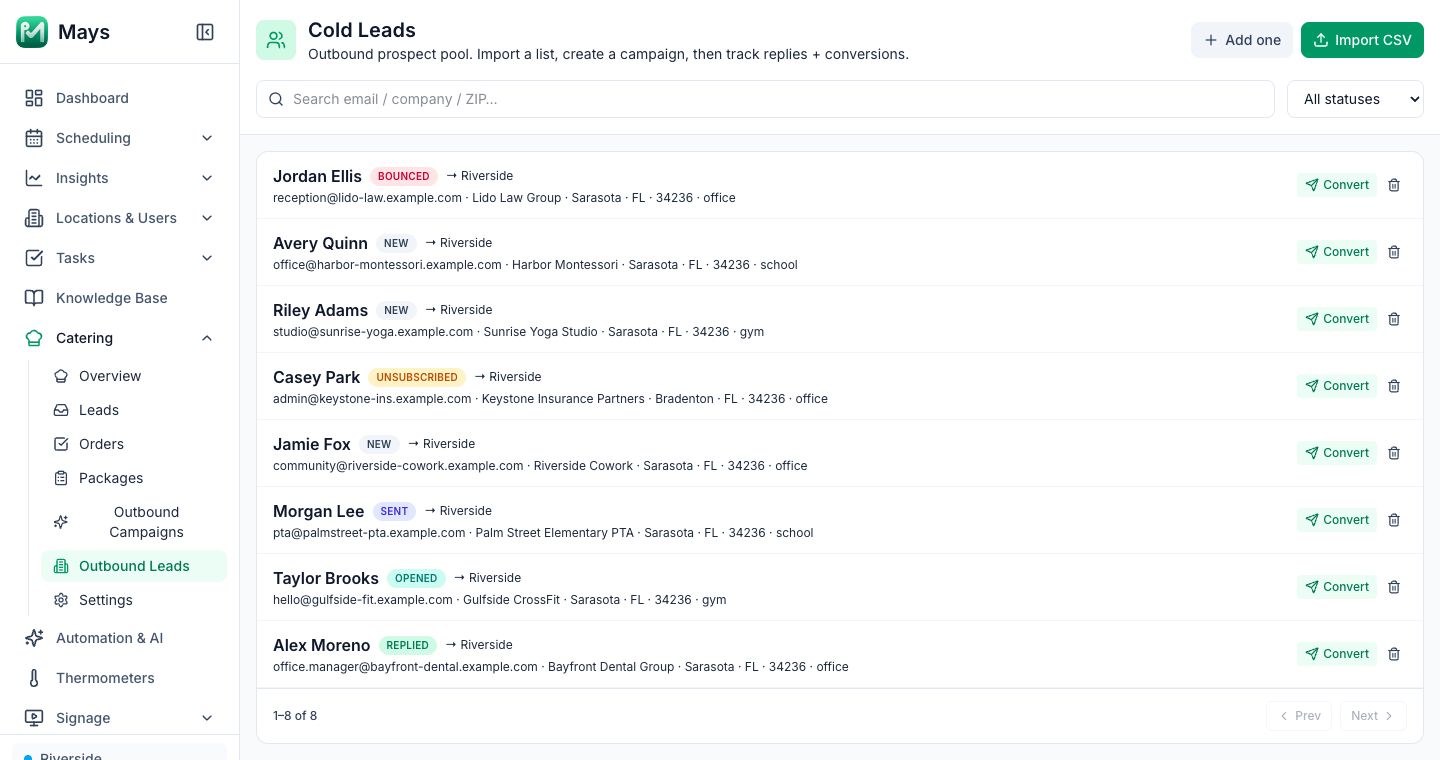
Catering outreach, set up with our team. Mays catering includes an outbound list for exactly this. The image at the top of this post shows it: Catering → Outbound Leads, where you import a CSV of local prospects (offices, gyms, schools) or add one at a time, each with a status from New through Sent, Opened and Replied, plus Unsubscribed and Bounced. Convert turns a prospect who's ready to order into a catering lead.
From the list, Outbound Campaigns sends emails in batches, at most 100 an hour. Each email ends with an unsubscribe link, and Mays skips anyone who has unsubscribed or bounced. Catering, including outreach, is configured with our team.
The event days themselves:
- On the schedule: add the market or the school night to the Events row, and that day's staff get a reminder that morning.
- Extra hands: post an open shift for the event, and staff who want the hours can claim it.
- The pack-out list: build an event checklist in Tasks → Templates (cups, lids, thermometer, card reader, signage, cash bank) with a Photo of the packed van, and send it with Create Task before each event.
Your community partnership checklist
- A 10-minute walking map of potential partners; pick two
- An easy first offer for each
- Catering menu with per-person prices and minimums
- Outreach emails with your postal address, an ad label and an unsubscribe link
- Promotional partnerships disclosed
- School sales checked against Smart Snacks and the school's rules
- Donations to nonprofits, in good faith
- Florida events: your license covers one unit; sales tax still applies
- Every contact tracked, with one follow-up
Become part of the neighborhood's routine
Keep your prospects, events and event-day checklists in one place.
Start your free trial: 30 days, every module, no card needed. Want catering outreach set up for your café? Book a walkthrough.