Walk-in cooler organization chart: what goes on which shelf, and FIFO
A walk-in gets organized once, on the day the first delivery arrives, and then by whoever puts the next delivery away. Six weeks later the raw chicken is on the top shelf because there was room, and the cut lettuce is underneath it.
A storage chart on the door fixes that. It tells everyone, including the delivery driver and the new prep cook, which shelf each kind of food goes on, and why.
This is general information, not legal advice. Your health inspector has the final word.
Why the order is top to bottom by cooking temperature
The rule behind the chart is cross-contamination: raw animal food drips. The 2022 FDA Food Code requires separating raw animal foods from ready-to-eat food, from cooked food and from "Fruits and vegetables before they are washed" (§3-302.11(A)(1)), and separating "types of raw animal FOODS from each other such as beef, FISH, lamb, pork, and POULTRY" by separate equipment or by "Arranging each type of FOOD in EQUIPMENT so that cross contamination of one type with another is prevented" (§3-302.11(A)(2)).
The Food Code's own explanation (Annex 3, public health reasons for §3-302.11) gives the order: "The required separation is based on a succession of cooking temperatures as specified under § 3-401.11 which are based on thermal destruction data and anticipated microbial load. For example, to prevent cross-contamination, fish and pork, which are required to be cooked to an internal temperature of 145°F for 15 seconds, shall be stored above or away from raw poultry, which is required to be cooked to an internal temperature of 165°F (<1 second, instantaneous) due to its considerably higher anticipated microbial load."
So: food that won't be cooked at all goes highest, and food that needs the hottest cook goes lowest. If something drips, it drips onto food that will be cooked hotter than it.
Section numbers are from the 2022 edition; check which one your state enforces (Florida, for example, enforces the 2017 edition). The FDA has since published a 2026 edition; the rules quoted here haven't changed in substance in it.
The chart
Shelf (top to bottom) | What goes here | Cooked to (§3-401.11) |
|---|---|---|
1. Top | Ready-to-eat: cooked and prepped food, sauces, dressings, cheese, deli meats, desserts, washed and cut produce | Not cooked again |
2 | Raw fish and seafood; raw eggs for dishes cooked to order | 145°F for 15 seconds |
3 | Whole cuts of raw beef, pork and lamb (steaks, chops, roasts) | 145°F for 15 seconds (roasts have their own time and temperature chart) |
4 | Ground and injected meats, ground fish; raw eggs not cooked to order | 155°F for 17 seconds |
5. Bottom | Raw poultry; stuffed meats and pasta; anything stuffed with raw meat, fish or poultry | 165°F, instantaneous |
Unwashed produce goes on its own rack, kept apart from raw animal food (§3-302.11(A)(1)(c)) and from ready-to-eat food (§3-302.11(A)(8)). If it has to share a rack with raw meat, it goes above the meat.
Where two foods share a temperature, like fish and pork, the Annex adds that they "shall be separated from one another during storage and preparation by maintaining adequate spacing or by placing the food in separate containers". Give each its own lidded container or its own end of the shelf.
The rules that go with it
- Six inches up. Food is stored "At least 15 cm (6 inches) above the floor" (§3-305.11(A)(3)). No cases on the walk-in floor, not even for an hour. (Some containers, like milk in plastic crates and canned or bottled food, may sit on a clean, dry floor under §3-305.11(C).)
- Covered. Food is stored "in packages, covered containers, or wrappings" (§3-302.11(A)(4)). Food that's still cooling is the exception: it may be "Loosely covered, or uncovered if protected from overhead contamination" while it cools (§3-501.15(B)(2)), which in practice means the top shelf.
- Labeled. Containers of ingredients out of their original package are "identified with the common name of the FOOD" (§3-302.12).
- Dated. In-house ready-to-eat TCS food held more than 24 hours is marked for "a maximum of 7 days. The day of preparation shall be counted as Day 1" (§3-501.17(A)), and discarded when it's past that date or has no date (§3-501.18(A)).
- No chemicals above food. Cleaning chemicals don't belong in the walk-in; the Food Code requires them in an area "that is not above FOOD" (§7-201.11(B)).
- 41°F or less. Cold TCS food is held at 41°F or below (§3-501.16(A)(2)). Keep the evaporator fan clear: don't stack boxes in front of it.
First in, first out
The Food Code sets the date marks (how to write the labels is in hiring a prep cook); first in, first out (FIFO) is how you use them without waste:
- Receive: check temperatures and dates, write the received date on cases without one.
- Rotate: move the older product to the front or the left, and put the new delivery behind it. Never stack new on top of old.
- Use: take from the front. If a prep cook has to move something to reach the right container, the shelf is set up wrong.
- Check: once a day, look for anything at or past its date. The line check is a natural moment.
Allergens need a home too: keep tree nuts, peanuts and sesame products in sealed, labeled containers on their own spot of the shelf, so a spill doesn't land in something that doesn't list them. The allergen matrix is only as good as the storage behind it.
A door sign you can post
Print this at the walk-in door:
WALK-IN: TOP TO BOTTOM
1 TOP     Ready-to-eat, cooked, prepped, washed produce
2         Raw fish and seafood
3         Raw whole cuts: beef, pork, lamb
4         Raw ground meats
5 BOTTOM  Raw poultry and anything stuffed

Everything 6 inches off the floor. Covered, labeled, dated.
Day of prep = Day 1. Gone after Day 7.
Oldest in front. New delivery behind.
No chemicals in the walk-in.
Set it up in Mays
Mays doesn't print the sign, but it can make the chart the way your team counts:
- Go to Inventory → Shelves (the page is called Shelves & bins) with your location picked in the sidebar.
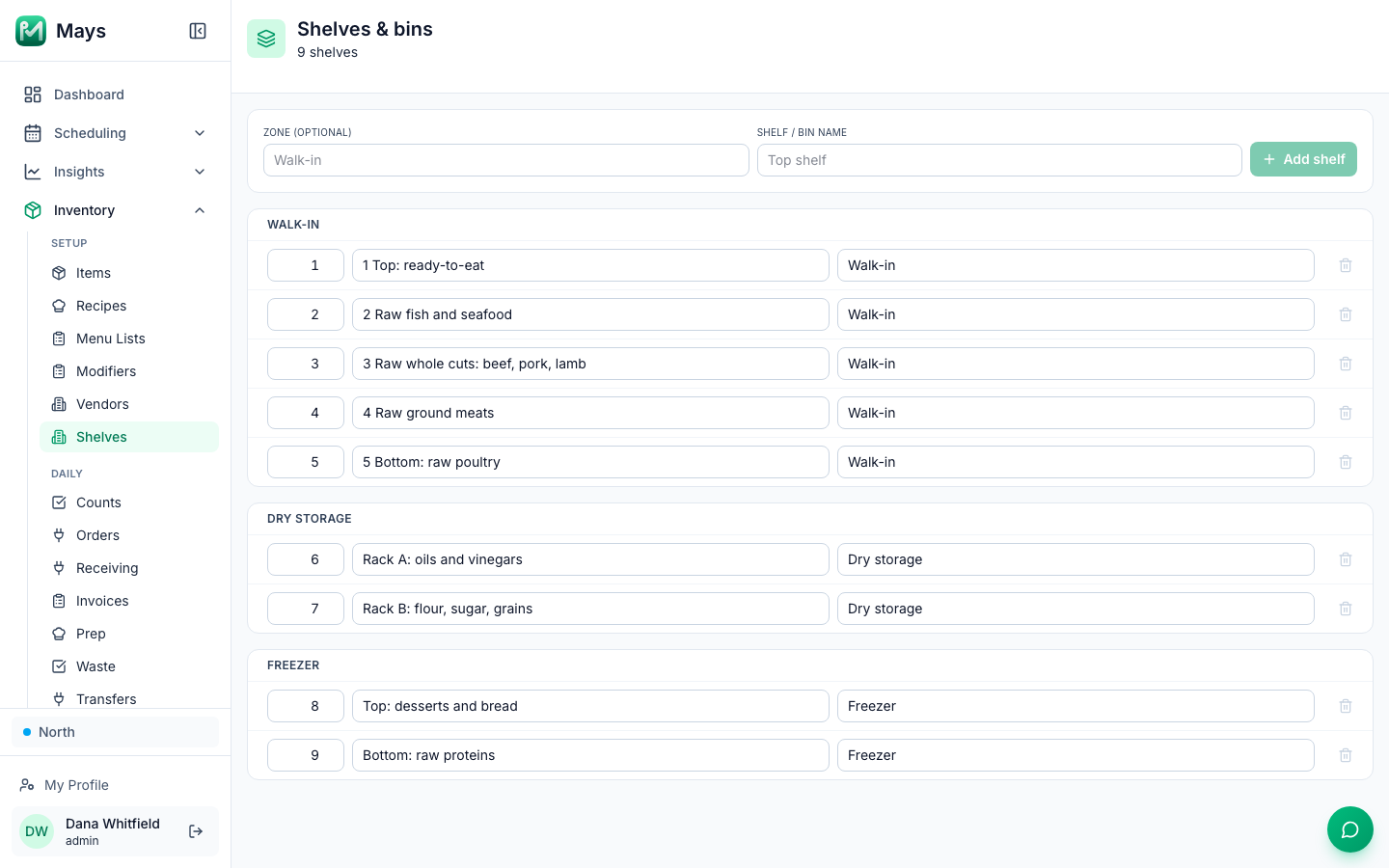
- Type a Zone (optional) of Walk-in, a Shelf / bin name such as 1 Top: ready-to-eat, and click Add shelf. Add the rest of the shelves the same way, top to bottom.
- Each shelf has an order number. Shelves are listed, and offered in the app, from the lowest number up, so number them in the order you walk the walk-in.
- Open each item under Inventory → Items, pick its Home shelf (for example Walk-in · 5 Bottom: raw poultry) and click Save item.
In the Mays app, a Guided count then goes shelf by shelf: pick the shelf you're standing at, and the items that live there are marked On this shelf. A cook counting the walk-in sees where the chicken should be, which is a daily reminder of the chart. Counting on the web doesn't use shelves.
Where Mays fits
- The storage order is the count order, so the chart is used every time someone counts, not just when it's taped up.
- A monthly walk-in clean goes on a Monthly checklist template, with a photo of the empty, clean shelves. See the restaurant cleaning schedule.
- The walk-in watches itself. Wireless thermometers record a reading every five minutes and alert your team when the temperature leaves its range; see temperature alerts.
Organize it once, keep it that way
Post the chart, set up the shelves in the same order, and the next delivery goes where it belongs.
Start your free trial: 30 days, every module, no card needed. Or book a walkthrough and we'll set up your shelves and counts with you.