Server sidework checklist: opening, running and closing (free template)
Sidework is the work servers do around the tables: stocking the station, rolling silverware, filling ice, wiping menus, breaking down the station at close. When it's vague ("help close"), the same two people do it every night and the rest leave early. When it's written down by station and checked before anyone cashes out, it gets done, and the next shift walks into a stocked floor.
This template is for a small full-service restaurant with three or four server sections, a service station with ice, tea and coffee, and a host stand.
This is general information, not legal advice.
The Food Code rules that land on servers
Most sidework is about readiness, but a few lines are food safety. Section numbers are from the 2022 FDA Food Code; check which edition your state enforces.
- Wiping cloths. Cloths used on counters and other surfaces are "Held between uses in a chemical sanitizer solution" and "Laundered daily" (§3-304.14(B)). The bucket is a sidework line, and so is its test strip.
- Ice scoops. A scoop used only for ice is stored "In a clean, protected location" (§3-304.12(E)), not buried in the ice bin.
- Silverware. "Knives, forks, and spoons that are not prewrapped shall be presented so that only the handles are touched by EMPLOYEES and by CONSUMERS if CONSUMER self-service is provided" (§4-904.11(B)). Roll silverware with clean hands, holding it by the handles.
- Preset tables. Tableware set on the table before guests arrive is "protected from contamination by being wrapped, covered, or inverted" (§4-904.13(A)). Exposed settings are allowed only if "Unused settings are removed when a CONSUMER is seated", or the ones left are cleaned and sanitized before further use (§4-904.13(B)).
- Condiments that go table to table. Food a guest has had can't be served to another, except a closed container such as "a narrow-neck bottle containing catsup, steak sauce, or wine", or food like "crackers, salt, or pepper" in "an unopened original PACKAGE" (§3-306.14). Open ramekins of sauce go back to the dish pit, not to the next table.
The template
Who is a section or a role, so it rotates with the schedule. Proof is a photo where seeing is the proof and a checkbox for the rest.
Opening sidework (before doors open)
Station | Task | Who | Proof |
|---|---|---|---|
Service station | Ice bin filled; scoop stored outside the ice | Opening server | Checkbox |
Service station | Tea brewed and dated; coffee brewed | Opening server | Checkbox |
Service station | Sanitizer bucket made and tested; clean cloths in it | Opening server | Checkbox |
Service station | Lemons cut, garnish tray filled and covered | Section 1 | Checkbox |
Service station | To-go boxes, bags, lids and straws stocked | Section 2 | Checkbox |
Dining room | Tables set; every setting wrapped, covered or inverted | Each section | Photo |
Dining room | Condiment bottles wiped and filled; salt and pepper full | Section 3 | Checkbox |
Dining room | Menus wiped; specials inserted | Host | Checkbox |
Host stand | Reservations and the floor plan for the shift checked | Host | Checkbox |
Host stand | Highchairs and booster seats wiped and sanitized | Host | Checkbox |
Running sidework (during service)
Station | Task | Who | Proof |
|---|---|---|---|
Service station | Ice, tea and coffee kept full; tea re-brewed on schedule | Section 1 | Checkbox |
Service station | Sanitizer bucket changed and tested mid-shift | Section 2 | Checkbox |
Dining room | Tables bused and reset within a few minutes of guests leaving | Each section | Checkbox |
Dining room | Restroom check: soap, towels, paper, floor | Section 3 | Checkbox |
Dining room | Open ramekins and used condiments back to the dish pit | Each section | Checkbox |
Closing sidework
Station | Task | Who | Proof |
|---|---|---|---|
Service station | Ice bin emptied or topped up per your close; scoop washed | Closing server | Checkbox |
Service station | Tea and coffee urns emptied and washed; tea pitchers to dish | Section 1 | Checkbox |
Service station | Garnish tray covered, dated and in the walk-in | Section 1 | Checkbox |
Service station | Station wiped and restocked for the opener | Section 2 | Photo |
Dining room | Silverware rolled to par, holding by the handles | Each section | Checkbox |
Dining room | Condiment bottles wiped, filled and capped | Section 3 | Checkbox |
Dining room | Tables and chairs wiped; booths crumbed | Each section | Checkbox |
Dining room | Floor swept under tables | Each section | Checkbox |
Close | Wiping cloths to the laundry bag; sanitizer bucket emptied | Closing server | Checkbox |
A rotation chart that's fair
Fixed sidework by section ("whoever has section 3 does condiments") is fair only if everyone rotates through the sections. Write the rotation down for the week:
Day | Section 1 | Section 2 | Section 3 | Closing server |
|---|---|---|---|---|
Mon | Garnish, tea | Station restock | Condiments | Ice, urns, cloths |
Tue | Station restock | Condiments | Garnish, tea | Ice, urns, cloths |
Wed | Condiments | Garnish, tea | Station restock | Ice, urns, cloths |
The closing server role rotates with the schedule. Whoever closes on Friday shouldn't close on Saturday too.
The check-out step
Sidework sticks when it's part of leaving. Before a server cashes out:
- They finish their section's closing list and tell the manager.
- The manager walks the section and the station: silverware at par, bottles capped, station stocked.
- Anything not done goes back to the server, with the reason, before cash-out.
This is also where the cash routine lives; see cash handling and till reconciliation. For the rest of a new server's training (POS, cash and the allergen questions), see hiring servers and cashiers.
Sidework and the tipped wage
If you pay servers a tipped cash wage, the US Department of Labor's tipped-employee fact sheet says a server's related duties are different from a second job: "Such a situation is distinguishable from that of a server who spends part of their time cleaning and setting tables, toasting bread, making coffee and occasionally washing dishes or glasses" (DOL Fact Sheet #15). Hours spent on a separate, non-tipped job are a different matter, and state rules can be stricter. Keep sidework to the work around the tables, and see tip pooling for new restaurant owners for the tip-credit basics.
Load it into Mays
Make one template per list: Server opening sidework, Server running sidework, Server closing sidework.
- Go to Tasks → Templates, click Create Template, name it and click Continue.
- Click Add Task Group and rename the group to a station (Service station, Dining room). Type each task into Add a task (press Enter) and press Enter.
- On the Settings tab, choose Daily and set a Visibility Window, for example 10:00 AM to 11:30 AM for opening and 9:00 PM to 11:30 PM for closing. Outside those hours the tasks don't show in the app.
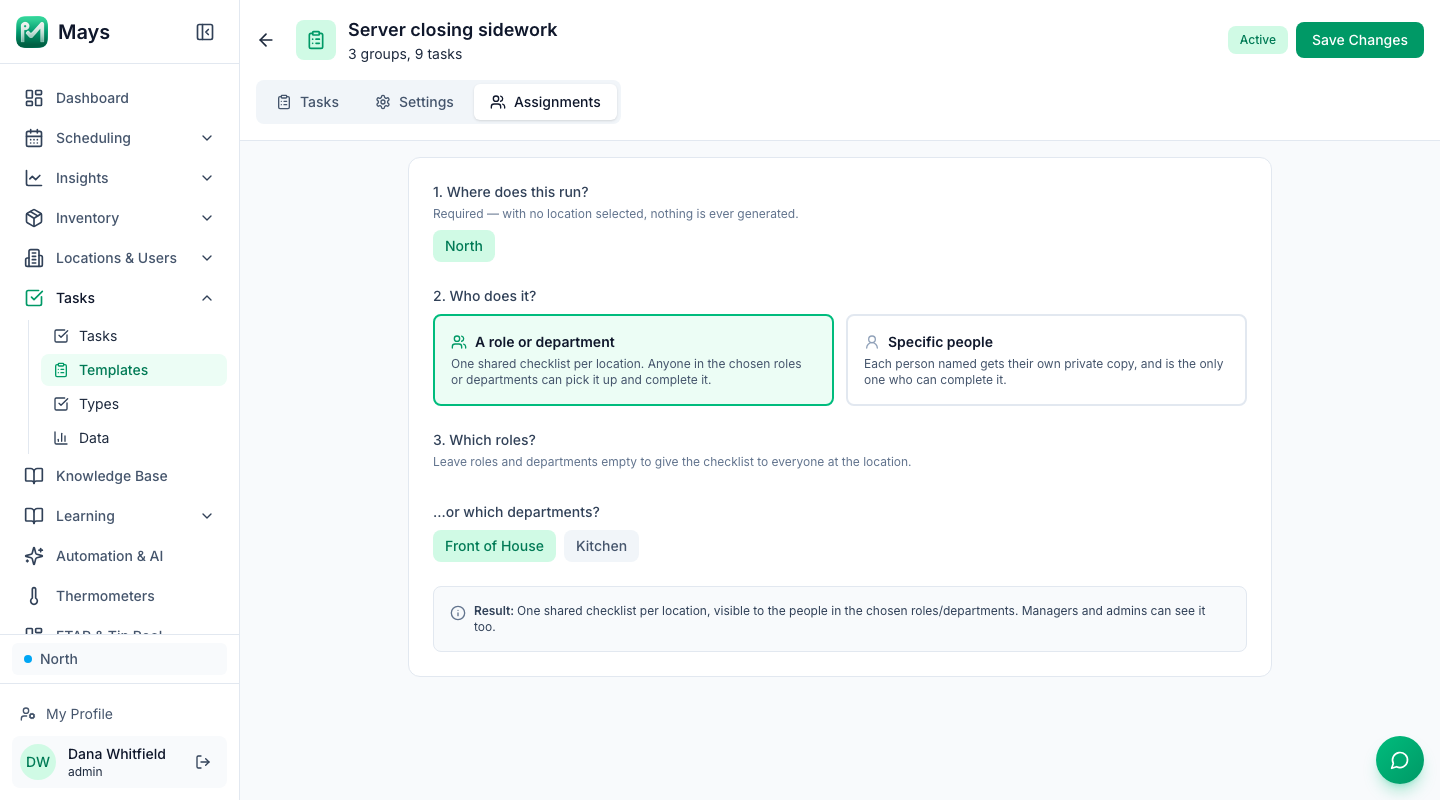
- On the Assignments tab, click the location, choose A role or department and pick your front-of-house department. That makes one shared checklist per location: any server can pick up a task, and the app shows who completed it.
- To give one task to one person every day (the host's reservation check, say), open the task's pencil and pick them under Assign to person (optional). Click Create Template.
One thing to know before you name the groups: in the app, groups are sorted alphabetically, not in the order you set them, and groups with the same name from different templates are listed together. Name them so the order reads right, for example 1 Service station and 2 Dining room, and add the list name if the opening and closing lists overlap in time.
# Server closing sidework
[1 Service station]
Ice bin emptied or topped up per your close; scoop washed
Tea and coffee urns emptied and washed; tea pitchers to dish
Garnish tray covered, dated and in the walk-in
Station wiped and restocked for the opener
[2 Dining room]
Silverware rolled to par, holding by the handles
Condiment bottles wiped, filled and capped
Tables and chairs wiped; booths crumbed
Floor swept under tables
[3 Close]
Wiping cloths to the laundry bag; sanitizer bucket emptied
Where Mays fits
- Sidework appears on its own on the team's task list every day, in the hours you set.
- The manager's check-out walk happens on the phone: they see which tasks are done and by whom, and can reject one with a reason so it goes back on the list.
- Photos come from the app's camera, so the station photo is from tonight.
- Rotation follows the schedule: with a shared list, whoever is on the floor picks up the tasks; for strict assignments, use Specific people, which gives each person their own copy.
For writing tasks two people do the same way, see checklists your staff will actually follow.
Make sidework part of cashing out
Write the three lists, post the rotation, and check sidework before anyone leaves. Your openers will notice the difference first.
Start your free trial: 30 days, every module, no card needed. Or book a walkthrough and we'll set up your sidework lists with you.