Florida food service licensing for a new café or restaurant: DBPR or FDACS?
Before you sell your first coffee in Florida, a state agency has to approve the space, take your application and inspect you. There are two main agencies, and which one you deal with depends on what you sell.
This is the first post in our series Florida compliance basics for a new café or restaurant. It covers who licenses you, the steps each agency asks for before opening, what it costs, and the other permits that sit around the food license.
This is general information, not legal advice. Updated October 5, 2026: every source below was checked on that date. Call the agency before you sign a lease or order equipment, and treat its answer as final.
Two agencies, one question: what do you sell?
DBPR's own page puts it plainly: "The State of Florida has three primary food regulatory agencies," the Department of Business and Professional Regulation (DBPR), the Department of Agriculture and Consumer Services (FDACS) and the Department of Health (DOH). "Each agency regulates a different part of the retail food service industry" (DBPR, Hotels and Restaurants jurisdiction).
From that page:
Agency | What it licenses (DBPR's list) |
|---|---|
DBPR, Division of Hotels and Restaurants | "Free standing restaurants", "Fast food services (takeout and delivery)", "Mobile units that serve hot dogs and/or full food service", "Bars that serve food", plus lodging |
FDACS | "bakeries, grocery stores, and convenience stores" |
DOH | "bars that do not serve food, civic and fraternal organizations, and institutions such as schools and detention facilities" |
FDACS's own permit page is more specific, and it matters for cafés. It issues retail food permits to food establishments "selling directly to customers," which "may include supermarkets, grocery stores, convenience stores, coffee shops, bakeries, retail meat markets, retail seafood markets, juice and smoothie bars," among others (FDACS, Retail Food Establishment Permit).
The law draws the same line from the other side. Florida's definition of a "public food service establishment" (the DBPR license) covers any place "where food is prepared, served, or sold for immediate consumption on or in the vicinity of the premises; called for or taken out by customers; or prepared prior to being delivered to another location for consumption." It then excludes "Any place of business issued a permit or inspected by the Department of Agriculture and Consumer Services under s. 500.12" and any place where the food "is limited to ice, beverages with or without garnishment, popcorn, or prepackaged items sold without additions or preparation" (s. 509.013(5), Florida Statutes).
So a full-service restaurant is DBPR. A grocery store is FDACS. A coffee shop, bakery-café or smoothie bar can be either, depending on what you make and how you serve it, and the agencies decide that, not you. If you later add something your agency doesn't cover, DBPR warns that switching "may require major equipment or physical plant changes" (DBPR jurisdiction page).
Our advice: write down your menu and how you'll serve it (seats, to-go, hot food, what you bake on site), and send it to both agencies before you sign anything. Get the answer in writing.
The DBPR path: restaurants and most cafés with a kitchen
DBPR's guide for a permanent food service license lists four steps: "Create a DBPR online account", "Determine if plan review is required", "Apply for a license (with plan review if required) and pay the license fee", and "Schedule and pass the licensing Inspection." If you need plan review, DBPR recommends applying for the license and plan review together with one of its combination applications: "This COMBO is the fastest way to apply and get open" (DBPR, Guide to Permanent Food Service).
Seating or non-seating
DBPR has two permanent licenses:
- A Seating license "is for a permanent structure that includes seats for customers to dine-in" and "allows for take-out/delivery and catering services."
- A Non-Seating license is for a permanent structure "that does not include any seating under the control of the food service," and also "allows for take-out, delivery services and catering services."
Your seat count is set by local rules: "Seating limits are established by building design, building code, fire safety, water and sewer capacity, and other considerations under the jurisdiction of local authorities" (same guide).
New license or change of owner
Taking over an old restaurant space changes which application you file. DBPR's guide says to apply for a new license in a new building, in a space that has never been a restaurant, or where a restaurant closed over 18 months ago. "If taking over a space currently licensed by a restaurant or where a restaurant has been closed less than a year, apply for CHANGE OF OWNER even if the business is completely different." Licenses don't move with you either: a license "may not be transferred from one place or individual to another" (s. 509.241(1), F.S.).
Plan review
DBPR's guide says plan review is required if you construct or use a space never licensed by the division, use a space closed for more than 18 months, use a remodeled space, or change the menu or concept. It isn't required when none of that applies, when the kitchen is already licensed and nothing changes, or when you share a licensed kitchen (each operator still needs its own license).
DBPR's plan review page asks for a complete application, a "Scale drawing of floor plan with equipment labeled" and a "Sample menu," and says online applicants "can expect it to be reviewed within 30 days." The same page lists what the reviewers look for, by topic: bathrooms, finishes, equipment, fire safety, handwashing sinks in every prep, warewashing and dispensing area, lighting, a mop sink, plumbing, a three-compartment sink or dishmachine, and more. Read it before your designer draws anything.
What it costs
From DBPR's food service fee page:
Item | Fee |
|---|---|
Application fee (new or change of ownership) | $50 |
Plan review | $0: "Plan Reviews are provided at no charge" |
Non-seating license, full year | $242 |
Seating license, 1–49 seats, full year | $262 |
Seating license, 50–149 seats, full year | $273 |
The $10 Hospitality Education Program fee is already included in the license fees. If you apply six months or less before your district's renewal period, you can pay the half-year fee instead.
Licenses renew every year on a date set by your county's district, not by when you opened: "The expiration date does not change, regardless of when an application is submitted." For example, Miami-Dade renews on October 1, Broward and Palm Beach on December 1, Hillsborough and Pinellas on February 1, and Orange on April 1.
The opening inspection
"All new licensees are required to pass a sanitation and safety inspection prior to opening" (DBPR guide). The law backs it up: you must "apply for and receive a license from the division prior to the commencement of operation," and operating without one is "a misdemeanor of the second degree" (s. 509.241, F.S.).
Our health inspection prep guide covers DBPR's opening checklist (form HR 5024-017), the routine inspections that follow and the violation classes, so we won't repeat them here.
After you open
- Display the license. It "shall be conspicuously displayed in the office or lobby," and if you cater, you "shall display their license number on all advertising for catering services" (s. 509.241(3)). Our catering guide covers catering under a DBPR license.
- No home kitchen. DBPR: "Food service operations MAY NOT be conducted in a private residence."
The FDACS path: coffee shops, bakeries, juice bars
If FDACS is your agency, its retail permit page lays out the steps:
- Check the building against FDACS's Food Establishment Minimum Construction Standards.
- Get water and sewer documentation: for a public system, "a copy of the water and sewerage bill or an application for water sewerage (for the location)."
- Optional plan review. FDACS calls it voluntary; the initial fee "is $55.10, which includes a $25 application fee and $30.10 for the first hour of plan review."
- Designate a Certified Food Protection Manager if you handle potentially hazardous food. Our post on food manager and food handler training covers the details.
- Apply. "Twenty-one (21) days prior to opening, a food permit application should be submitted to FDACS." After you submit, "a field inspector will make contact within three to five business days to schedule an onsite inspection. The onsite inspection will typically be conducted within two weeks."
- Pass the inspection and pay. Payment instructions are emailed after the inspection, and "Payment is required before the food permit can be issued."
The fee depends on what you do; the statute caps it at $650 a year (s. 500.12(1)(b), F.S.). A permit for a new establishment "is valid for 1 calendar year after the date of issuance," a late renewal adds up to $100, and permits "are not transferable from one person or physical location to another" (same section).
The permits around the food license
The food license isn't the only one. FDACS's advice applies whichever agency you have: "Before making financial commitments, such as signing a lease or construction contracts or purchasing an existing business, contact the business license, zoning and building authorities in your area to find out their requirements."
- Local business tax receipt from your city and county. Under FDACS, you "must exhibit a current food permit or an active letter of exemption" before the local business tax certificate is issued or renewed (s. 500.12(8)).
- Building and fire. DBPR's plan review page notes that missing fire items won't stop plan approval "but may result in a failed fire safety inspection," and points you to the State Fire Marshal or your local fire authority.
- Sales tax registration with the Florida Department of Revenue, covered in the sales tax post in this series.
- Beer and wine need a license from DBPR's other division: the Division of Alcoholic Beverages and Tobacco "issues licenses or permits that are required for any business or person to manufacture, import, export, store, distribute or sell alcoholic beverages" (DBPR, Alcoholic Beverages & Tobacco). It is a separate application with its own zoning step.
Your licensing checklist
- Menu and service style written down, and sent to DBPR and FDACS for a written answer on who licenses you
- Zoning, building and local business tax rules checked before you sign the lease
- DBPR: online account, plan review if your space needs it, seating or non-seating license, $50 application fee
- FDACS: construction standards, water and sewer papers, permit application 21 days before opening
- Opening inspection passed before the first sale
- License displayed, and your district's renewal date on the calendar
- Sales tax, alcohol and fire permits handled separately
Where Mays fits
Mays doesn't file license applications or track renewal dates for you. It helps with what comes after:
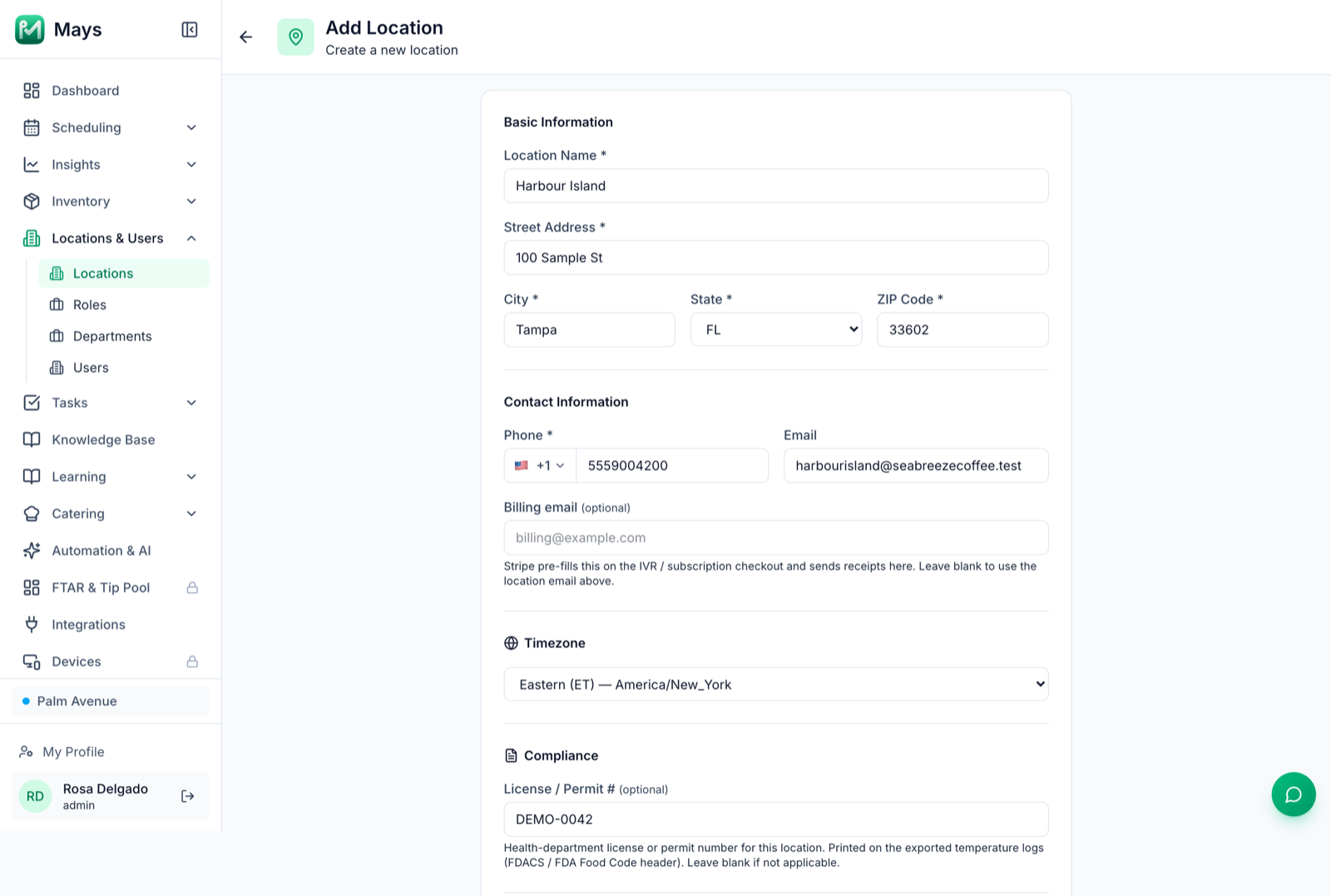
- Your license number on file. Add it to the location under Locations & Users → Locations in License / Permit # (the image at the top of this post). Mays prints it at the top of every temperature log you export as a PDF or CSV, ready for an inspector.
- Inspection-ready routines. Build your opening inspection walk-through and your daily checks as checklist templates with photo and number answers; the inspection prep guide has a self-inspection checklist to copy.
- One-off reminders. Use Tasks → Create Task for a one-time job like "Display the new DBPR license by the counter," assigned to a manager. A task created on the web is for today, so keep your renewal date on a calendar too.
Get your opening routines in place
Set up your location, your opening checklist and your first schedule before the inspector arrives.
Start your free trial: 30 days, every module, no card needed. Or book a walkthrough and we'll set it up with you.
Next in the series: Florida sales tax for restaurants and cafés.