Incident report form for a restaurant: injuries, illness complaints and what to record
A guest slips by the drink station. A cook cuts a finger to the bone. A caller says her family got sick after Saturday's dinner. Each needs the right response in the moment, and each needs a written record the same day, while the people who saw it are still on shift and the details are still clear.
This post is the form: what to write down, for which kind of incident, and when someone outside the restaurant needs to hear about it. How to talk to an upset guest is in handling customer complaints; Florida's workers' compensation steps after an employee injury are in workers' compensation for a Florida restaurant. This post doesn't repeat them.
This is general information, not legal, medical or insurance advice. In an emergency, call 911 first. Your insurer, your health department and your attorney have the final word on what to report.
When to tell someone outside the restaurant
What happened | Who to tell | The rule |
|---|---|---|
An apparent foodborne illness outbreak, a sewage backup, an extended power or water outage, a fire or flood | Your health department, right away, and stop the affected operations | The permit holder "shall immediately discontinue operations and notify the REGULATORY AUTHORITY if an IMMINENT HEALTH HAZARD may exist because of an emergency such as a fire, flood, extended interruption of electrical or water service, SEWAGE backup, misuse of POISONOUS OR TOXIC MATERIALS, onset of an apparent foodborne illness outbreak, gross insanitary occurrence or condition, or other circumstance that may endanger public health" (FDA Food Code §8-404.11(A)) |
A food employee who is jaundiced or diagnosed with norovirus, hepatitis A, Shigella, Shiga toxin-producing E. coli, typhoid fever or nontyphoidal Salmonella | Your health department | "The person in charge shall notify the regulatory authority when a food employee is: (1) Jaundiced, or (2) Diagnosed with an illness due to a pathogen" on that list (§2-201.11(B)) |
A guest says your food made them sick | Your health department, if your state or local code requires it or you suspect an outbreak | The CDC asks people who get sick to "Help solve outbreaks by reporting your illness to your local health department" (CDC, Foodborne Outbreaks). Don't discourage a guest from reporting. |
An employee dies from a work-related incident | OSHA, within 8 hours | "Within eight (8) hours after the death of any employee as a result of a work-related incident, you must report the fatality" to OSHA (29 CFR 1904.39(a)(1)) |
An employee is hospitalized as an in-patient, or loses an eye or has an amputation | OSHA, within 24 hours | "Within twenty-four (24) hours after the in-patient hospitalization of one or more employees or an employee's amputation or an employee's loss of an eye, as a result of a work-related incident, you must report" it to OSHA (1904.39(a)(2)) |
Any employee injury | Your workers' compensation carrier, by your state's deadline | Florida's is 7 days after you know about it; see the workers' comp post |
A guest injury, or anything that could become a claim | Your general liability insurer | Your policy sets the deadline; call your agent the same day |
Section numbers are from the 2022 FDA Food Code. The FDA has since published a 2026 edition; the rules quoted here haven't changed in substance in it, and the clean-up section below was renumbered.
Two procedures to have in writing before you need them
- Vomit and diarrhea clean-up. "A FOOD ESTABLISHMENT shall have written procedures for EMPLOYEES to follow when responding to vomiting or diarrheal events that involve the discharge of vomitus or fecal matter onto surfaces in the FOOD ESTABLISHMENT" (§2-501.11; §2-502.11 in the 2026 edition). For norovirus, the CDC says: "To disinfect, use a chlorine bleach solution with a concentration of 1,000 to 5,000 ppm (5 to 25 tablespoons of household bleach [5% to 8%] per gallon of water) or use an EPA-registered disinfecting product against norovirus", and "Leave bleach disinfectant on the affected area for at least 5 minutes" (CDC, How to Prevent Norovirus). That's much stronger than your sanitizer bucket, so keep a labeled kit (gloves, absorbent, bags, the right product) and the steps with it.
- An allergic reaction. The FDA says people with a food allergy who start having symptoms "should stop eating the food immediately, evaluate the need to use emergency medication (such as epinephrine) and seek medical attention" (FDA, Food Allergies). Staff should call 911 for trouble breathing, swelling of the throat or a guest who passes out, and keep the dish and its ingredient list for the record.
The incident report form
Fill it in the same day, by the manager on duty, with the people involved and any witnesses still there. Write what you saw and what people said, in their words. Don't guess the cause and don't assign blame on the form.
1. The basics
Field | Example |
|---|---|
Type | Guest injury / Employee injury / Guest illness complaint / Allergic reaction / Foreign object in food / Property damage / Other |
Date and time it happened | Mon 12:40 pm |
Where in the store | Drink station, in front of the lid caddy |
Reported by and to | Barista to the manager on duty, 12:42 pm |
2. The people
Field | Example |
|---|---|
Who was involved | Name, phone, guest or employee (and position) |
Witnesses | Names and phones, guests and staff |
Who handled it | Manager on duty |
3. What happened
Field | Example |
|---|---|
In their words | "I didn't see the puddle." |
In ours | Iced tea spilled about 5 minutes earlier; no wet-floor sign was out yet |
Injury or symptoms | Scraped left palm; no other injury reported |
Care given | Hand washed, antiseptic and a bandage from the first-aid kit; guest declined more care |
911 called? | No |
4. If food is involved
Field | Example |
|---|---|
What they ate or drank, and when | Chicken sandwich, Saturday about 7 pm |
Symptoms and when they started | Stomach cramps and vomiting, Sunday about 2 am |
Others in their party sick? | Two of four |
Product kept? | Remaining chicken from that batch held, labeled "do not use," with the delivery date |
Our records for that day | Temperature logs, receiving log and any employee illness reports pulled |
5. Who was told, and follow-up
Field | Example |
|---|---|
Health department | Not needed / Called, name and time |
OSHA | Not needed / Reported, time |
Insurer or workers' comp carrier | Agent emailed, time |
Follow-up | Manager calls the guest tomorrow at 10 am; wet-floor sign rule at pre-shift |
Signatures | Manager on duty; the employee involved, for an employee injury |
Keep a photo of the spot, the object or the product with the form. Then read the month's reports at your weekly manager meeting: three slips at the same spot is a floor problem, not bad luck. For product held after an illness complaint, your receiving log tells you which delivery it came from.
Where Mays fits
Mays has no incident module, but the form above works as a custom form:
- Build the form once. Under Tasks → Types, an admin clicks New task type and adds the fields: a Single choice for the type of incident, Date / time, Text boxes for who, what happened, care given, witnesses, food involved and follow-up, Yes / No for "911 called" and "health department notified", a Photo, and a Signature for the manager.
- Put it in an on-demand template. Under Tasks → Templates, create a template with one task whose answer type is Custom form, pick Incident report under Task Type in the task's Edit Task window, and set Frequency to Custom.
- Start it when something happens. The manager on duty goes to Tasks → Create Task → From Template and assigns it to themselves, then fills it in on the iPhone or Android app, photo and signature included.
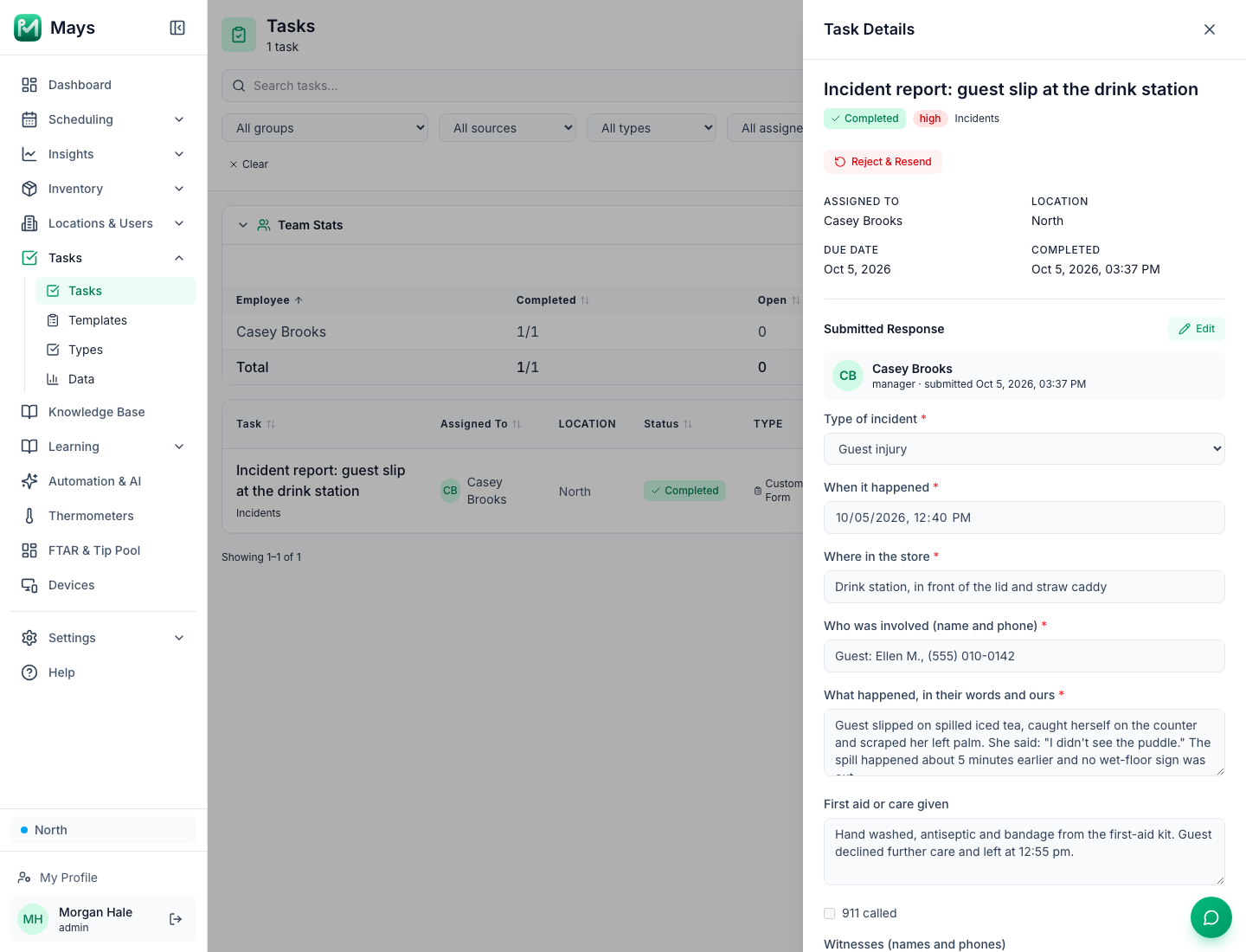
On the web, the submitted report opens from Tasks → Tasks with every answer and the signature, and a manager can correct an answer with Edit (the image at the top of this post). Tasks → Data lists every report for the dates you pick, with Export CSV for your insurer (photos and signatures stay on each report and aren't in the CSV).
- The handover: write a line in the manager Logbook under Incidents or Health & Safety and tick Needs follow-up, so the next shift knows. The logbook is text only, for managers and admins.
- Each follow-up as a task: Tasks → Create Task → Custom Task, assigned to one person, who gets a notification, with a Photo answer if you want proof (the wet-floor sign in place, the carrier's claim number).
- The procedures where staff can find them: put the vomit clean-up steps and the allergic-reaction steps in the Knowledge Base, shared with the location, so they're on every phone.
Three limits to know: choosing a form for a task needs access to Tasks → Types, which only admins have by default; staff can't start a form on their own, so incidents go through the manager on duty; and an incident report doesn't alert anyone by itself, so call or message the people who need to know.
Write it down the same day
Have the form ready before you need it, fill it in while everyone's still there, and close every follow-up.
Start your free trial: 30 days, every module, no card needed. Or book a walkthrough and we'll build your incident report form with you.