Mock health inspection scoring sheet: run the inspector's form before the inspector does
A self-inspection asks "is everything in order?" A mock inspection asks "what would an inspector write down if they walked in right now?" That takes someone playing the inspector, an unannounced visit, and the inspector's form.
This post lays that form out as a scoring sheet: the FDA's model Food Establishment Inspection Report (Form 3-A in Annex 7 of the Food Code), which many health departments use or adapt. If you want a walk-through organized by Food Code chapter instead, use our monthly self-inspection checklist. If you're in Florida, the health inspection prep guide has DBPR's own violation categories. Run the mock inspection once a quarter, and after any big change in staff or menu.
This is general information, not legal advice. Your health department may use its own form and its own scoring, and your inspector has the final word.
How the real form is marked
Section numbers and item names here are from the 2022 FDA Food Code. The FDA has since published a 2026 edition; we compared the form and the rules quoted here, and the differences are noted below.
The FDA's marking instructions (Guide 3-B in Annex 7) give each of the first 29 items one of four marks: "'IN' which means that the item is in compliance; 'OUT' which means that the item is not in compliance; 'N.O.' which means that the item was not observed during the inspection; or 'N.A.' which means that the item is not applicable for the facility."
Two more boxes go next to an OUT:
- COS (corrected on site). "Marking COS indicates that all violations cited under that particular item number have been corrected and verified before completing the inspection." Fixing half of an item doesn't earn the box.
- R (repeat). "Marking R indicates that the same violation under a particular item number was cited on the last inspection report."
Items 1 to 29 are the foodborne illness risk factors and public health interventions, the practices most often behind outbreaks; items 30 to 56 are good retail practices, basic sanitation and upkeep. The header counts the OUTs and repeats in items 1 to 29, and "A score is optional for this form."
The Food Code also sorts every provision into three levels (§1-201.10). A priority item is one "whose application contributes directly to the elimination, prevention or reduction to an acceptable level, hazards associated with foodborne illness or injury", like cooking, cooling and handwashing. A priority foundation item "supports, facilitates or enables one or more PRIORITY ITEMS", like training, equipment and records. A core item is everything else, mostly sanitation and maintenance.
Running the mock inspection
- Pick an inspector who doesn't work the shift: a manager from another location, a partner or a consultant. Don't announce it, and come during service.
- Start with the person in charge. Real inspections often open with a conversation. The FDA's guide says the inspector "should assess this item by asking open-ended questions" about the operation. Ask the person in charge what your cold-holding temperature is, how a cook cools a batch of soup, which symptoms keep an employee home, and where the vomit clean-up kit is.
- Carry the tools: a probe thermometer, sanitizer test strips, a flashlight and your last real inspection report, so you can mark R honestly.
- Write down every temperature you probe, in range or not.
The scoring sheet: risk factors and interventions (items 1 to 29)
Mark IN, OUT, N.O. or N.A., then tick COS or R for any OUT. "What to look for" is our shorthand, not the FDA's wording.
# | Item | What to look for | Mark | COS | R |
|---|---|---|---|---|---|
1 | PIC present, demonstrates knowledge, and performs duties | Someone in charge who can answer food safety questions | |||
2 | Certified Food Protection Manager | A current certificate on file for at least one manager | |||
3 | Management and food employee knowledge, and conditional employee; responsibilities and reporting | Staff know what illnesses and symptoms they must report | |||
4 | Proper use of restriction and exclusion | Sick staff kept off food, or home | |||
5 | Clean-up of vomiting and diarrheal events | Written procedure and a kit on site | |||
6 | Proper eating, tasting, drinking, or tobacco products use | Drinks covered, no eating at the prep table | |||
7 | No discharge from eyes, nose, and mouth | No one working food with a runny nose or cough | |||
8 | Hands clean and properly washed | Washing at the right moments, for long enough | |||
9 | No bare hand contact with RTE foods or a pre-approved alternate properly followed | Gloves, tongs or tissue on ready-to-eat food | |||
10 | Adequate handwashing sinks, properly supplied and accessible | Soap, towels, sign, nothing stored in the sink | |||
11 | Food obtained from sources that comply with Law | Invoices from licensed suppliers, nothing homemade | |||
12 | Food received at proper temperature | Receiving log with temperatures | |||
13 | Food in good condition, safe and unadulterated | No dented, swollen or spoiled product | |||
14 | Required records available: molluscan shellfish identification, parasite destruction | Shellfish tags kept, fish records if you serve it raw | |||
15 | Food separated and protected | Raw below ready-to-eat, everything covered | |||
16 | Food-contact surfaces: cleaned and sanitized | Sanitizer at label strength, boards and slicers clean | |||
17 | Proper disposition of returned, previously served, reconditioned, and unsafe food | Returned food thrown out, not re-served | |||
18 | Proper cooking time and temperatures | Probe a cooked item and record it | |||
19 | Proper reheating procedures for hot holding | Reheated food hits its temperature fast enough | |||
20 | Proper cooling time and temperatures | Cooling log, and a probe of anything cooling now | |||
21 | Proper hot holding temperatures | 135°F or above | |||
22 | Proper cold holding temperatures | 41°F or below | |||
23 | Proper date marking and disposition | Dated, Day 1 counted, nothing past 7 days | |||
24 | Time as a Public Health Control: procedures and records | Written procedure and time marks, if you use it | |||
25 | Consumer advisory provided for raw or undercooked food | Menu notice for undercooked items | |||
26 | Pasteurized foods used; prohibited foods not offered | Applies to highly susceptible populations | |||
27 | Food additives: approved and properly used | No unapproved additives | |||
28 | Toxic substances properly identified, stored, and used; held for retail sale, properly stored | Labeled bottles, chemicals below and away from food | |||
29 | Compliance with variance, specialized process, reduced oxygen packaging criteria or HACCP plan | If you vacuum-pack, cure or sous-vide |
In the 2026 edition: item 5 is now Illness Documentation, which checks for a written employee health policy as well as the vomit and diarrhea procedure, and item 16 adds "and disinfected". Use the edition your health department enforces.
The scoring sheet: good retail practices (items 30 to 56)
The FDA's form doesn't split these into IN, OUT, N.O. and N.A. (items 30, 32 and 33 aside): an item is marked only when something under it is out, with COS and R as above. Walk the building with this list:
# | Item | Mark |
|---|---|---|
30–35 | Pasteurized eggs where required; water and ice from an approved source; variance for special processes; cooling methods and equipment; plant food cooked for hot holding; approved thawing | |
36 | Thermometers provided and accurate | |
37 | Food properly labeled; original container | |
38 | Insects, rodents and animals not present | |
39 | Contamination prevented during food preparation, storage and display | |
40–46 | Personal cleanliness; wiping cloths; washing produce; in-use utensils; storage of utensils, equipment and linens; single-use articles; gloves | |
47–49 | Food and non-food-contact surfaces built and used properly; warewashing facilities and test strips; non-food-contact surfaces clean | |
50–54 | Hot and cold water; plumbing and backflow; sewage; toilet facilities; garbage | |
55–56 | Physical facilities maintained and clean; ventilation, lighting and designated areas |
A house score
The FDA form doesn't require a score, so use a simple one of your own that tells you what to do next. This is our suggestion, not an official grade:
Result | What it means | Next step |
|---|---|---|
0 OUT in items 1 to 29, 3 or fewer OUT in 30 to 56 | Ready | Fix the retail items this week |
1 or 2 OUT in items 1 to 29, all COS | Close | Retrain on those items at the next pre-shift |
Any OUT in 1 to 29 without COS, or any R | Not ready | Fix it today and re-run the mock inspection in two weeks |
Close out every OUT
The Food Code gives the regulatory authority, not you, these outer limits for corrections. Under §8-405.11, a permit holder "shall at the time of inspection correct a violation of a PRIORITY ITEM or PRIORITY FOUNDATION ITEM". The authority may allow longer, "not to exceed: (1) 72 hours after the inspection, for the permit holder to correct violations of a priority item; or (2) 10 calendar days after the inspection, for the permit holder to correct violations of a priority foundation item". Core items are due by an agreed date, "no later than 90 calendar days after the inspection" (§8-406.11). The 2026 edition keeps the same limits.
Treat those as ceilings, not targets.
Item # | What we found | Fixed on site? | Who fixes the rest | By when |
|---|---|---|---|---|
22 | Sandwich cooler at 44°F | Product moved to the walk-in | Owner calls for service | Today |
10 | Back sink blocked by a sanitizer bucket | Yes | — | Done |
Daily temperatures belong in your line check and temperature logs, which items 20 and 22 lean on.
Where Mays fits
Build the sheet once as a checklist template and start it when you choose, so the timing stays a surprise:
- Go to Tasks → Templates, create a template named Mock inspection, and add one task group per block of the sheet.
- Make each item a Multiple Choice task with the options IN, OUT, N.O. and N.A., and add Number tasks for the temperatures you probe.
- On the Settings tab, set Frequency to Custom, so it doesn't run on a fixed day.
- When it's time, go to Tasks → Create Task → From Template and give it to the person playing the inspector.
- Fixes become tasks. For each OUT that needs someone else, create a one-off task under Tasks → Create Task → Custom Task, with a Photo answer as proof. A manager can reject it with a reason if it isn't right.
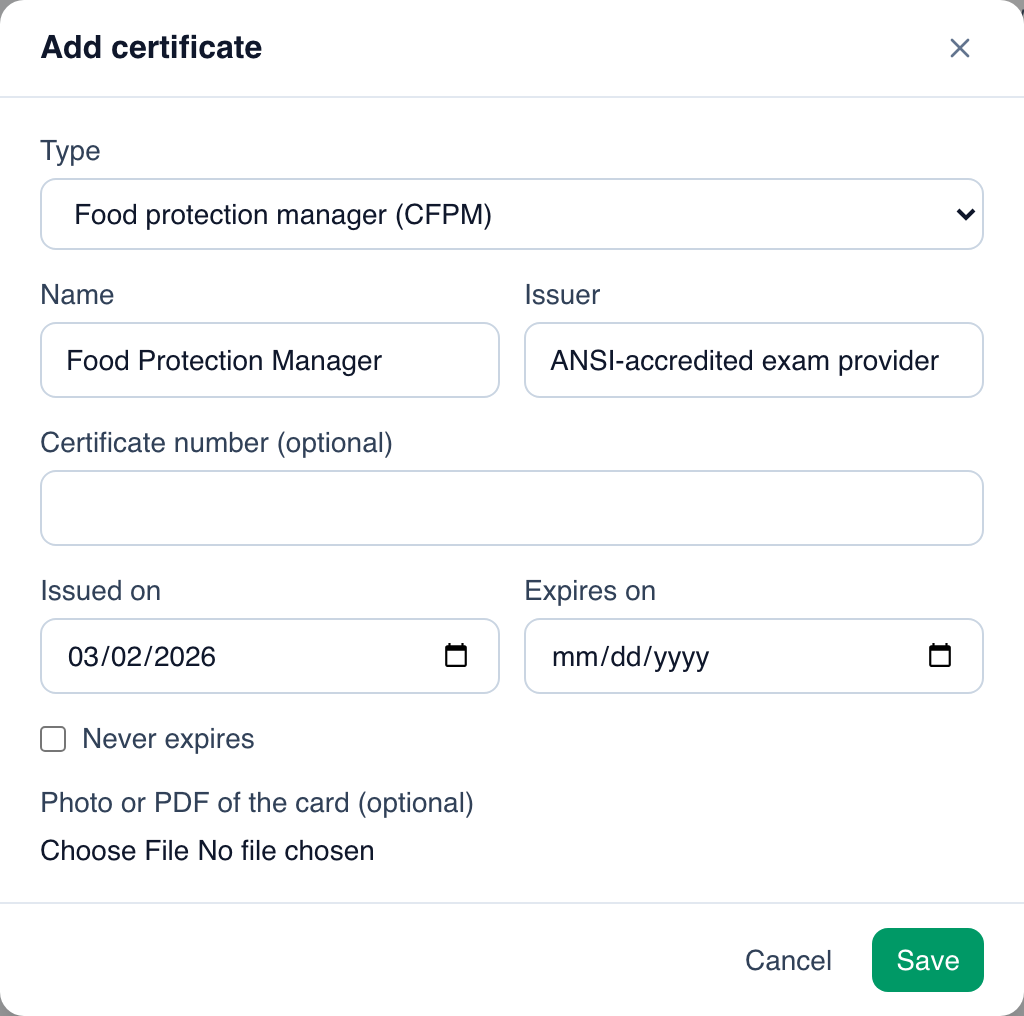
- Item 2 on file. Turn on Labor law compliance in Settings → Organization, then add each manager's food protection manager certificate on their Certificates tab, with its dates and a photo of the card (the image at the top of this post). Mays reminds them and their managers before it expires.
Two limits to know: Mays doesn't count OUT answers or compute a score, so tally the sheet yourself; and a Custom template only runs when someone starts it.
Practice the inspection, not just the cleaning
An inspector's form rewards habits, not a scrub the night before. Run the sheet and close every OUT.
Start your free trial: 30 days, every module, no card needed. Or book a walkthrough and we'll build your mock inspection template with you.