Food manager certification and food handler training in Florida: who needs what, and by when
Florida asks for two different food safety credentials, and new owners often mix them up. One is an exam that your managers pass. The other is a training course that everyone who handles food takes. They have different deadlines, different providers and different proof.
This is the fifth post in our series Florida compliance basics for a new café or restaurant. Our first-week training guide has the short version of the deadlines; this post goes through the rules behind them, the proof an inspector asks for, and how it works if FDACS licenses you instead of DBPR.
This is general information, not legal advice. Updated October 5, 2026: every source below was checked on that date. Check the current rules with DBPR or FDACS, and treat your inspector's word as final.
The two credentials side by side
For a restaurant or café licensed by DBPR's Division of Hotels and Restaurants:
Food manager certification | Food handler training | |
|---|---|---|
Who | "all managers who are responsible for the storage, preparation, display, and serving of foods to the public" | "all food service employees" of the establishment |
What | Pass a test from an accredited exam program | Complete a DBPR-approved training program. No exam: the standards "shall not include an examination" |
Deadline | "Managers have a period of 30 days after employment to pass the required test" | "Food service employees must receive certification within 60 days after employment" |
Valid for | "a period of five years from the date of issuance" | "Certification pursuant to this section shall remain valid for 3 years" |
Source |
Certified food protection managers
Who has to be certified
The statute is broad: "All managers employed by a food service establishment must have passed an approved test and received a certificate attesting thereto" (s. 509.039). DBPR's rule adds who must be on the hook at any given time (Rule 61C-4.023(1)):
- "Each licensed establishment shall have a minimum of one certified food protection manager responsible for all periods of operation."
- "The operator shall designate in writing the certified food protection manager or managers for each location."
- "A current list of certified food protection managers shall be available upon request in each establishment."
- "When four or more employees, at one time, are engaged in the storage, preparation or serving of food in a licensed establishment, there shall be at least one certified food protection manager present at all times when said activities are taking place."
- The certified manager "need not be present in the establishment during those periods of operation when there are three or fewer employees engaged in the storage, preparation, or serving of foods."
That fourth rule is the one that shapes your schedule. A slow Tuesday afternoon with a barista and a cashier needs no certified manager in the building. Saturday brunch with a cook, a prep cook, a barista and a server does.
Our advice: have at least one certified manager before you open, since the rule asks for one "responsible for all periods of operation." Then certify a second person (often your first shift lead) so your busiest shifts are never short. Keep a one-page "certified food protection managers" list, signed by you, with the certificates behind it.
Where to take the exam
DBPR: "Florida law requires food managers to complete training and pass a certification exam within 30 days of employment. Private entities provide the training and testing." DBPR's food manager page lists the accredited exam programs it accepts, including ServSafe (National Restaurant Association Educational Foundation), the National Registry of Food Safety Professionals, 360training.com / Learn2Serve, Above Training / State Food Safety and The Always Food Safe Company, LLC, and links the national accreditation list. The rule says DBPR "shall accept all certification examinations approved by the Conference for Food Protection" (Rule 61C-4.023(3)).
Food handler training for everyone else
What it covers
DBPR's rule sets the content: every food service employee is trained "on professional hygiene and foodborne disease prevention," and "must receive training which relates to their assigned duties": cooks on "safe methods of thawing, cooking, cooling, handling, holding and storing foods," servers on "safe methods of serving food," and the people who clean on "proper cleaning and sanitization methods" (Rule 61C-4.023(4)). Online courses are allowed: training "may be provided through written materials, interactive distance learning, in-person instruction, or any other method of delivery that conveys the necessary information, so long as the training program has been approved by the division."
Only approved programs count
DBPR: "Florida requires all food service employees to be trained on proper food handling and hygiene practices every three years. Only division-approved training programs are accepted as meeting the training requirement" (DBPR, Food Service Employee Training). The page links DBPR's list of approved programs. Before you pay for a course, check that the program is on it, or ask the provider which approved program it uses and look that up.
The law lets you train people yourself: "The public food service establishment may designate any certified food service manager to perform this function" (s. 509.049(5)), as long as it's with an approved program. A course in your own app, or your own SOPs, doesn't count unless DBPR approved the program.
The proof inspectors ask for
Establishments "must provide the division with proof of employee training upon request, including, but not limited to, at the time of any division inspection," and the proof "shall include the name of the trained employee, the date of birth of the trained employee, the date the training occurred, and the approved food safety training program used" (s. 509.049(5)).
If an outside provider trains your staff, it issues "an original certificate for each employee certified by the provider" to the establishment and "an original card to be provided to each certified employee," and each must be produced "in its duly issued original form upon request of the division" (s. 509.049(6)(a)). DBPR's bulletin is blunter: "Photocopies are not acceptable" (DBPR Industry Bulletin 2013-03). Keep the originals in one binder at the store, and ask new hires who trained elsewhere for their card on day one.
Fines can follow: DBPR may impose "administrative fines of up to $1,000" for failing to provide proof of training (s. 509.049(8)). On the inspection report, food manager certification (53a) and food handler training (53b) are their own categories; our inspection prep guide has the classes and penalties.
A timeline for a new opening
When | What |
|---|---|
Before opening | At least one manager certified; designated in writing; the list on site |
Each hire's first day | Book their food handler course; collect any existing card |
Day 30 after a manager starts | Manager exam passed |
Day 60 after anyone starts | Food handler training done, original certificate on file |
Every shift with 4+ people on food | A certified manager in the building |
3 years / 5 years | Food handler training renewed / manager certificate renewed |
If FDACS licenses you
Coffee shops, bakeries and juice bars are often permitted by FDACS rather than DBPR (see the licensing post in this series). FDACS has its own manager rule: "All Retail Food Establishments shall have a certified food protection manager that is certified by a food protection manager certification program that is evaluated and listed by a Conference for food Protection-recognized accrediting agency," with exceptions such as places that sell only prepackaged, non-potentially hazardous food (Rule 5K-4.021(1), F.A.C.). Its permit page says the manager must be able to "Coordinate employee food safety training" and "Conduct periodic in-house self-inspections of daily operations" (FDACS).
The 60-day food handler law (s. 509.049) is written for DBPR's public food service establishments. If you're under FDACS, ask your inspector what training records they expect for the rest of your staff.
Your food safety credentials checklist
- Know your agency: DBPR or FDACS
- At least one certified food protection manager before opening, designated in writing, list on site
- A second certified person for your busiest shifts
- Every food employee booked into a DBPR-approved course in their first week
- Original certificates and cards in one binder; renewal dates tracked
- A certified manager scheduled whenever four or more people work food
Where Mays fits
Turn on Labor law compliance in Settings → Organization, and Mays tracks these credentials per person and per location:
- Certificates on each team member's page. Under Locations & Users → Users, the Certificates tab holds each person's Food handler card and Food protection manager (CFPM) certificate with the issuer, number, issue and expiry dates, and a photo or PDF of the card. Managers and admins add them on the web; staff see theirs in the app under Profile → My certificates.
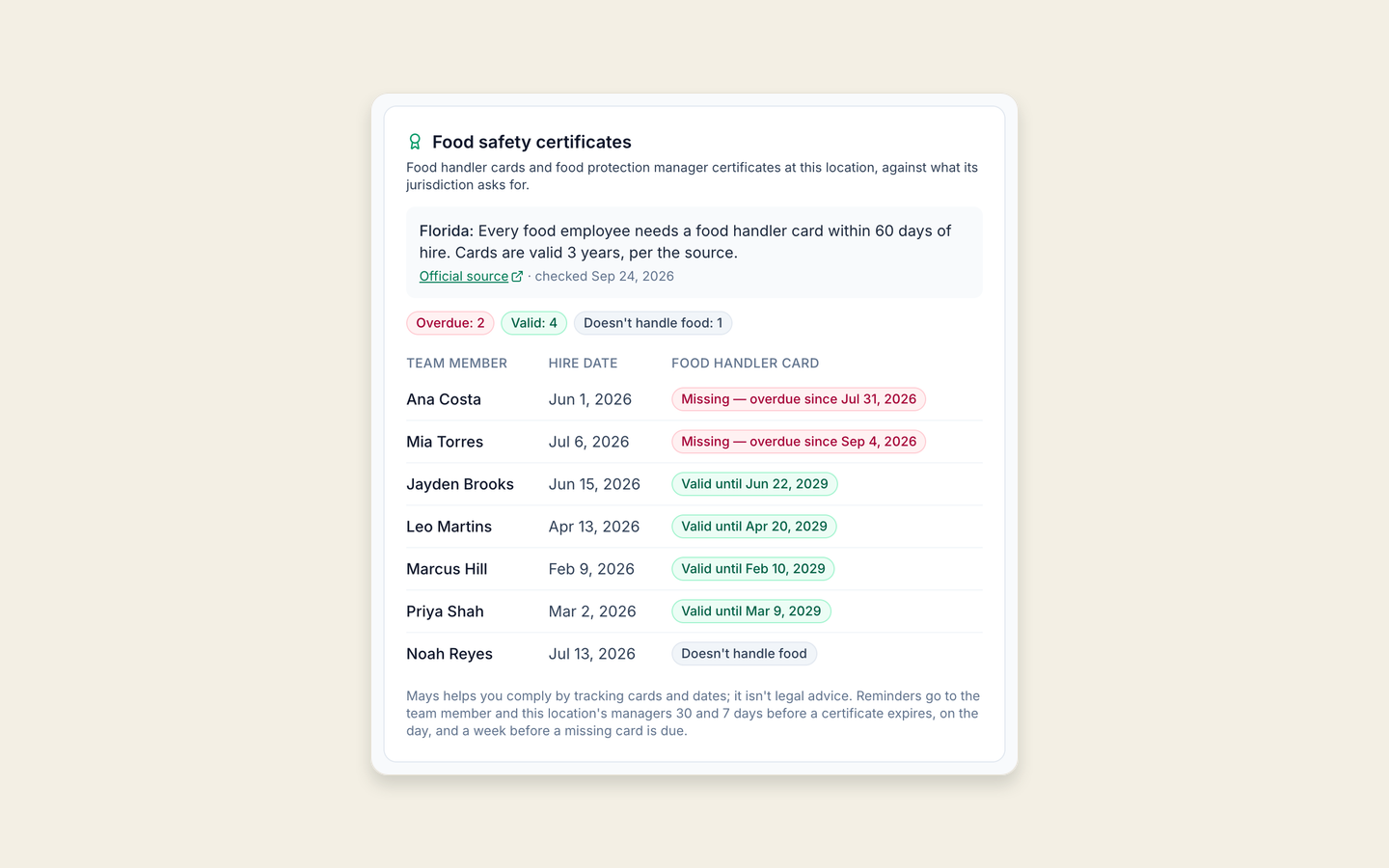
- The location's panel. On the location's Scheduling tab, Food safety certificates applies Florida's rule, a food handler card within 60 days of hire, valid 3 years, and lists everyone on the schedule from worst to best: overdue, expired, due, valid (the image at the top of this post). Someone who never handles food, like a host, can be marked Doesn't handle food with a reason.
- Reminders. Mays reminds the team member 30 days and 7 days before a certificate expires and on the day, and a week before a missing food handler card is due. The location's managers get one message listing their team's cards.
What it doesn't do yet: for Florida, Mays checks food handler cards only. It doesn't count the 30-day manager deadline, and it doesn't check that a certified manager is scheduled when four or more people work food, so check that yourself when you build the schedule. And Mays training modules are for your own SOPs: they're not a DBPR-approved food handler program.
Keep every card in one place
Record your team's cards once, and let Mays remind people before they expire.
Start your free trial: 30 days, every module, no card needed. Or book a walkthrough and we'll set it up with you.
Previous in the series: Workers' compensation in Florida · Next: Employing minors in a Florida restaurant.