Every punch your team makes lands in a pay period on the Time Clock page. Review it there, fix what's wrong, approve it, and close the period when it's ready for payroll.
Where: Scheduling → Time Clock on the web. It's part of Scheduling (Pro plan). Managers and admins can use all of it; a custom role needs View Schedule to open it, and Build & manage native schedule to add, edit, approve or close, and to see the Labor Summary, the export and any pay figures — with View Schedule alone it sees hours but no money. Pay periods are per location — switch location in the sidebar.
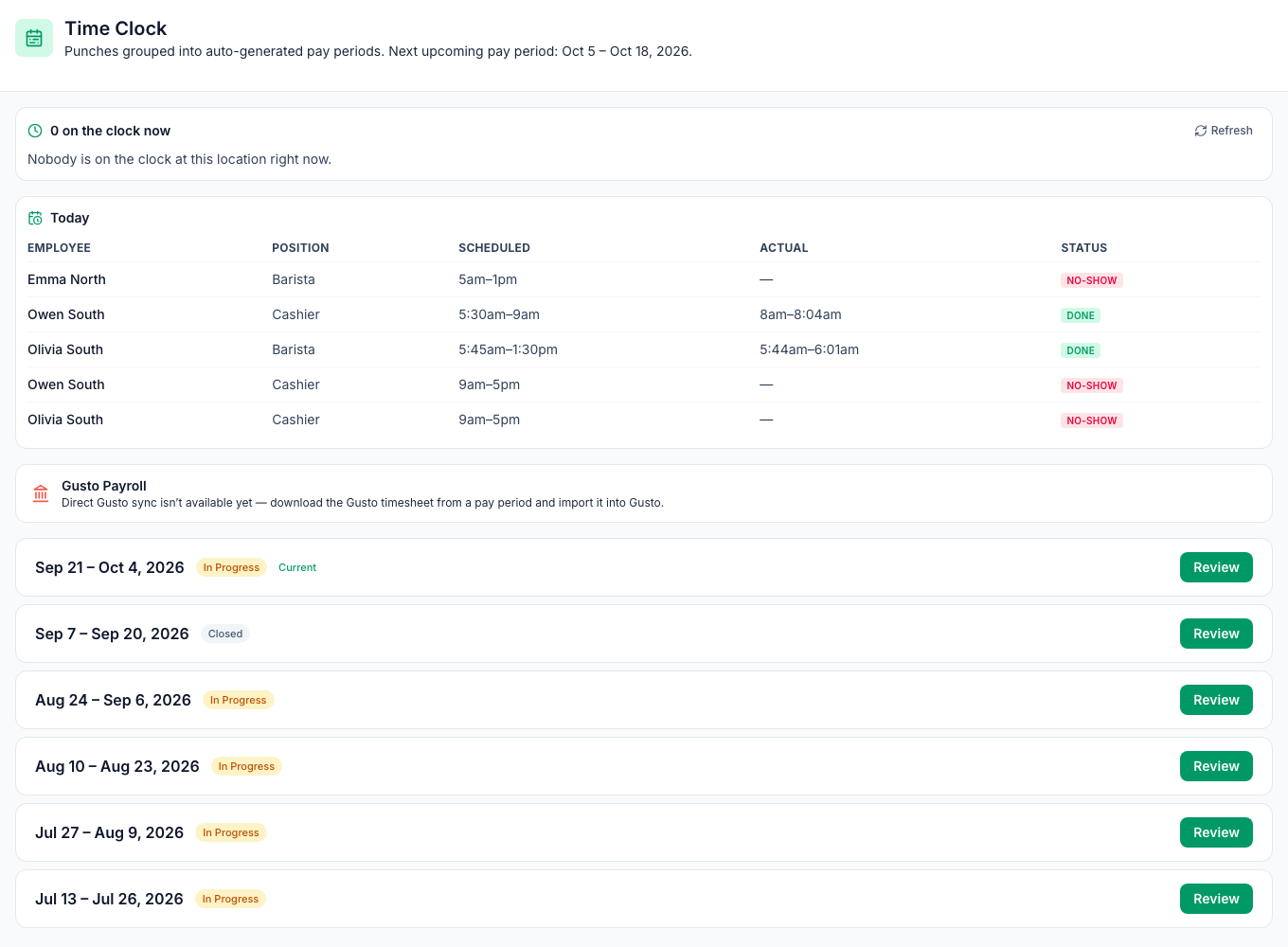
The page lists the current pay period and the five before it, newest first. Each shows In Progress or Closed; click Review to open one. The live on the clock now strip and the Today table at the top are covered in Attendance, late and no-show alerts.
Set how long a pay period is
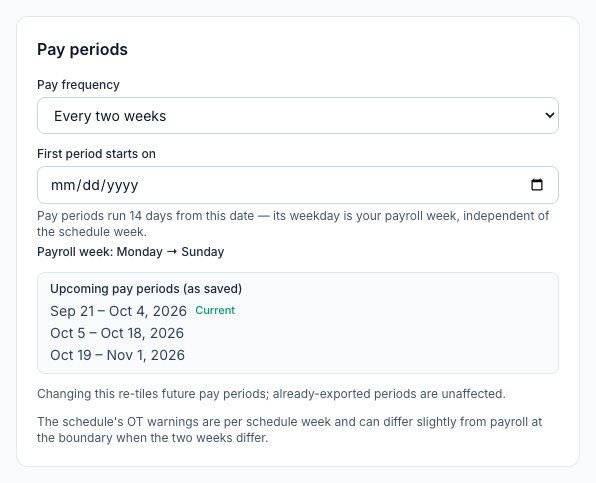
An admin sets this once for the whole company, under Scheduling → Settings → Pay periods:
- Pay frequency — Weekly, Every two weeks (the default), Twice a month (1st & 16th) or Monthly.
- First period starts on — the date the cycle starts from. Its weekday is your payroll week, which can differ from the schedule week.
The box underneath previews the next periods. Changing the settings redraws the periods, so do it between payroll runs.
Review the punches
A pay period has five tabs: Employee Punches, Warnings, Exceptions, Labor Summary and Tips (the tip pool breakdown and, where Labor law compliance's Tips is on at a Wisconsin location, tip declarations — see Tip declarations). The top card shows how many punches are approved (for example 2/7 approved) and how many days are left.
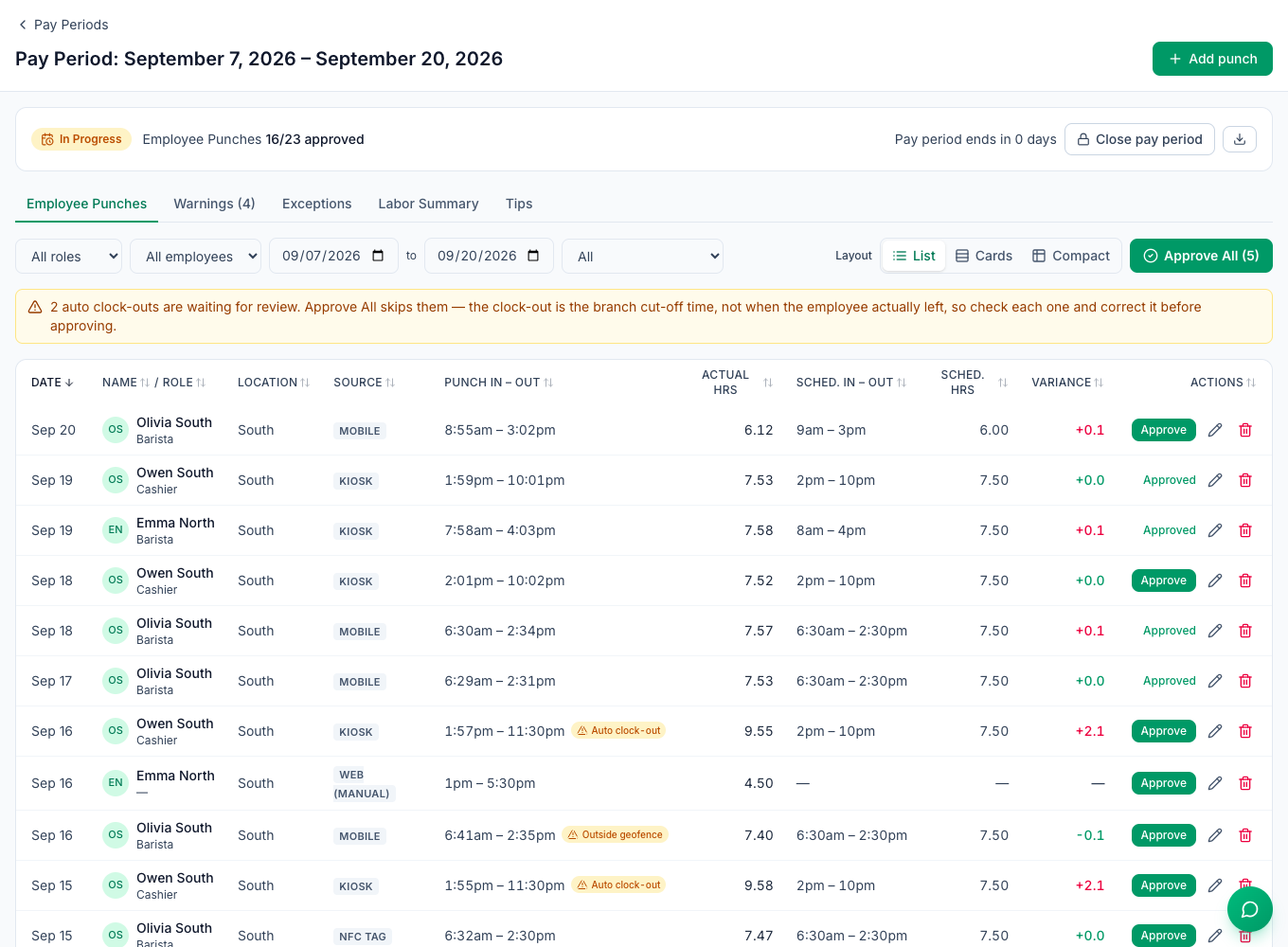
Filter by role, employee, dates, or status (Unapproved, Approved, Missing punch-out, No matching shift). Choose a Layout:
Layout | What you see |
|---|---|
List | One row per punch: date, name and role, location, Source, Punch In – Out, actual hours, scheduled times and hours, Variance and actions. Click any column header to sort; click again to reverse. |
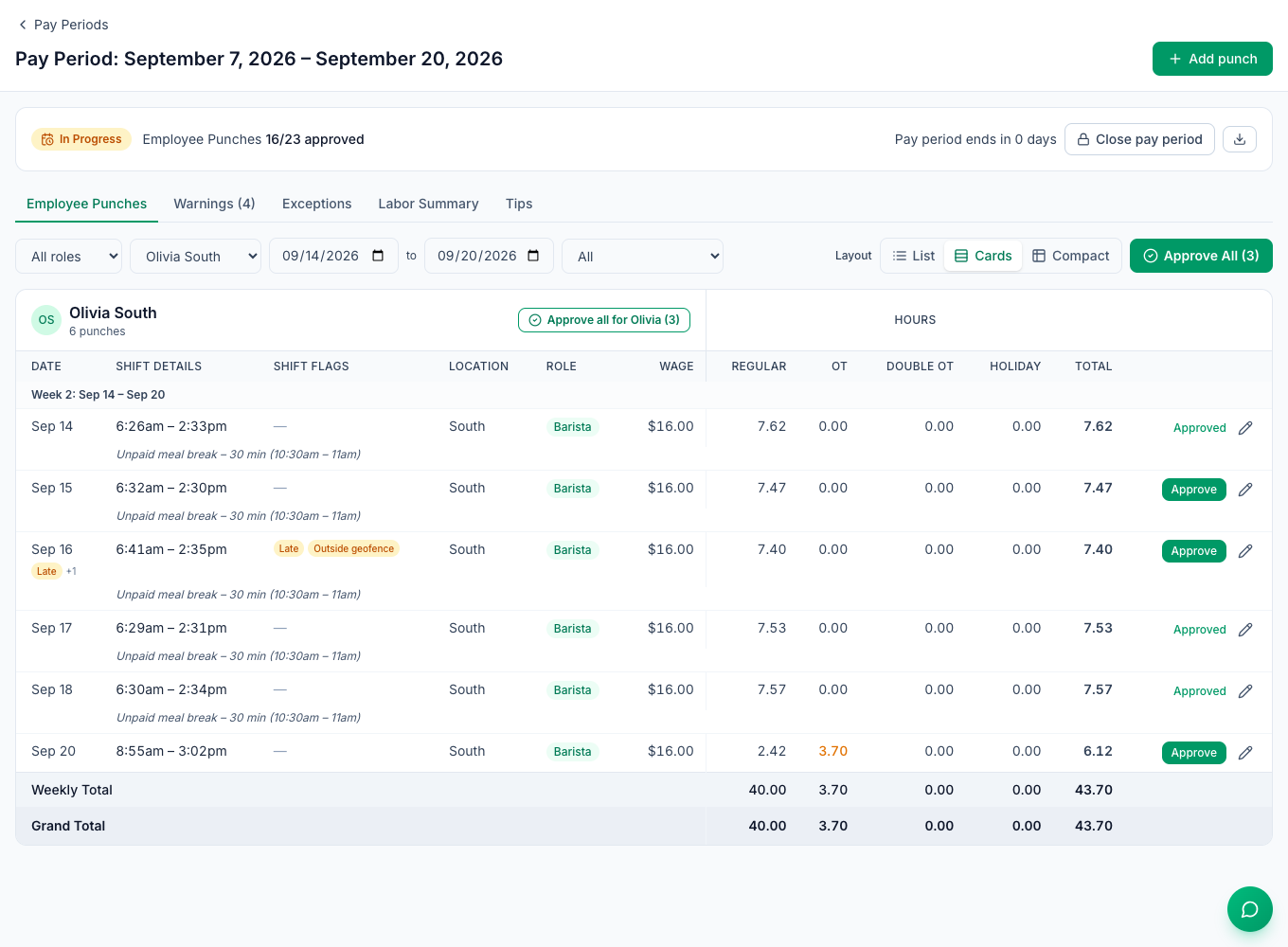
Cards | One card per employee, grouped by week, with each break on its own line, Shift Flags such as Late, Early out, Outside geofence or a missed break, and hours split into Regular, OT, Double OT, Holiday and Total. Approve all for approves that person's punches. |
Compact | One line per employee with their hour totals — a quick check before payroll. |
Your layout choice is remembered in this browser.
Source tells you how the punch was made: Mobile (the app), NFC tag, Kiosk, Web (manual) (added by a manager), 7shifts or Imported. Variance is actual minus scheduled hours; red means the person worked longer than scheduled.
Add, fix or delete a punch
- To add a missing punch, click Add punch. Pick the Employee, set Clock in, Clock out and Break (min), add Notes if you like, and click Add punch. The clock-in starts at the current time, so change the date first.
- To fix one, click the pencil. For a punch that's still open the window is called Set punch-out. It also shows the breaks taken and, if your location asks, the employee's answer about their breaks. Click Save.
- To delete one, click the bin in the List layout and confirm Delete this punch? This cannot be undone.
The employee gets a notification each time: Time punch added, Time punch edited or Time punch removed.
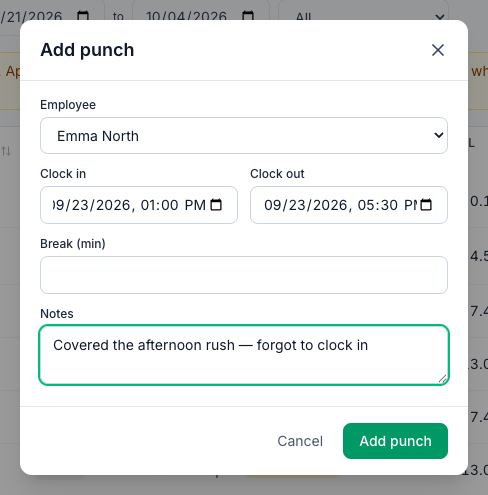
A punch you add shows Web (manual) as its source and a No matching shift warning, because it isn't tied to a scheduled shift. It takes the position of the person's shift at that location that day — shown as their Role — or — if they had no shift, and it saves their wage the same way a clock-in does.
Approve punches
Click Approve on a row, or Approve All to approve every finished punch that matches your filters. Approved punches show Approved; the employee is told their punches were approved. There's no un-approve.
Approve All skips automatic clock-outs. When a location closes forgotten punches automatically, the clock-out time is the cut-off, not when the person actually left. Those rows carry an Auto clock-out badge and a yellow banner reminds you to check each one and correct it. Once you set a different clock-out time, the badge goes and Approve All includes the punch; if the cut-off was right, approve it on its own row. See Grace periods, rounding and auto-approval.
Warnings and exceptions
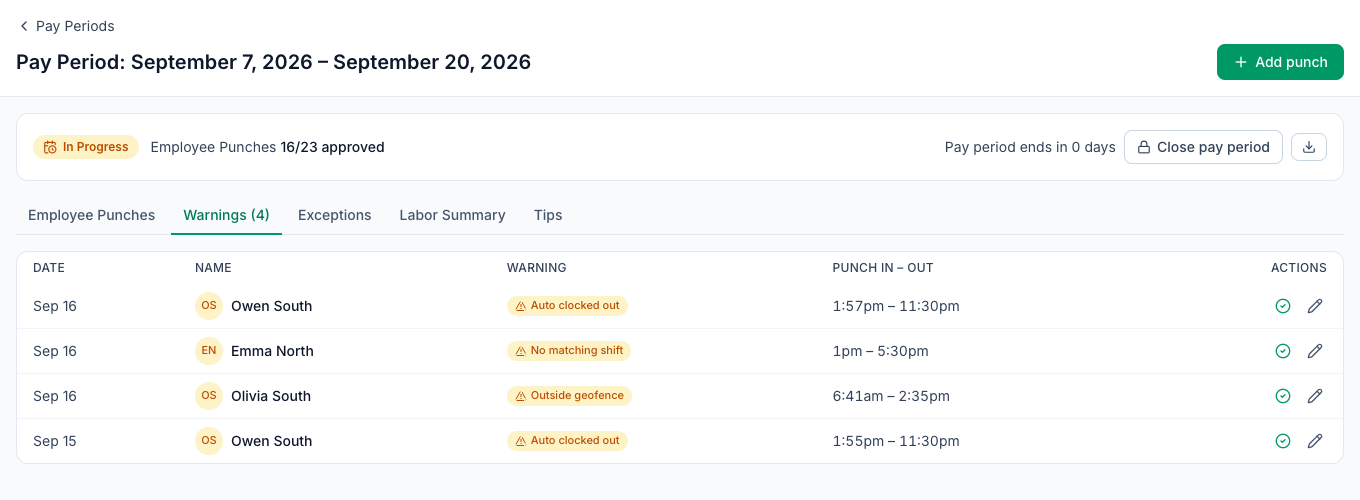
The Warnings tab lists punches that need a look:
Warning | Meaning |
|---|---|
Missing punch-out | Still open from an earlier day. Click Set punch-out to close it. |
No matching shift | Not tied to a scheduled shift — for example a punch you added, or someone who clocked in on a day off. |
Outside geofence | The phone was outside the location's radius at clock-in. See Punch verification and geofencing. |
Auto clocked out | Closed automatically at the location's cut-off time. |
Each row has approve and edit buttons.
The Exceptions tab lists missed, late or short breaks when your location tracks them, and the split-shift, spread-of-hours and reporting-pay premiums your location's rules pack or, with Labor law compliance's Premiums on, the law at its address sets — see Labor & compliance.
Labor Summary
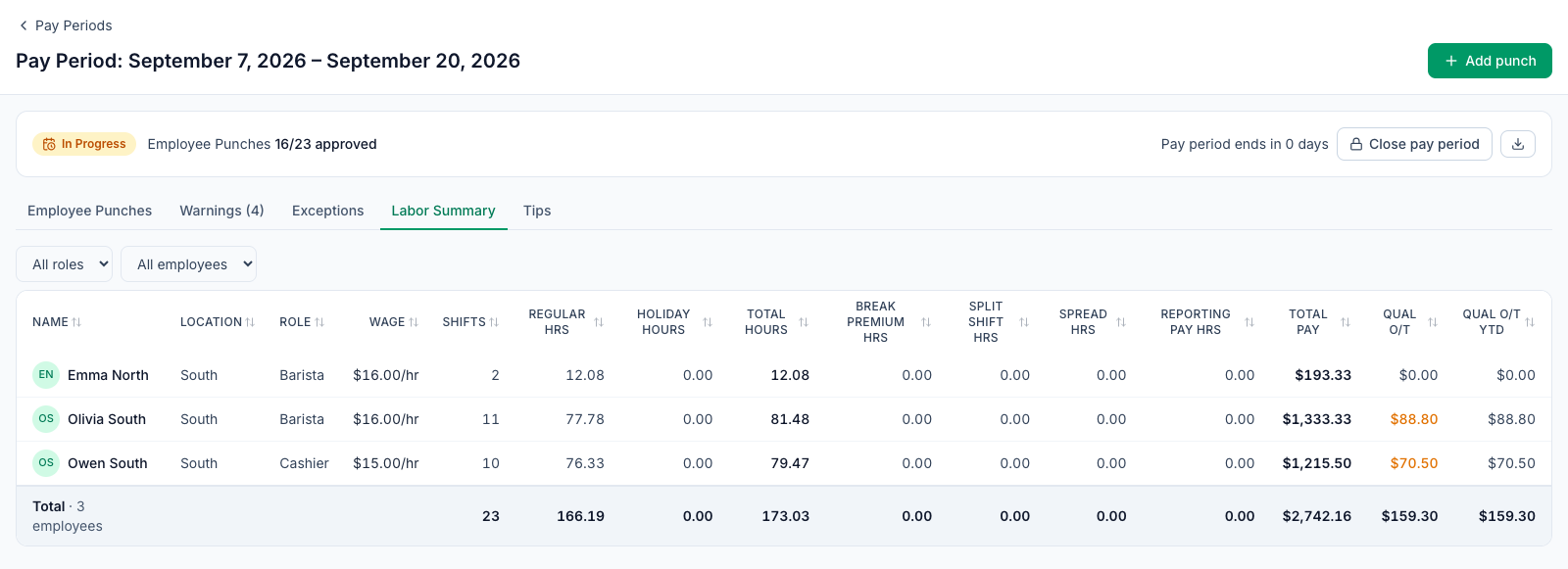
One row per employee with their Location, Role (the position they worked), Wage, Shifts (finished punches), Regular Hrs, Holiday Hours, Total Hours, the break, split-shift, spread-of-hours (Spread Hrs) and reporting-pay premium hours, Compliance Fees where the location costs them, Total Pay, Qual O/T (overtime pay) and Qual O/T YTD, plus a Total row at the bottom. Filter by role or employee and sort by any column. You need Build & manage native schedule to see this tab.
- Overtime follows your overtime settings in Scheduling → Settings → Workweek & overtime: Weekly OT threshold (hours) (40 by default — a blank box means 40, and 0 isn't accepted), OT multiplier, and the optional daily overtime, double time and 7th consecutive day. With Labor law compliance's Overtime law on at the location, the overtime law at its address applies too where it's more protective, or the location's own rules do — see Labor & compliance. It's counted per payroll week, and it's always calculated: Overtime warnings enabled only controls the warnings on the schedule, never pay here or in the exports.
- Total Hours minus Regular Hrs is the overtime and double-time. Holiday Hours stays at 0.00.
- Pay: each punch saves the person's wage when they clock in — their own hourly wage, or else their position's wage — and a punch you add here saves it the same way. Wage is the rate the period was actually paid at, and Total Pay and Qual O/T come from the saved wages. Punches for salaried staff or anyone with no wage set — and older punches made in Mays before it began saving the wage at clock-in in late September 2026 — show — and $0.00; pay those from the hours in your payroll provider.
Close the pay period
- Make sure nobody is still clocked in on a shift in the period, and approve every finished punch. Mays won't close a period while anyone is on the clock in it (1 person is still clocked in on a shift in this period — clock them out before closing it.) or while any punch is unapproved, and tells you how many are left.
- Click Close pay period and confirm Close this pay period? Approvals, edits and deletes will be locked until it is reopened.
A closed period shows Closed with who closed it and when, in the location's time zone. Adding, editing, deleting and approving are blocked until you click Reopen pay period — and so is clocking out on a shift in the period: the employee's own clock-out, the kiosk's and Force clock-out are all refused. The employee sees This shift is in a closed pay period, so it can't be changed. Ask a manager to reopen the period.; you see Pay period is closed — reopen it first. A shift belongs to the period of the day it was clocked in. To export for payroll, see Exporting payroll (CSV and Gusto).
Good to know
- Hours count whether or not they're approved. Approval is your review step; totals and exports include every finished punch. Punches still open aren't counted.
- Only the last six periods are listed. Older ones are still there, just not in the list.
- Times on the List layout and in Add punch use your computer's time zone. The Cards layout uses the location's. If you manage a location in another time zone, use Cards to check times.
- Employees see their own punches under My Hours in the app — see My Hours and estimated pay.