Employee illness reporting form and exclusion chart: the Food Code's five symptoms, six illnesses and when people come back
A barista texts at 5:40 am: "threw up twice last night, feel ok now, should I come in?" The opener has to answer in a minute, and the answer is in the Food Code. This post turns it into two pages you can print: a chart of who stays home and when they come back, and a form to fill in each time someone reports.
This is general information, not legal or medical advice. Your state or county adopts its own edition of the Food Code, and your health department has the final word.
What changed in the 2026 Food Code
Section numbers below are from the 2022 FDA Food Code. We checked each one against the 2026 edition, which keeps the reporting list and the waiting periods and changes three things:
- A written illness policy for everyone. New §2-501.11: the permit holder "shall provide a written EMPLOYEE Illness Policy, available upon request", covering the symptoms, the diagnoses, and "Illness EXCLUSION and/or RESTRICTION and reinstatement after illness symptom or disease resolution." The 2026 guidance calls it "a new requirement in the 2026 Food Code for all food establishments".
- Lab tests instead of stool cultures. For coming back after Shigella, STEC or Salmonella, the 2026 text asks for "consecutive negative laboratory test results from a validated test" where 2022 said stool specimen cultures.
- Vomit clean-up moved. The written clean-up procedure for vomiting and diarrheal events moves from §2-501.11 to §2-502.11. The requirement itself is the same.
What employees must report
The Food Code makes the permit holder "require FOOD EMPLOYEES and CONDITIONAL EMPLOYEES to report to the PERSON IN CHARGE information about their health and activities as they relate to diseases that are transmissible through FOOD" (§2-201.11(A)). A conditional employee is someone you've offered a job to who hasn't started.
Report this | Details |
|---|---|
Five symptoms | Vomiting; diarrhea; jaundice; sore throat with fever; a boil or infected wound that's open or draining (on hands or wrists unless covered with a finger cot or similar and a glove; on arms unless covered; elsewhere unless covered with a dry, tight bandage) |
Six diagnoses (the "Big 6") | Norovirus; hepatitis A virus; Shigella spp.; Shiga toxin-producing E. coli (STEC); typhoid fever (Salmonella Typhi); nontyphoidal Salmonella |
Past typhoid | Typhoid fever in the past three months without antibiotic treatment |
Exposure | Linked to a confirmed outbreak, or living with someone diagnosed with one of the illnesses, within: 48 hours (norovirus), 3 days (STEC, Shigella), 14 days (typhoid), 30 days (hepatitis A) |
You call the health department when a food employee is "Jaundiced" or "Diagnosed with an illness due to a pathogen" in the Big 6 list (§2-201.11(B)).
The exclusion chart
Two words do the work. Exclude means "to prevent a PERSON from working as an EMPLOYEE in a FOOD ESTABLISHMENT or entering a FOOD ESTABLISHMENT as an EMPLOYEE." Restrict means the person "does not work with exposed FOOD, clean EQUIPMENT, UTENSILS, LINENS, or unwrapped SINGLE-SERVICE or SINGLE-USE ARTICLES" (§1-201.10). A restricted barista can run the register; they can't make drinks.
This chart is for a café or restaurant that doesn't serve a highly susceptible population (the Food Code means places like child or adult day care, hospitals, nursing homes and senior centers, whose rules are stricter). From §2-201.12 and §2-201.13:
Situation | Action | Can come back when |
|---|---|---|
Vomiting or diarrhea, no diagnosis | Exclude | Symptom-free for at least 24 hours, or a health practitioner's note that it's not infectious |
Jaundice that started in the last 7 days | Exclude, call the health department | With health department approval, and jaundiced more than 7 days, or a practitioner's note that it isn't hepatitis A |
Diagnosed: hepatitis A | Exclude, call the health department | With health department approval, and one of the conditions in §2-201.13(B) |
Diagnosed: typhoid fever | Exclude, call the health department | With health department approval and a practitioner's note |
Diagnosed: norovirus | Exclude while sick, call the health department; restrict once symptom-free 24 hours | With health department approval, and more than 48 hours symptom-free, or a practitioner's note |
Diagnosed: Shigella or STEC | Same as norovirus | With health department approval, and more than 7 days symptom-free, or a practitioner's note with negative tests |
Diagnosed: nontyphoidal Salmonella | Same as norovirus | With health department approval, and more than 30 days symptom-free, or a practitioner's note with negative tests |
Sore throat with fever | Restrict | A practitioner's note (for example, more than 24 hours on antibiotics for strep) |
Infected cut or boil, not covered | Restrict | Once it's covered as the rule says |
Exposure only (no symptoms, no diagnosis) | No exclusion or restriction here; record it and watch for symptoms | Not applicable (the exposure rules restrict staff where a highly susceptible population is served) |
Diagnosed without symptoms? Norovirus, Shigella, STEC and Salmonella without symptoms mean restrict, not exclude, in a café like this (§2-201.12(D) to (G)). When in doubt, exclude and call: an extra shift off costs less than an outbreak.
The reporting form
Fill in one per report, whether it came by text, call or in person. Keep them where only managers can see them.
Field | Fill in |
|---|---|
Employee name, position, location | |
Reported to (person in charge), date and time | |
How it was reported | Text / call / in person |
Symptoms (tick all) | ☐ Vomiting ☐ Diarrhea ☐ Jaundice ☐ Sore throat with fever ☐ Infected cut or boil (where?) |
When symptoms started, and when they last had one | |
Diagnosed by a health practitioner? Which illness? | ☐ Norovirus ☐ Hepatitis A ☐ Shigella ☐ STEC ☐ Typhoid ☐ Salmonella ☐ None |
Exposure (outbreak, household) and date | |
Action | ☐ Excluded ☐ Restricted (to which duties) ☐ No action needed, why |
Health department called? Date, time, name | |
Shifts covered by | |
Return date and what allowed it | 24 hours symptom-free / practitioner's note / health department approval |
Signatures | Person in charge, employee |
If someone vomits at work, the clean-up procedure applies too (§2-501.11 in 2022, §2-502.11 in 2026). Our incident report form covers that event, and the manager shift log is where the next manager reads that someone was sent home.
Proving people know the rule
The person in charge must make sure employees "are informed in a verifiable manner of their responsibility to report" (§2-103.11(P)). The Food Code's Annex 3 lists ways to show it, including "completion of Form 1-B, 'Conditional Employees or Food Employees Reporting Agreement' in Annex 7", and "Presenting evidence such as curriculum and attendance rosters documenting that each employee has completed a training program which includes all the information required for reporting in Form 1-B".
So: a signed reporting agreement at hire (our new employee orientation checklist has a line for it), a short training everyone passes, and the chart above posted where the schedule is.
Where Mays fits
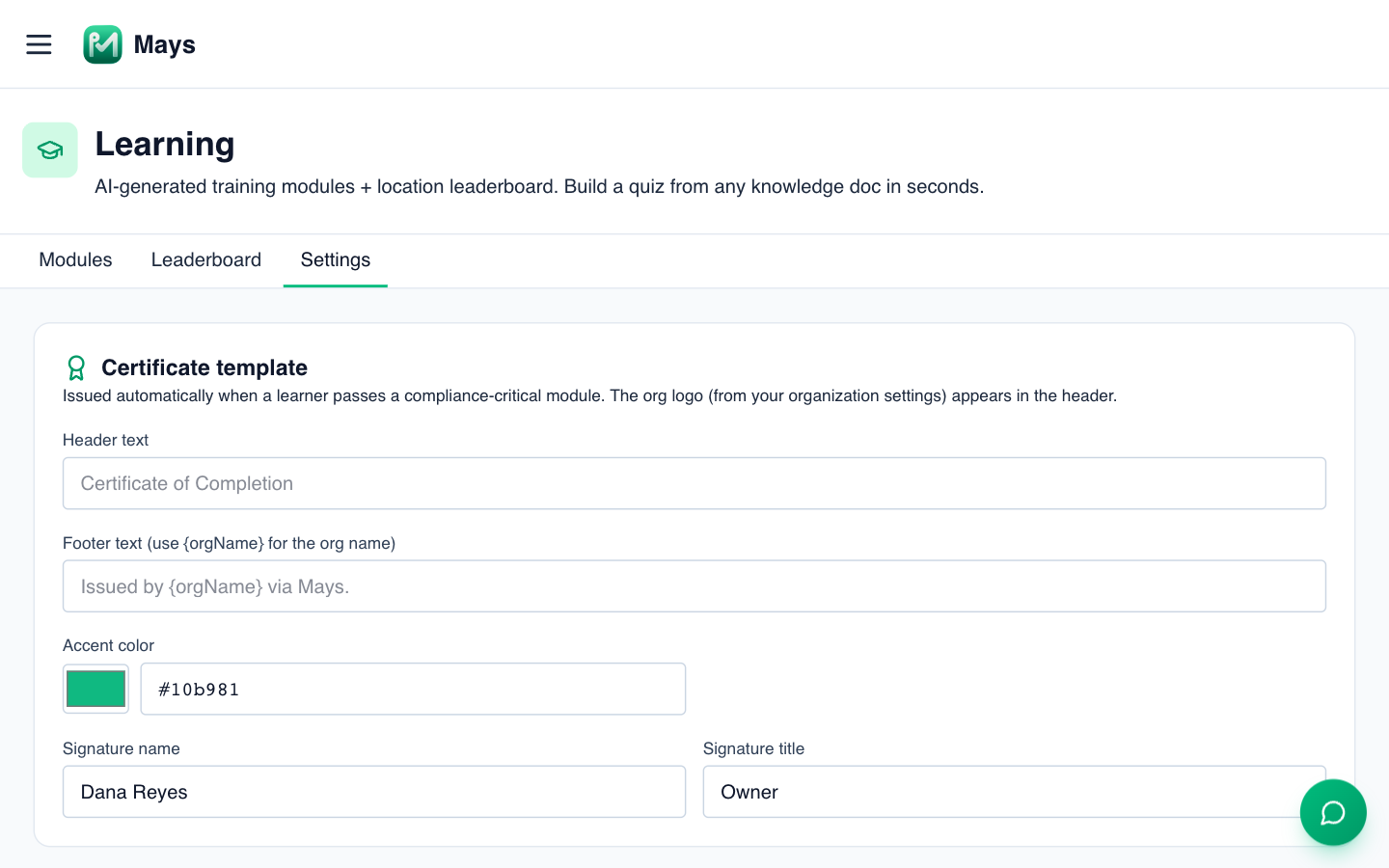
- The training, with a certificate. Build a short module on the reporting rule under Learning → Modules and tick Compliance-critical (issues a PDF certificate on pass) when you create it. The first time someone passes, Mays creates a PDF certificate with their name, score and date, designed under Learning → Settings (the image at the top of this post). Who's taken it on the module lists each person's attempts and best score. See Training certificates and Assigning training.
- The written policy. Put your illness policy and this chart in a Knowledge Base article shared with every location. See Knowledge Base basics.
- The form. Build the reporting form under Tasks → Types with Yes / No fields for each symptom, a Text field for the diagnosis, a Date / time for onset and a Signature, then send it as a one-off task with Custom form as the answer. Forms are filled in on the iPhone and Android apps, and each one lands in Task Data. See Building custom forms.
- The time off. Record the days out as Sick time off, so they show in the Attendance and Time Off reports. See Time off requests.
- The cover. In the Mays app, Find cover on the shift lists who's free, or puts the shift up for grabs. See Finding cover for a shift.
What Mays doesn't do: it has no read-and-sign step on a Knowledge Base article, admins can't open someone's certificate on the web yet (the person shares it from their phone), and it doesn't call the health department for you.
Print it, post it, train it
The 5:40 am text deserves a 30-second answer: "Vomiting last night means you're out until you've gone 24 hours without symptoms. I'll find cover." Print the chart and put it next to the schedule.
Start your free trial: 30 days, every module, no card needed. Or book a walkthrough and we'll build the illness training and form with you.