Power outage and boil-water notice checklist for a café: when to close, what to keep and what to throw out
The lights go out at 2:10 on a Thursday. The espresso machine stops, the walk-in goes quiet, and the shift lead looks at you. Or the city texts a boil-water notice at 6 am, an hour before you open, and your ice machine, your soda gun and your hand sinks all run on tap water.
Both are easier to handle with a plan written before they happen. This post is that plan: one checklist for an outage, one for a boil-water notice, and the log that goes with them.
This is general information, not legal advice. Your health department decides whether you can stay open and what you have to throw out. Call them.
The rule behind both: stop, then call
The FDA Food Code, the model code the FDA offers state and local health departments to adopt, says a permit holder "shall immediately discontinue operations and notify the REGULATORY AUTHORITY if an IMMINENT HEALTH HAZARD may exist because of an emergency such as a fire, flood, extended interruption of electrical or water service, SEWAGE backup, misuse of POISONOUS OR TOXIC MATERIALS, onset of an apparent foodborne illness outbreak, gross insanitary occurrence or condition, or other circumstance that may endanger public health" (§8-404.11(A)).
Two exceptions matter for a café:
- You "need not discontinue operations in an area of an establishment that is unaffected" (§8-404.11(B)).
- The health department "may agree to continuing operations in the event of an extended interruption of electrical or water service if" a "written emergency operating plan has been approved", immediate corrective action is taken, and the health department "is informed upon implementation of the written emergency operating plan" (§8-404.11(C)).
And once you've stopped: "the PERMIT HOLDER shall obtain approval from the REGULATORY AUTHORITY before resuming operations" (§8-404.12). The 2026 edition keeps all three paragraphs.
So the most useful thing you can do this week is ask your health department whether they approve emergency operating plans, and write one. The checklists below are a starting point.
Before it happens
Do this now | Done |
|---|---|
Health department's number (and after-hours number) posted by the phone and saved in managers' phones | ☐ |
Utility outage line and water utility's notice page saved | ☐ |
A thermometer in every cooler and freezer that works without power, plus a probe thermometer with spare batteries | ☐ |
Flashlights at the office and the walk-in | ☐ |
Coolers, ice packs or a source of bagged ice for a long outage | ☐ |
Bottled water and single-use cups, enough for handwashing and drinking for one shift | ☐ |
Who decides: name of the person who closes the store and calls the health department | ☐ |
How you'll tell guests: a sign for the door and a line for your Google Business Profile | ☐ |
The FDA's guidance for households is a useful planning baseline: "Have coolers on hand to keep refrigerated food cold if the power will be out for more than 4 hours" (FDA, Food and Water Safety During Power Outages and Floods).
Checklist: the power goes out
Time | Step | Done |
|---|---|---|
Minute 0 | Note the time the power went out | ☐ |
Minute 0 | Stop cooking and taking orders that need power; finish what's in hand only if it's safe | ☐ |
Minute 5 | Keep cooler and freezer doors closed | ☐ |
Minute 10 | Call the utility: is it your building or the street, and how long? | ☐ |
Minute 15 | Record the temperature of every cooler and freezer (log below) | ☐ |
Every 30 min | Record them again. Probe a few TCS foods near the door, not just the air | ☐ |
If it'll be long | Call the health department; move high-risk items to coolers with ice | ☐ |
Power back | Note the time; record every unit and a sample of foods; decide what to keep (below) | ☐ |
Keeping doors shut buys time. The FDA's household figures: "The refrigerator will keep food cold for about 4 hours if it is unopened" and "A full freezer will keep the temperature for approximately 48 hours (24 hours if it is half full) if the door remains closed." A walk-in opened twenty times a shift won't do as well.
Deciding what to keep
The Food Code's line for cold TCS food (time/temperature control for safety) is 41°F or less, and for hot holding 135°F or above (§3-501.16(A)). Food that left those ranges isn't automatically waste, but the decision belongs to your health department's rule, not a guess. For households, the FDA says to "Discard any refrigerated perishable food (such as meat, poultry, seafood, milk, eggs, or leftovers) that has been at refrigerator temperatures above 40°F for 4 hours or more." Ask your inspector what they apply to a food business, and write it into your plan.
Two rules of thumb for the decision itself: you need temperatures and times to decide anything, which is what the log is for; and "You can't rely on appearance or odor" (the same FDA page).
Checklist: a boil-water notice
Step | Done |
|---|---|
Read the notice: which area, from when, and what the utility says about drinking, cooking and handwashing | ☐ |
Call the health department: can you open, and on what conditions? | ☐ |
Turn off and bag the ice machine; discard the ice made since the notice | ☐ |
Turn off drinks made with tap water: soda gun, tea and coffee brewers, water filters, the dipper well | ☐ |
Switch to bottled water for drinks, cooking and food that's eaten raw | ☐ |
Handwashing: follow the health department's instruction (bottled or boiled water in a container, or tap water if they allow it) | ☐ |
Dishes: single-use plates and utensils, or follow the health department's instruction | ☐ |
Sign on the door and menu changes (no fountain drinks, no iced drinks) | ☐ |
When the notice is lifted: flush lines, clean and sanitize the ice machine, replace filters as the manufacturer says, then restart | ☐ |
The Food Code backs two of these. Ice: "Ice for use as a FOOD or a cooling medium shall be made from DRINKING WATER" (§3-202.16). Water during an interruption must come from an approved alternative, such as "A supply of containers of commercially BOTTLED DRINKING WATER" or "One or more closed portable water containers" (§5-104.12). Both are unchanged in 2026.
If you have to make water safe yourself, the EPA says: "Bring water to a rolling boil for at least one minute. At altitudes above 5,000 feet (1,000 meters), boil water for three minutes." It adds that boiling "will not destroy other contaminants, such as heavy metals, salts, and most other chemicals" (EPA, Emergency Disinfection of Drinking Water). For a boil-water notice, the utility's notice is the instruction to follow.
The emergency log
Print one per event. Made-up example:
Time | Unit or food | Temperature | Doors opened? | Note | Initials |
|---|---|---|---|---|---|
2:10 pm | Power out | Street outage, utility says 2 to 4 hours | MR | ||
2:25 pm | Walk-in cooler | 38°F | No | MR | |
2:25 pm | Reach-in (line) | 40°F | Yes, once | Moved dairy to walk-in | MR |
3:00 pm | Reach-in (line) | 43°F | No | Called health department, case number noted | MR |
3:30 pm | Chicken salad (probe) | 44°F | Held for decision | MR | |
4:40 pm | Power back | MR | |||
4:45 pm | Decision | Per health department: discard reach-in TCS items, keep walk-in | MR, DR |
Then record what you threw out (item, quantity, cost) for your insurer. Our insurance basics post suggests asking your agent whether food that spoils in a breakdown or a power outage is covered.
Where Mays fits
- Sensors that keep logging. With Govee thermometers connected, Mays records a reading from each sensor about every five minutes and creates a high-priority task at the location when a unit stays out of range past its alert delay. See Temperature thresholds and alerts. One caution for outages: if your internet goes down with the power, the sensors can't report, and an offline sensor doesn't alert. The Offline filter on the Thermometers page shows which ones went quiet.
- The record for the inspector. A thermometer's page has a Health-department log export for any dates, one row per hour or every reading, with a Pass or Fail on each row, as a PDF or CSV. See Health-department temperature logs.
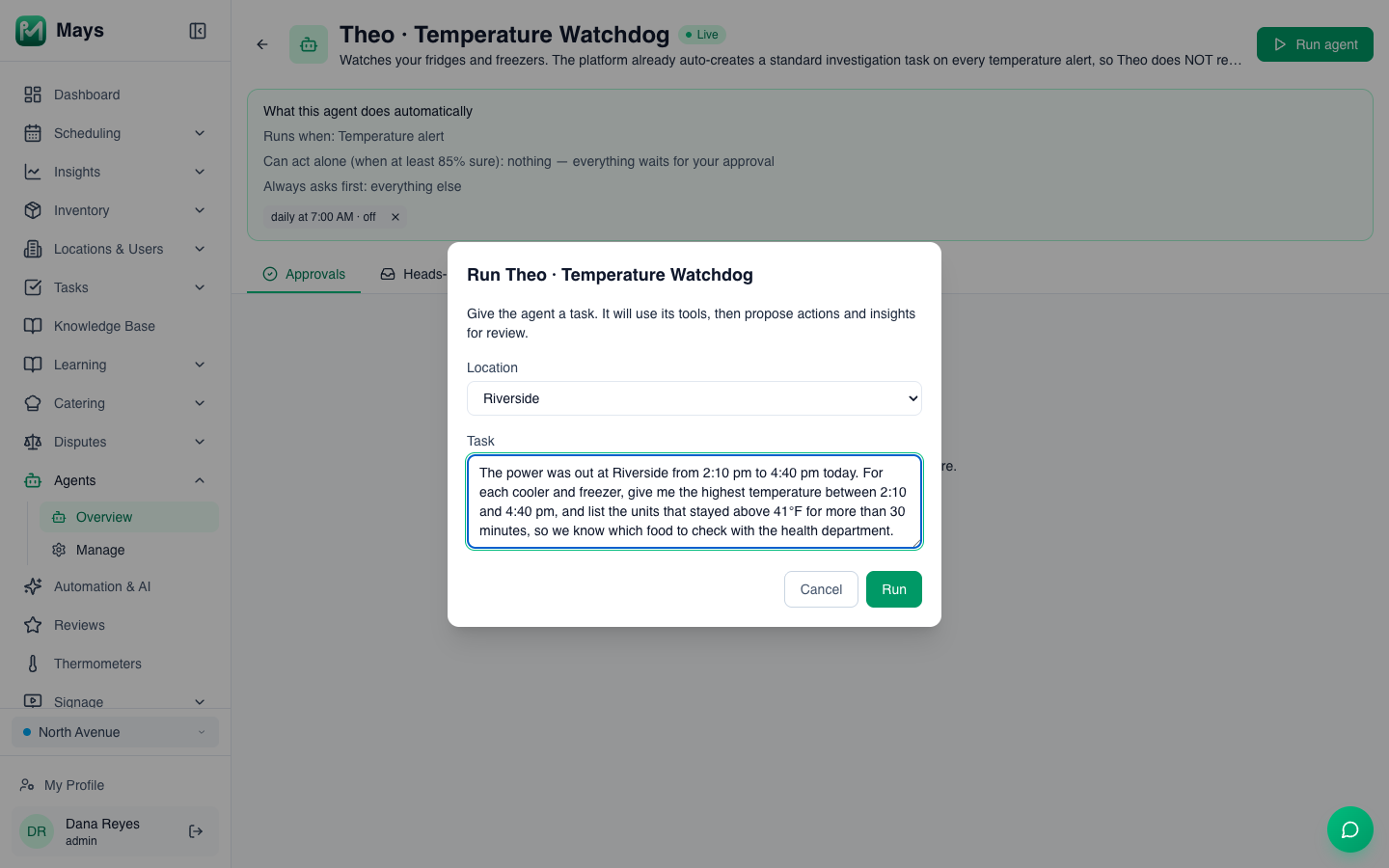
- Ask Theo what happened. Theo, the Temperature Watchdog among Mays's AI agents, can read a sensor's temperature history. Click Run agent on his page, pick the location and type the question (the image at the top of this post). What he finds and proposes waits on his page for your review, and a run for a location uses AI credits.
- Tasks for the reset. A one-off task with a Photo answer ("ice machine cleaned and sanitized") makes sure the reopening steps get done and leaves proof. See Creating one-off tasks.
- The plan, where staff find it. Put both checklists in a Knowledge Base article, and the discarded food in Inventory → Waste so it comes out of stock with its cost.
What Mays doesn't do: it can't see a power outage on its own, and probe readings your team writes on paper during the outage aren't in the thermometer log. Type them into a task or keep the sheet with the export.
Write it down before the lights go out
An outage with a log, a phone call and a decision is a bad afternoon. An outage without them can be a lost permit and a walk-in full of guesses.
Start your free trial: 30 days, every module, no card needed. Or book a walkthrough and we'll set up your thermometers and the emergency checklist with you.