Hiring a dishwasher or porter: job description, safety training and the closing checklist
The dish station is where a kitchen keeps its plates, its pans and its health inspection score. It's also where the strongest chemicals, the hottest water and the wettest floor in the building meet. New owners often hire for it last and train for it least, and then wonder why the 9 pm close takes until 11.
This is the third post in our Hiring and training by role series. It covers the job description, pay data, the safety training the rules expect, and a closing checklist. The general hiring process is in Hiring your first restaurant team.
This is general information, not legal advice. Updated October 5, 2026: every source below was checked on that date.
What the job is
In a small kitchen the dishwasher and the porter are often the same person. They:
- run the dish machine or the three-compartment sink, and check the sanitizer;
- keep clean plates, pans and utensils flowing back to the line;
- take out trash, recycling and cardboard;
- sweep and mop during and after service, and keep the floor dry;
- put away deliveries and rotate stock when asked;
- clean the dish area, the floor drains and the mats at close.
It's a job with a lot of judgment: when to push dishes and when to stop and mop a spill, which chemical goes where, what to do when the machine's temperature drops. Hire for reliability and train for the rest.
What dishwashers earn
The BLS occupation is dishwashers (SOC 35-9021). O*NET's sample titles for it include "Dish Machine Operator (DMO)", "Kitchen Steward" and "Utility Worker" (O*NET 35-9021.00), which is where many porter jobs land.
Dishwashers: restaurants and other eating places, May 2025 | Hourly |
|---|---|
25th percentile | $14.00 |
Median | $16.58 |
75th percentile | $17.73 |
Source: BLS Occupational Employment and Wage Statistics, May 2025 national industry estimates for NAICS 7225 (median series OEUN000000072250035902108; 25th and 75th percentiles: the series ending in 07 and 09). Across all industries the median was $16.73. Your state's minimum wage is the floor.
A dishwasher and porter job description
Dishwasher / Porter, [full-time / part-time], [pay range] an hour
[Your restaurant], [neighborhood]

What you'll do
- Run the dish machine and the three-compartment sink during service
- Keep clean plates, pans and tools moving back to the line
- Check and record the sanitizer and the machine temperature
- Take out trash, recycling and cardboard; keep the back door area clean
- Sweep and mop during and after service, and keep floors dry
- Close the dish station and the kitchen floor with our checklist

What you need
- Available [days and times, including weekend evenings]
- Able to stand for a full shift, work with hot water and lift 40 lb
- Reliable: the kitchen can't close without you

What we offer
- [Pay range] an hour, paid weekly / every two weeks
- Non-slip shoes [if you provide them] and the gloves and eye protection for every chemical
- Paid safety training on day one, and room to move to prep or the line

To apply, send your availability to [email].
"Room to move to prep" is worth meaning. Many prep cooks and line cooks started on dish.
Safety training: chemicals and safety data sheets
Dish and cleaning chemicals are what OSHA's Hazard Communication Standard is about. Three parts of it matter for a small kitchen:
- Safety data sheets on hand. "The employer shall maintain in the workplace copies of the required safety data sheets for each hazardous chemical, and shall ensure that they are readily accessible during each work shift to employees when they are in their work area(s)." Electronic access is allowed "as long as no barriers to immediate employee access in each workplace are created by such options" (29 CFR 1910.1200(g)(8)).
- Training before they use the chemicals. "Employers shall provide employees with effective information and training on hazardous chemicals in their work area at the time of their initial assignment, and whenever a new chemical hazard the employees have not previously been trained about is introduced into their work area" (1910.1200(h)(1)). The training covers the hazards, how to protect themselves, and where the safety data sheets are (1910.1200(h)(2) and (3)).
- A written program. Employers "shall develop, implement, and maintain at each workplace, a written hazard communication program" that includes a list of the hazardous chemicals present (1910.1200(e)(1)).
There's an exemption for some consumer products, but only when the use in your workplace results "in a duration and frequency of exposure which is not greater than the range of exposures that could reasonably be experienced by consumers" (1910.1200(b)(6)(ix)). A dish machine detergent used all shift is not a bottle of dish soap at home. When in doubt, keep the SDS.
The FDA Food Code adds the food-safety side (2022 edition): a spray bottle or bucket filled from a bulk container must be labeled with the common name of the chemical (§7-102.11); chemicals are stored apart from food and never above food, equipment or clean dishes (§7-201.11); and you need a test kit that measures the sanitizer's concentration (§4-302.14), with the concentration in a dish machine checked with a test kit or other device (§4-501.116).
What to teach on day one:
- Where the SDS binder is, and how to find a product in it
- Which chemical is for what: detergent, rinse aid, sanitizer, degreaser, oven cleaner
- The gloves and eye protection for each one, from its label and SDS
- Never mix chemicals. OSHA's young worker restaurant guide specifically warns against mixing chlorine and ammonia products (OSHA eTool: clean-up)
- How to fill and label a spray bottle, and how to test the sanitizer
- What to do if a chemical gets in the eyes or on the skin: the eyewash or sink, then tell the lead
Burns, slips and the walk-in
Burns. Dish water, the machine's final rinse and pans straight off the line are all hot enough to burn. OSHA's restaurant guide for young workers recommends letting items cool before unloading, keeping away from steam and testing water temperature before putting hands in (OSHA eTool: clean-up). Teach the machine's door, the hot side of the sink and where the burn kit is.
Slips. The rule is direct: "The floor of each workroom is maintained in a clean and, to the extent feasible, in a dry condition" (29 CFR 1910.22(a)(2)). Mop spills right away, use wet-floor signs, keep mats clean and flat, and wear non-slip shoes.
The walk-in. OSHA's guide warns that staff can be trapped in cold storage if the door closes, and tells employers to make sure walk-in freezers can be opened from the inside and to check cold storage at closing so no one is left inside (OSHA eTool: delivery and storage). Put "walk-in checked, nobody inside" on the closing checklist.
Teens at the dish station
Dish is a common first job, and federal rules allow 14- and 15-year-olds to run a dishwasher: the permitted machines include "dishwashers" (29 CFR 570.34(i)). The limits that catch kitchens out:
- They may clean equipment and handle grease filters or hot oil only when the equipment and liquids "do not exceed a temperature of 100 °F" (570.34(i)).
- They may not work in freezers and meat coolers, beyond entering "occasionally" and "momentarily" to fetch items (29 CFR 570.33(i)).
- Operating a cardboard baler or trash compactor is on the list of jobs too hazardous for anyone under 18, with a narrow exception for 16- and 17-year-olds loading certain equipment (29 CFR 570.63).
Hours limits for teens are in the hiring guide, and your state may be stricter.
The dish station closing checklist
Copy this, adjust it to your machine, and put a name on it every night.
Dishes and machine
- Last load run, everything put away dry, nothing left soaking overnight
- Machine drained, curtains and scrap trays out, washed and air-dried
- Wash arms checked for clogs and rinsed
- Sanitizer concentration tested and recorded for the day
- Three-compartment sink drained, scrubbed and dried
Chemicals
- Every spray bottle labeled, caps on, stored below and away from food and clean dishes
- Chemical shelf tidy, nothing leaking, the SDS binder in its place
Floor and trash
- Floor drains cleared, drain covers back in place
- Mats out, washed and hung; floor swept, mopped and squeegeed dry
- Trash, recycling and cardboard out; back door area clear; bins closed
Last checks
- Walk-in and freezer checked: doors closed, nobody inside
- Hot water and machine off as your procedure says
- Photo of the clean dish station for the closing lead
Where Mays fits
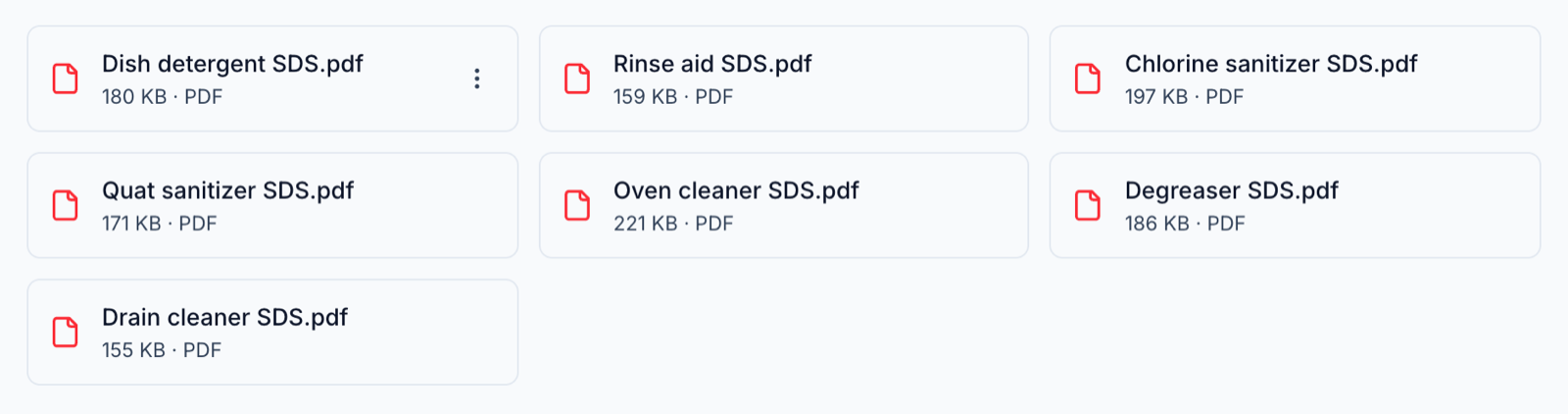
- The SDS binder on every phone. Make a folder in the Knowledge Base and upload each safety data sheet; PDFs, Word files and images up to 50 MB each are accepted. The image at the top of this post shows a folder with seven sheets. New folders start private, so share it with the location. Staff read it in the app's Knowledge tab. Keep a printed binder too, so access doesn't depend on a charged phone or a working connection.
- Chemical training with a record. Turn your chemical SOPs into a short quiz in Learning and mark it compliance-critical: someone who passes gets a PDF certificate, and the module page lists everyone's attempts and best score. It's a record of your own training, not a substitute for the program and training the standard describes.
- The closing checklist. Build the list above as a template under Tasks → Templates with a Photo task for the clean station, and a Visibility Window so it shows up on the closer's phone only near close.
- Teens and equipment. With Labor law compliance on, a Dishwasher position can carry a Minimum age and tasks such as a cardboard baler or trash compactor, filtering hot oil above 100°F, or freezer work, and at a location with minors' rules on, Mays warns you when someone too young is scheduled on it.
Mays doesn't keep your written hazard communication program or a chemical inventory, so keep those in your own files (a knowledge base article works).
Your dishwasher hiring checklist
- A job description that says dish and porter work honestly, with a path to prep
- The SDS binder complete, where every shift can reach it, and a written program
- Chemical training on day one, before they touch a bottle
- Burns, slips and the walk-in covered in the first shift
- Teen hires checked against the equipment, freezer and temperature limits
- A closing checklist with a name on it every night
Close the kitchen with Mays
Put the SDS binder on every phone, give the closer a checklist with photo proof, and see who's been trained on what.
Start your free trial: 30 days, every module, no card needed. Next in the series: hiring a shift lead.