Washington restaurant pay rules (2026): what to pay tipped and non-tipped staff
Washington has no tip credit, so a server starts from the same $17.13 an hour as the dishwasher, and tips come on top (WA L&I, minimum wage). What changes the number is the address: Seattle pays $21.30, and several other cities and unincorporated King County set their own rates, some of them by employer size. Washington is also strict about service charges: if the menu and receipt don't say how much of one goes to the staff who served, all of it does (WA L&I, tips and service charges).
This page puts Washington's figures in one place. It covers what you owe tipped staff like servers and bartenders, what you owe everyone else, and two example weeks with the math shown. Every figure links to the official page it comes from.
This is general information, not legal advice. Whether a rule applies can depend on your business's size and your own facts; the note at the end says more.
Washington pay rules at a glance
As of October 21, 2026:
Rule | Washington |
|---|---|
Minimum wage | $17.13 an hour, since January 1, 2026 |
Tipped employees | The full minimum wage: Washington doesn't allow a tip credit |
Overtime | 1.5× the regular rate after 40 hours in a workweek; no daily overtime |
Meal and rest breaks for adults | Washington has break rules; see Breaks below |
Next change | $17.73 minimum wage from January 1, 2027 |
Sources: WA L&I, minimum wage; US DOL, state minimum wage laws.
Other Washington rates:
- workers aged 14 or 15 (85% of the adult minimum wage): $14.56 an hour
Who counts as a tipped employee in Washington
Washington doesn't allow a tip credit (WA L&I, minimum wage), so there's no separate tipped wage: servers and bartenders get at least the full minimum wage, and their tips come on top. Who counts as tipped still matters for tip pools, below.
What you must pay tipped staff in Washington
Servers, bartenders and baristas who get tips must be paid at least the full $17.13 an hour in wages (WA L&I, minimum wage), and their tips are all theirs, on top. There's no tipped cash wage and no weekly tip make-up to calculate. From January 1, 2027, that's $17.73 (WA L&I, minimum wage).
What you must pay non-tipped staff in Washington
Cooks, dishwashers, prep cooks, and cashiers or counter staff who don't get tips are paid like any other hourly employee:
- At least $17.13 an hour for every hour worked, and at least $17.73 from January 1, 2027 (WA L&I, minimum wage). No tip credit applies.
- Overtime is at least 1.5 times their regular rate for hours over 40 in a workweek. At $17.13 an hour, that's $25.695 (US DOL, state minimum wage laws).
- Can they share in the tip pool? Yes. Washington lets a pool you require include staff who don't serve customers directly, such as kitchen staff and hourly lead workers, but not salaried-exempt managers or business owners, and no one can be made to put in more than they got in tips (WA L&I, tips and service charges).
Worked examples (made-up numbers)
The names, hours and tips below are made up. The rates are Seattle's as of October 21, 2026. Elsewhere in Washington, use the rates for your area above.
A server's week
Sam is a server. For a 32-hour week you pay him at least 32 × $21.30 = $681.60 in wages, before tips. His tips are all on top, whatever they come to; there's no make-up to calculate.
A cook's week with overtime
Ana is a line cook paid the Seattle minimum wage, $21.30 an hour. Over five days she works 8, 9, 10, 9 and 9 hours: 45 hours in all.
Hours | Rate | Pay | |
|---|---|---|---|
Regular hours | 40 | $21.30 | $852.00 |
Overtime hours (over 40) | 5 | $31.95 (1.5 × $21.30) | $159.75 |
Total | 45 | $1,011.75 |
Overtime is counted by the workweek, and hours can't be averaged across two weeks: a long week earns overtime even if the next one is short (US DOL, overtime). Bonuses can change the rate too; see Time clock, breaks and overtime: first-month payroll mistakes to avoid.
Tip pooling rules in Washington
Washington has its own tip-pool rules (WA L&I, tips and service charges): Washington has no tip credit. Employers may require tip pools or tip-outs, which may include non-serving staff such as kitchen staff and hourly leads, but not salaried-exempt managers or owners. Employees cannot be required to put in more than they received in tips. Employers may deduct only the tip's proportional share of card fees.
Federal rules apply too, and where the two differ, follow the stricter one (US DOL, tips):
- The business, its managers and supervisors never keep employees' tips. A manager can't take anything from a pool; they may keep only tips for service they directly and solely provide. An owner with a real stake who helps run the business counts as a manager too.
- Kitchen staff: federal law lets a pool you require include cooks and dishwashers only when everyone in it gets at least the full minimum wage and no tip credit is taken, which in Washington is always the case.
- Card fees: you may reduce a card tip by the percentage the card company actually charges you, and no more (DOL Fact Sheet #15).
- Service charges: under federal law, a mandatory service charge isn't a tip: money you share from one is wages, and it counts in the regular rate for overtime (DOL Fact Sheet #15). Washington adds its own rule: A business that provides food, beverages, entertainment or porterage, such as a restaurant, catering house, convention center or hotel, and adds an automatic service charge, including one labeled "gratuity", "delivery charge" or "porterage charge", must disclose on the itemized receipt and on any menu the percentage paid to the employees serving the customer (RCW 49.46.160). If nothing is disclosed, or the disclosure is unclear, the entire service charge must be paid to the employee who served the customer. What employees get from a service charge is on top of their hourly wages (WA L&I, tips and service charges).
- Pay pooled tips out by the regular payday for the week or pay period (DOL Fact Sheet #15).
In Seattle, breaking the state's service-charge law is also a violation of the city's Wage Theft Ordinance, and the disclosure applies to electronic menus and receipts too (Seattle OLS, Wage Theft Q&A).
How to split a pool fairly, with a worked example: Tip pooling for new restaurant owners.
Overtime in Washington
Washington's overtime law draws the same line as the federal one (US DOL, state minimum wage laws): non-exempt employees get at least 1.5 times their regular rate for hours over 40 in a workweek (US DOL, overtime).
A workweek is any fixed, recurring stretch of seven days that you choose, and hours can't be averaged across two weeks. There's no daily overtime, no double time and no seventh-day premium under Washington or federal law, and weekend or holiday hours don't earn a premium by law.
Breaks in Washington
- Meal breaks: A 30-minute meal period for a shift of more than 5 hours, starting between the second and the fifth hour, and no more than 5 hours in a row without one. Another 30-minute meal period is due when someone works 3 or more hours past their scheduled shift, and one for each further 5 hours. It's paid if the employee has to stay on duty or on call on the premises, or is called back, and unpaid if they're free of all duties. Adults can waive it if they and the employer agree, and L&I can grant variances (WAC 296-126-092).
- Rest breaks: A paid 10-minute rest break for each 4 hours worked, as close to the middle of that time as possible, and no more than 3 hours without one. Where the work allows, shorter breaks adding up to 10 minutes per 4 hours count instead. Employees can't waive rest breaks, and the employer can require them to stay on site (WAC 296-126-092).
- Minors: Outside agriculture, 16- and 17-year-olds get an uninterrupted 30-minute meal break, with no more than 5 hours in a row without one, and a paid 10-minute rest break when working 4 hours or more, with no more than 3 hours without one. Under 16: a 30-minute meal break, with no more than 4 hours in a row without one, a paid 10-minute rest break, and no more than 2 hours in a row without a meal or rest break. Meal breaks come on top of rest breaks, and minors can't waive either (WA L&I, youth breaks).
Other Washington rules that affect pay
- Paid sick leave: Employees earn at least 1 hour of paid sick leave for every 40 hours worked, from their first day. Unused balances of 40 hours or less must carry over to the next year, and employees can use their leave from their 90th calendar day of work. Seattle and Tacoma have their own paid sick leave ordinances (WA L&I, paid sick leave).
- Food handler training: Every food employee needs approved food-safety training. Who: anyone who works with unpackaged food, food equipment or utensils, or surfaces where unwrapped food is put; a new worker may work up to 14 days before getting the card if the employer provides food safety training (WA DOH, food worker card).
Local rates in Washington
These cities and counties set their own minimum wage, as recorded on October 5, 2026. An employer pays the highest rate that applies where the work is done.
Area | Who it covers | Minimum wage | Next change |
|---|---|---|---|
Seattle | all employers, regardless of size, for employees working within Seattle city limits | $21.30 | $22.14 on January 1, 2027 |
King County (unincorporated) | 500 or more employees | $20.82 | $21.57 on January 1, 2027 |
King County (unincorporated) | more than 15 but fewer than 500 employees | $19.82 | $21.57 on January 1, 2027 |
King County (unincorporated) | 15 or fewer employees and annual gross revenue of $2 million or more | $19.82 | $21.57 on January 1, 2027 |
King County (unincorporated) | 15 or fewer employees and annual gross revenue of less than $2 million | $18.32 | $19.57 on January 1, 2027 |
Renton | employers with at least 15 employees worldwide, or over $2 million of annual gross revenue in Renton; since July 1, 2026 every covered employer pays the same rate | $21.57 | $22.28 on January 1, 2027 |
Everett | Large employers: more than 500 employees, including franchisees of a network with more than 500 in all | $20.77 | $21.52 on January 1, 2027 |
Everett | Other covered employers (15 to 500 employees, or over $2 million in Everett revenue) | $19.77 | $20.52 on January 1, 2027 |
Bellingham | employers as defined in the state minimum wage act, of any size | $19.13 | January 1, 2027 (rate not published yet) |
Burien | large employers (501 or more employees) | $21.78 | $22.49 on January 1, 2027 |
Burien | medium employers (16 to 500 employees) | $20.78 | $22.49 on January 1, 2027 |
Burien | small employers (15 or fewer employees) | $19.28 | $20.49 on January 1, 2027 |
Tukwila | employers with at least 15 employees worldwide (if one of them has worked in Tukwila), with more than $2 million in annual gross revenue in Tukwila, or franchisees of networks with more than 500 employees worldwide | $21.65 | — |
Sources: Seattle OLS, 2026 minimum wage; King County; Renton; Everett; WA L&I, local rates; Burien. "—" means we found no date for the next change; check the city's or county's page.
Local ordinances on other rules (sick leave, scheduling): SeaTac, Tacoma.
SeaTac and Tacoma
SeaTac's $20.74 applies only to employers in the hospitality and transportation industries (WA L&I, local rates). That can include a restaurant in a large hotel or an institutional food service operation, but not a standalone restaurant, which pays the state rate (SeaTac SMC 7.45).
Tacoma has no minimum wage of its own in effect, so the state rate applies (Tacoma council report). A citizen initiative that included a $20 minimum wage is tied up in an appeal (City of Tacoma, Initiative 2), and in July 2026 the city said its deputy mayor was developing an ordinance for the full council to consider in the fall (City of Tacoma, July 2026).
In unincorporated King County, count employees as the average over the past 12 months, wherever they worked, and revenue as the business's total worldwide revenue (King County).
Seattle's scheduling law
Seattle's Secure Scheduling Ordinance covers food service businesses with 500 or more employees worldwide; a full-service restaurant is covered only if it also has 40 or more full-service locations worldwide. A covered employer posts schedules 14 days ahead, owes predictability pay for many changes after that, and pays time and a half for hours between a closing and an opening shift less than 10 hours apart (Seattle OLS, Secure Scheduling).
How Mays helps
Mays runs the schedule, time clock, tip pool and payroll export for each location. For Washington pay rules, that means:
- Positions and wages. Give each position a default hourly wage of at least the minimum wage that applies where you are, servers included, since Washington has no tip credit. Turn on Labor law compliance and Mays looks up each location's minimum wage from its address and warns you when a position's default wage, someone's hourly wage or a punch is below it. It never blocks the save. It switches to the new rate on January 1, 2027 by itself, and admins get a reminder 30 and 7 days before, listing the wages below the new rate.
- A tip pool per location. Split pooled tips by hours worked, equally or by FTAR score, per pay period or day by day, and choose which positions receive. Leave managers and admins out of the pool is on by default, so leave it on. The tips come from your connected POS at that location (Square or Union) or from tips synced with 7shifts time punches, and each person's share appears in the Tip Payouts report and the payroll export. If you take your card processor's fee out of card tips, turn on Labor law compliance and Deduct the card processing fee from card tips: Mays deducts only your processor's percentage, split in proportion to each person's card tips, and shows it on the pay period and in the export. With Labor law compliance on, the card also lists Washington's service-charge rule as a checklist, with its source.
- Time clock and timesheets. Staff clock in on their phone, a shared kiosk or an NFC tag. Timesheets run by pay period. Overtime is counted by the workweek, and with Labor law compliance on, by any daily, double-time and seventh-day rule the location's state sets too, which Mays reads from its address; the schedule's labor cost, the reports and the pay summary all include it.
- Payroll export. A standard CSV or a Gusto-format CSV with regular and overtime hours and pooled tips for each employee. A card surcharge you share with staff goes in as wages, not tips.
- Minors. Turn on Labor law compliance and work rules for minors at a location, and Mays warns you when a shift breaks a minor's hours or time-of-day limits under federal law, and the auto-scheduler won't put a minor on one. It doesn't track minors' breaks yet, so build a minor's meal break into their shifts when you schedule them.
- Food handler cards. Turn on Labor law compliance and keep each person's card in Mays with its expiry date and a photo. Each location shows who has no card on file and whose card is about to expire, and Mays reminds the employee and their managers before a card expires.
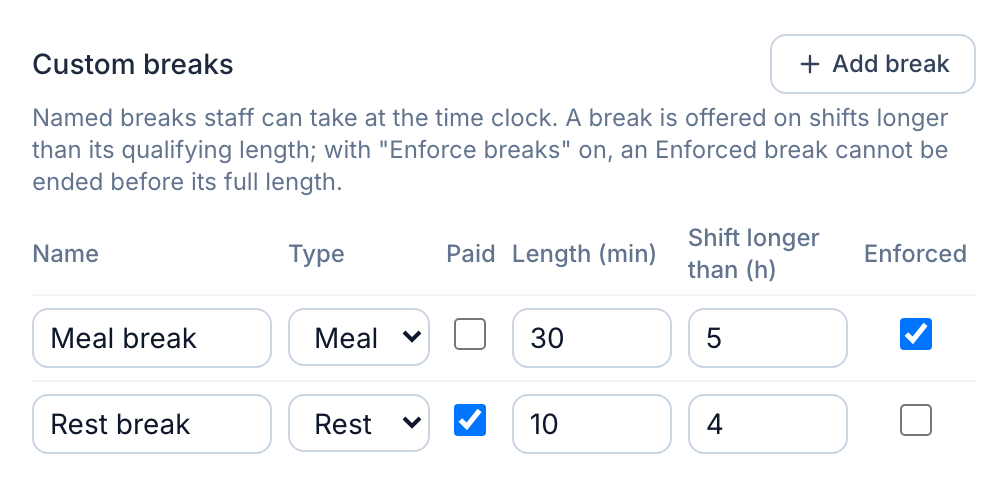
- Breaks at the time clock. Under a location's Labor & compliance card, add Washington's breaks as custom breaks, for example an unpaid 30-minute meal break for shifts longer than 5 hours and a paid 10-minute rest break. Staff choose the break when they start it, and with Enforce breaks at the time clock on, a break marked enforced can't be ended early. Outside California, Mays doesn't check when a meal break starts or track missed breaks, so review those yourself.
- Paid sick leave. With Labor law compliance on, the Sick category under Scheduling → Settings → Time off & PTO accrual shows Washington's rules for each location (and Seattle's or Tacoma's where they apply), and Apply these rules fills them in: at least one hour for every 40 worked, a carryover of up to 40 hours into the next year, and the waiting period for new hires, counted from the Hire date on each person's Employment tab. Everyone who works hours earns it from approved punches, managers included. When a new year starts, Mays trims each balance to the carryover limit you set; leave it blank to carry everything over.
Sources
Every figure on this page comes from these official pages, as they read on the date shown.
- Washington L&I, minimum wage, checked October 5, 2026
- Washington L&I, tips and service charges, checked September 24, 2026
- US Department of Labor, state minimum wage laws, checked September 24, 2026
- US Department of Labor, overtime pay, checked September 24, 2026
- US Department of Labor, tips under the FLSA, checked September 24, 2026
- US Department of Labor, Fact Sheet #15: tipped employees under the FLSA, checked September 24, 2026
- City of Seattle Office of Labor Standards, Wage Theft Ordinance questions and answers, checked September 24, 2026
- WAC 296-126-092 (meal periods and rest breaks), checked September 24, 2026
- Washington L&I, youth employment: wages, rest breaks and meal periods, checked September 24, 2026
- Washington L&I, paid sick leave, checked September 24, 2026
- Washington Department of Health, food worker card, checked September 24, 2026
- City of Seattle Office of Labor Standards, 2026 minimum wage fact sheet, checked October 5, 2026
- King County, minimum wage in unincorporated King County, checked October 16, 2026
- City of Renton, labor standards, checked October 16, 2026
- City of Everett, minimum wage, checked October 16, 2026
- Washington L&I, local minimum wage rates, checked September 24, 2026
- City of Burien, minimum wage, checked October 16, 2026
- City of SeaTac, Hospitality and Transportation Industry Employment Standards (SMC 7.45), checked September 24, 2026
- City of Tacoma, Tacoma minimum wage community and stakeholder engagement report (June 30, 2026), checked September 24, 2026
- City of Tacoma, update on Initiative 2, checked September 24, 2026
- City of Tacoma, deputy mayor seeks feedback on a minimum wage proposal (July 14, 2026), checked September 24, 2026
- City of Seattle Office of Labor Standards, Secure Scheduling Ordinance, checked October 5, 2026
This page is general information, not legal advice. Laws change, and coverage rules (your business's size, whether federal law covers you) decide which of them apply. Check the pages above, and ask an employment lawyer or accountant about your situation.
Run Washington payroll on the right numbers
Set each position's wage, turn on the tip pool with managers left out, and let the time clock count overtime by the workweek. Then payroll is an export, not an evening.
Start your free trial: 30 days, every module, no card needed. Setting up a tip pool? Read Tip pooling for new restaurant owners.