Oregon restaurant pay rules (2026): what to pay tipped and non-tipped staff
Oregon sets three minimum wages by region, and all three rise every July with inflation (BOLI, minimum wage schedule). On June 3, 2026 they were $16.30 an hour in the Portland metro area, $15.05 in most of the state and $14.05 in 18 nonurban counties, and the state had already announced the rates for July 1, 2026 (BOLI, press releases). There's no tip credit, so servers get the full rate for their area and keep their tips on top. Meal and rest breaks are required and timed, and the largest food-service chains owe their staff predictable schedules.
This page puts Oregon's figures in one place. It covers what you owe tipped staff like servers and bartenders, what you owe everyone else, and two example weeks with the math shown. Every figure links to the official page it comes from.
Updated September 24, 2026: Oregon's minimum wages rose on July 1, 2026, as scheduled: $16.80 an hour in the Portland metro area, $14.55 in the nonurban counties and $15.55 in the rest of the state through June 30, 2027. Elsewhere on this page, the rates are the ones in effect on June 3, 2026. They change again on July 1, 2027; the new rates had not been published when we checked.
This is general information, not legal advice. Whether a rule applies can depend on your business's size and your own facts; the note at the end says more.
Oregon pay rules at a glance
As of June 3, 2026:
The Portland metro area | The nonurban counties | The rest of the state | |
|---|---|---|---|
Minimum wage | $16.30 an hour | $14.05 an hour | $15.05 an hour |
Rule | Oregon |
|---|---|
Tipped employees | The full minimum wage for the area: Oregon doesn't allow a tip credit |
Overtime | 1.5× the regular rate after 40 hours in a workweek; no daily overtime |
Meal and rest breaks for adults | Oregon has break rules; see Breaks below |
Next change | $16.80 in the Portland metro area, $14.55 in the nonurban counties and $15.55 in the rest of the state from July 1, 2026; they change again on July 1, 2027 (new rates not published yet) |
Sources: BOLI, minimum wage schedule; BOLI, minimum wage; BOLI, overtime.
Which rate applies goes by the employer's fixed location where the employee does more than 50% of their work in a pay period; someone who works in more than one region is paid each region's rate for the hours there, or the highest rate for all hours (OAR 839-020). A shift that runs past midnight into the first day of new rates is paid at the new rates for the hours after midnight (BOLI, minimum wage).
Who counts as a tipped employee in Oregon
Oregon doesn't allow a tip credit (BOLI, minimum wage), so there's no separate tipped wage: servers and bartenders get at least the full minimum wage, and their tips come on top. Who counts as tipped still matters for tip pools, below.
What you must pay tipped staff in Oregon
Servers, bartenders and baristas who get tips must be paid at least the full minimum wage for the area where they work: $16.30 an hour in the Portland metro area, $14.05 in the nonurban counties and $15.05 in the rest of the state (BOLI, minimum wage schedule). Their tips are all theirs, on top. There's no tipped cash wage and no weekly tip make-up to calculate. From July 1, 2026, it's $16.80 in the Portland metro area, $14.55 in the nonurban counties and $15.55 in the rest of the state (BOLI, minimum wage).
What you must pay non-tipped staff in Oregon
Cooks, dishwashers, prep cooks, and cashiers or counter staff who don't get tips are paid like any other hourly employee:
- At least your region's minimum wage for every hour worked: $16.30 an hour in the Portland metro area; $14.05 in the nonurban counties; $15.05 in the rest of the state (BOLI, minimum wage schedule). From July 1, 2026: $16.80 in the Portland metro area; $14.55 in the nonurban counties; $15.55 in the rest of the state (BOLI, minimum wage). No tip credit applies.
- Overtime is at least 1.5 times their regular rate for hours over 40 in a workweek. At $16.30 an hour, that's $24.45; at $14.05 an hour, $21.075; at $15.05 an hour, $22.575 (BOLI, overtime).
- Can they share in the tip pool? Yes. Oregon doesn't allow a tip credit, so a pool you require can include kitchen staff who don't usually get tips (US DOL, tips). Managers and supervisors can never take from the pool.
Oregon has no training wage: everyone gets at least the minimum wage from their first hour (BOLI, minimum wage).
Worked examples (made-up numbers)
The names, hours and tips below are made up. The rates are Portland metro's as of June 3, 2026. Elsewhere in Oregon, use the rates for your area above.
A server's week
Sam is a server. For a 30-hour week you pay him at least 30 × $16.30 = $489.00 in wages, before tips. His tips are all on top, whatever they come to; there's no make-up to calculate.
A cook's week with overtime
Ana is a line cook paid the Portland metro minimum wage, $16.30 an hour. Over five days she works 9, 9, 9, 8 and 9 hours: 44 hours in all.
Hours | Rate | Pay | |
|---|---|---|---|
Regular hours | 40 | $16.30 | $652.00 |
Overtime hours (over 40) | 4 | $24.45 (1.5 × $16.30) | $97.80 |
Total | 44 | $749.80 |
Overtime is counted by the workweek, and hours can't be averaged across two weeks: a long week earns overtime even if the next one is short (US DOL, overtime). Bonuses can change the rate too; see Time clock, breaks and overtime: first-month payroll mistakes to avoid.
Tip pooling rules in Oregon
No specific Oregon rule found — federal rules apply (BOLI, minimum wage). Under federal law (US DOL, tips):
- The business, its managers and supervisors never keep employees' tips. A manager can't take anything from a pool; they may keep only tips for service they directly and solely provide. An owner with a real stake who helps run the business counts as a manager too.
- Kitchen staff: federal law lets a pool you require include cooks and dishwashers only when everyone in it gets at least the full minimum wage and no tip credit is taken, which in Oregon is always the case.
- Card fees: you may reduce a card tip by the percentage the card company actually charges you, and no more (DOL Fact Sheet #15).
- Service charges aren't tips. Money you share with staff from a mandatory service charge is wages, and it counts in the regular rate for overtime (DOL Fact Sheet #15).
- Pay pooled tips out by the regular payday for the week or pay period (DOL Fact Sheet #15).
How to split a pool fairly, with a worked example: Tip pooling for new restaurant owners.
Overtime in Oregon
Oregon's overtime law draws the same line as the federal one (BOLI, overtime): non-exempt employees get at least 1.5 times their regular rate for hours over 40 in a workweek (US DOL, overtime).
A workweek is any fixed, recurring stretch of seven days that you choose, and hours can't be averaged across two weeks. There's no daily overtime, no double time and no seventh-day premium under Oregon or federal law, and weekend or holiday hours don't earn a premium by law.
Breaks in Oregon
- Meal breaks: A 30-minute meal period, relieved of all duties, for a work period of 6 to 8 hours: on a shift of 7 hours or less it comes after the second hour and before the fifth begins, on a longer one after the third and before the sixth, and very long shifts earn more. If the employee isn't relieved of all duties for the full 30 minutes, the whole period is paid. A server or bartender aged 18 or older who gets and reports tips may waive it in writing, on the state's form, no sooner than 7 days after starting; a waived meal still can't stretch a shift past 8 hours without a meal period, and either side can end the waiver on 7 days' written notice (BOLI, meals and breaks).
- Rest breaks: A paid rest break of at least 10 minutes for every 4-hour segment of work or major part of one, taken near its middle and apart from the meal period; it can't be added to the meal period or used to leave early, and employees can't waive it. The one exception is an adult who works alone, for less than 5 hours in any 16 hours, in a retail or service business, and can leave to use the restroom. Minors get 15 minutes instead of 10 (BOLI, meals and breaks).
- Minors: Minors under 18 get a paid rest break of 15 minutes, not 10, for each 4-hour segment. The meal-period exceptions for hardship, industry custom and unforeseeable events can apply only to 16- and 17-year-olds, and the server's meal waiver only at 18 or older, so no minor can waive a meal period (BOLI, meals and breaks).
Other Oregon rules that affect pay
- Reporting-time pay: For minors under 18 only: an employer that has a minor report for work must give them enough work to earn at least half of what the agreed hours would pay, or pay them the greater of 1 hour at their regular rate or half the agreed hours, unless it followed a posted no-report policy in good faith or events beyond its control prevented the work (OAR 839-021).
- Predictive scheduling: Covers retail, hospitality and food-service employers with 500 or more employees worldwide. Post the written schedule 14 days ahead and give each new hire a good-faith estimate of their hours. An employee can decline shifts that aren't on the posted schedule, and a change you make after posting owes predictability pay: an extra hour's pay for added time or a moved shift, and half pay for hours cut. Work within 10 hours of the end of the previous day's shift is paid at 1.5 times the regular rate, even when the employee agreed to it (BOLI, predictive scheduling).
- Paid sick leave: Employees earn at least 1 hour of sick time for every 30 hours worked. It's paid at an employer with 10 or more employees in Oregon, or 6 or more if the employer has a location in Portland, and unpaid but protected at smaller ones. You can cap use at 40 hours a year, carryover at 40 hours and the balance at 80, and new hires can wait until their 91st day to use it (BOLI, sick time).
- Food handler training: Every food employee needs approved food-safety training. Who: anyone who prepares or serves food in a licensed restaurant or food service facility, within 30 days of being hired; the certificate lasts 3 years (ORS ch. 624).
Paid Leave Oregon, paydays and deductions
- Paid Leave Oregon. Contributions are 1% of wages in 2026, 60% of that from the employee and 40% from the employer; an employer with fewer than 25 employees doesn't pay its share but still withholds the employees' (Paid Leave Oregon).
- Paydays and final pay. Paydays can't be more than 35 days apart. Someone you fire is paid by the end of the next business day; someone who quits with 48 hours' notice, not counting weekends and holidays, is paid on their last day, and without notice within 5 business days or on the next payday, whichever comes first (ORS ch. 652).
- Deductions. Till shortages can't come out of pay, and a minimum-wage employee can only be required to buy a generic uniform, like black pants and a white shirt, with no payroll deduction for it (BOLI, paycheck deductions).
Local rates in Oregon
Apart from the regional rates above, which state law sets, we found no Oregon city or county with its own minimum wage.
State law keeps it that way: Oregon's cities and counties can't set their own minimum wage, sick-leave rules or scheduling rules (ORS ch. 653).
How Mays helps
Mays runs the schedule, time clock, tip pool and payroll export for each location. For Oregon pay rules, that means:
- Positions and wages. Give each position a default hourly wage of at least the minimum wage that applies where you are, servers included, since Oregon has no tip credit. Turn on Labor law compliance and Mays looks up each location's minimum wage from its address and warns you when a position's default wage, someone's hourly wage or a punch is below it. It never blocks the save. The rate for July 1, 2027 isn't published yet; once Mays has it, admins get a reminder 30 and 7 days before.
- A tip pool per location. Split pooled tips by hours worked, equally or by FTAR score, per pay period or day by day, and choose which positions receive. Leave managers and admins out of the pool is on by default, so leave it on. The tips come from your connected POS at that location (Square or Union) or from tips synced with 7shifts time punches, and each person's share appears in the Tip Payouts report and the payroll export. If you take your card processor's fee out of card tips, turn on Labor law compliance and Deduct the card processing fee from card tips: Mays deducts only your processor's percentage, split in proportion to each person's card tips, and shows it on the pay period and in the export.
- Time clock and timesheets. Staff clock in on their phone, a shared kiosk or an NFC tag. Timesheets run by pay period. Overtime is counted by the workweek, and with Labor law compliance on, by any daily, double-time and seventh-day rule the location's state sets too, which Mays reads from its address; the schedule's labor cost, the reports and the pay summary all include it.
- Payroll export. A standard CSV or a Gusto-format CSV with regular and overtime hours and pooled tips for each employee. A card surcharge you share with staff goes in as wages, not tips.
- Reporting-time pay for minors, per location. Turn on Labor law compliance and Mays reads Oregon's rule from each location's address and records it when a punch is clocked out. Each lands on the pay period's Exceptions tab and in its own column of the pay summary and the payroll export, and the location's settings list the conditions Mays can't check beside the official source.
- Minors. Turn on Labor law compliance and work rules for minors at a location, and Mays warns you when a shift breaks a minor's hours or time-of-day limits under federal law, and the auto-scheduler won't put a minor on one. It doesn't track minors' breaks yet, so build a minor's meal break into their shifts when you schedule them.
- Food handler cards. Turn on Labor law compliance and keep each person's card in Mays with its expiry date and a photo. Each location shows who has no card by the 30-day deadline after their hire date and whose card is about to expire, and Mays reminds the employee and their managers before a card expires.
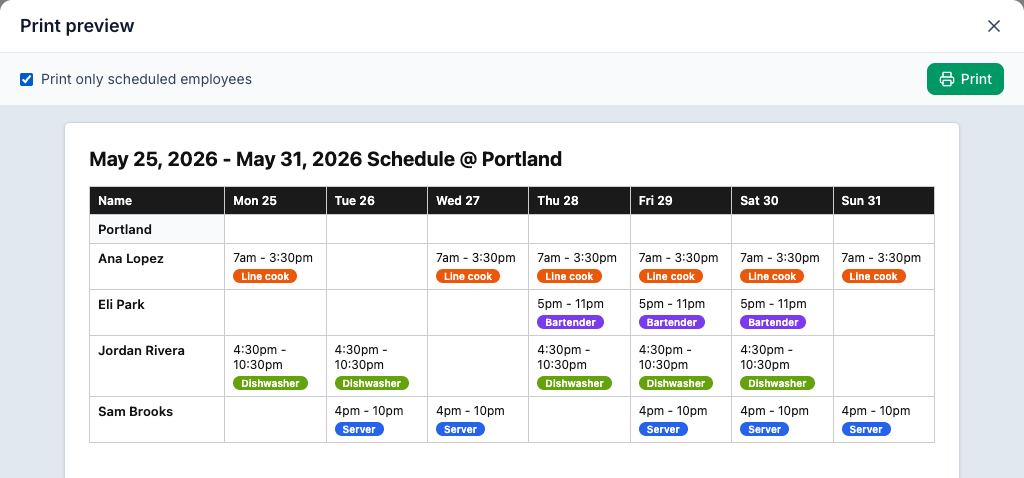
- A schedule to post. On the schedule, Print opens a preview of the week with each person's shifts by day, and Print only scheduled employees leaves out anyone who's off. A food-service employer the scheduling law covers posts the schedule 14 days ahead; Mays doesn't check that window or work out predictability pay for later changes, so track those yourself.
- Breaks at the time clock. Under a location's Labor & compliance card, add Oregon's 30-minute meal period and paid 10-minute rest break as custom breaks. Outside California, Mays doesn't check when a meal period is taken or record a server's waiver, so review punches and keep the waiver forms yourself.
- Sick time. With Labor law compliance on, the Sick category under Scheduling → Settings → Time off & PTO accrual shows Oregon's rules for each location, and Apply these rules fills them in: at least one hour for every 30 worked, Oregon's yearly limits on earning and using sick time, its balance and carryover limits, and its waiting period for new hires, counted from the Hire date on each person's Employment tab. Everyone who works hours earns it from approved punches, managers included.
Sources
Every figure on this page comes from these official pages, as they read on the date shown.
- Oregon BOLI, minimum wage schedule, checked September 24, 2026
- Oregon BOLI, press releases, checked September 24, 2026
- Oregon Bureau of Labor and Industries (BOLI), minimum wage, checked September 24, 2026
- Oregon BOLI, overtime (for employers), checked September 24, 2026
- Oregon Administrative Rules, chapter 839, division 20 (wage and hour), checked September 24, 2026
- US Department of Labor, tips under the FLSA, checked September 24, 2026
- US Department of Labor, overtime pay, checked September 24, 2026
- US Department of Labor, Fact Sheet #15: tipped employees under the FLSA, checked September 24, 2026
- Oregon BOLI, meals and breaks, checked September 24, 2026
- Oregon Administrative Rules, chapter 839, division 21 (employment of minors), checked September 24, 2026
- Oregon BOLI, predictive scheduling, checked September 24, 2026
- Oregon BOLI, sick time, checked September 24, 2026
- Oregon Revised Statutes, chapter 624 (food service facilities), checked September 24, 2026
- Paid Leave Oregon, employers overview, checked September 24, 2026
- Oregon Revised Statutes, chapter 652 (hours and wages), checked September 24, 2026
- Oregon BOLI, paycheck deductions, checked September 24, 2026
- Oregon Revised Statutes, chapter 653 (minimum wages; employment conditions), checked September 24, 2026
This page is general information, not legal advice. Laws change, and coverage rules (your business's size, whether federal law covers you) decide which of them apply. Check the pages above, and ask an employment lawyer or accountant about your situation.
Run Oregon payroll on the right numbers
Set each position's wage, turn on the tip pool with managers left out, and let the time clock count overtime by the workweek. Then payroll is an export, not an evening.
Start your free trial: 30 days, every module, no card needed. Setting up a tip pool? Read Tip pooling for new restaurant owners.