Massachusetts restaurant pay rules (2026): what to pay tipped and non-tipped staff
Massachusetts pays tipped staff a service rate: $6.75 an hour against a $15.00 minimum wage, as long as you've told them about it in writing and their tips make up the difference, checked at the end of every shift (454 CMR 27.00; MA Attorney General, pay). Voters kept it that way in November 2024, when they rejected a ballot question that would have raised the service rate step by step to the full minimum wage (2024 Question 5). Around that rate, the rules are strict about who gets the tips and relaxed about overtime: pooled tips and service charges go only to the staff who serve, and the state's overtime law doesn't reach restaurant staff at all, so their overtime comes from federal law.
This page puts Massachusetts's figures in one place. It covers what you owe tipped staff like servers and bartenders, what you owe everyone else, and two example weeks with the math shown. Every figure links to the official page it comes from.
Updated September 24, 2026: these figures are still current. Massachusetts's minimum wage is $15.00 an hour ($6.75 cash wage for tipped employees). No increase is scheduled.
This is general information, not legal advice. Whether a rule applies can depend on your business's size and your own facts; the note at the end says more.
Massachusetts pay rules at a glance
As of July 29, 2026:
Rule | Massachusetts |
|---|---|
Minimum wage | $15.00 an hour, since January 1, 2023 |
Tipped employees: minimum cash wage | $6.75 an hour, if you take the tip credit |
Maximum tip credit | $8.25 an hour |
Who counts as tipped | Customarily and regularly receives more than $20 a month in tips under Massachusetts law; more than $30 for an employer the federal law covers |
Overtime | 1.5× the regular rate after 40 hours in a workweek; no daily overtime (the federal rule: Massachusetts's own overtime law leaves out restaurant staff) |
Meal and rest breaks for adults | Massachusetts has break rules; see Breaks below |
Next change | None scheduled |
Sources: Mass.gov, minimum wage law; US DOL, tipped wages by state; US DOL, overtime.
Other Massachusetts rates:
- most agricultural workers: $8.00 an hour
Who counts as a tipped employee in Massachusetts
In Massachusetts, a tipped employee is someone who customarily and regularly receives more than $20 a month in tips (Mass.gov, minimum wage law). An employer the federal Fair Labor Standards Act (FLSA) covers must also meet the federal test to pay less than the federal minimum wage: more than $30 a month in tips (US DOL, tipped wages by state).
In a restaurant that usually means servers, bartenders, bussers and counter staff who serve customers, including baristas who get tips. Cooks and dishwashers usually aren't tipped employees. Only tips the employee actually receives count. If someone works two jobs, say a server who also works prep shifts, the tip credit applies only to the hours in the tipped job (DOL Fact Sheet #15).
What you must pay tipped staff in Massachusetts
Servers, bartenders, bussers and baristas who get tips can be paid a lower cash wage, with part of their tips counted toward the minimum wage. That's the tip credit, and it comes with conditions:
- Pay at least $6.75 an hour in cash wages. That's the $15.00 minimum wage minus the most you can credit from tips, $8.25 (Mass.gov, minimum wage law).
- Cash wages plus tips must reach $15.00 for every hour worked, week by week. If tips fall short in a workweek, you pay the difference by the regular payday for that week (DOL Fact Sheet #15).
- Tell them first. Before you take the tip credit, tell each tipped employee, in writing or out loud: the cash wage you pay, the tip credit you claim, that the credit can't be more than the tips they actually get, that they keep all their tips except through a valid tip pool, and that the credit doesn't apply unless you've told them all this (DOL Fact Sheet #15).
- Overtime is figured on the full minimum wage. An overtime hour is worth 1.5 × $15.00 = $22.50. After the $8.25 tip credit, you pay at least $14.25 of it in cash wages (DOL Fact Sheet #15).
You don't have to take the tip credit. If you pay tipped staff the full $15.00 an hour, their tips are all on top, there's nothing to make up at the end of the week. Massachusetts still keeps cooks and dishwashers out of a tip pool you require, though (see below).
Massachusetts's own conditions
- Tell them in writing. You can pay the service rate only if you've told the employee about Massachusetts's tip-credit law in writing, and all their tips stay with them or go through a tip pool (454 CMR 27.00).
- Check every shift, not every week. Massachusetts is stricter than the weekly federal check above: at the end of each shift, if the service rate plus tips come to less than the minimum wage for the hours worked, add the difference to the next paycheck (MA Attorney General, pay).
- The 2024 ballot question failed. It would have raised the service rate in steps to the full minimum wage by 2029, and let an employer paying everyone at least the minimum wage share tips with all its staff; 64.1% of voters said no (2024 Question 5; 2024 ballot results).
What you must pay non-tipped staff in Massachusetts
Cooks, dishwashers, prep cooks, and cashiers or counter staff who don't get tips are paid like any other hourly employee:
- At least $15.00 an hour for every hour worked (Mass.gov, minimum wage law). No tip credit applies.
- The same goes for a tipped employee's hours in a non-tipped job, like a server's prep shift (DOL Fact Sheet #15).
- Overtime is at least 1.5 times their regular rate for hours over 40 in a workweek. At $15.00 an hour, that's $22.50 (US DOL, overtime).
- Can they share in the tip pool? No. Massachusetts limits a required pool to staff who customarily and regularly receive tips (M.G.L. c. 149, § 152A). Managers and supervisors can never take from the pool.
Worked examples (made-up numbers)
The names, hours and tips below are made up. The rates are Massachusetts's as of July 29, 2026.
A server's week: when you have to top up
Sam is a server paid the $6.75 cash wage. He works 26 hours in each of two weeks: a busy one with $390.00 in tips and a slow one with $140.00.
Busy week | Slow week | |
|---|---|---|
Hours worked | 26 | 26 |
Cash wages (26 × $6.75) | $175.50 | $175.50 |
Tips received | $390.00 | $140.00 |
Cash wages + tips | $565.50 | $315.50 |
Minimum for the week (26 × $15.00) | $390.00 | $390.00 |
You pay on top | $0.00 | $74.50 |
In the slow week, $140.00 in tips covers only part of the $214.50 tip credit (26 × $8.25), so you pay the difference by the regular payday: $390.00 − $315.50 = $74.50. In the busy week you owe nothing extra, and every dollar of tips is still Sam's.
A cook's week with overtime
Ana is a line cook paid the Massachusetts minimum wage, $15.00 an hour. She works five 9-hour days: 45 hours.
Hours | Rate | Pay | |
|---|---|---|---|
Regular hours | 40 | $15.00 | $600.00 |
Overtime hours (over 40) | 5 | $22.50 (1.5 × $15.00) | $112.50 |
Total | 45 | $712.50 |
Overtime is counted by the workweek, and hours can't be averaged across two weeks: a long week earns overtime even if the next one is short (US DOL, overtime). Bonuses can change the rate too; see Time clock, breaks and overtime: first-month payroll mistakes to avoid.
Tip pooling rules in Massachusetts
Massachusetts has its own tip-pool rules (M.G.L. c. 149, § 152A): Tips and service charges can be pooled only among wait staff, service employees and service bartenders, and the law has no exception for an employer that pays the full minimum wage. Owners, kitchen and administrative staff, and anyone with managerial responsibility on the day, such as a shift supervisor, can't share; counter staff in a quick-service restaurant who prepare or serve food as part of the counter team can. An employer can't take any payment or deduction from a tip, and tips are paid out by the end of the same business day.
Federal rules apply too, and where the two differ, follow the stricter one (US DOL, tips):
- The business, its managers and supervisors never keep employees' tips. A manager can't take anything from a pool; they may keep only tips for service they directly and solely provide. An owner with a real stake who helps run the business counts as a manager too.
- With a tip credit, a pool you require can include only staff who customarily and regularly receive tips: servers, bartenders, bussers, counter staff who serve customers.
- Without a tip credit, federal law would let you include cooks and dishwashers, but Massachusetts doesn't: a pool you require stays limited to staff who serve customers.
- Card fees: federal law lets you reduce a card tip by the card company's actual fee percentage, but Massachusetts doesn't allow it.
- Service charges: under federal law, a mandatory service charge isn't a tip: money you share from one is wages, and it counts in the regular rate for overtime (DOL Fact Sheet #15). Massachusetts adds its own rule: A service charge, or any fee a customer would reasonably expect to go to the staff (a "service fee" or "service surcharge" included), goes in full only to the wait staff, service employees and service bartenders, in proportion to the service each provided. An employer can add a house or administrative fee it keeps only if the customer is told in writing that it isn't a tip or service charge for the staff (M.G.L. c. 149, § 152A).
- Pay pooled tips out by the regular payday for the week or pay period (DOL Fact Sheet #15).
The Attorney General treats tips as paid on time if they're paid by the end of the pay period in which they were earned (MA AG tips advisory).
How to split a pool fairly, with a worked example: Tip pooling for new restaurant owners.
Overtime in Massachusetts
Massachusetts has its own overtime law (M.G.L. c. 151, § 1A): Time and a half for hours over 40 in a workweek, but the state law doesn't apply to employees in a restaurant, or in a hotel, motel or gas station. Restaurant staff are owed overtime under the federal Fair Labor Standards Act where it covers the employer.
Under the federal rule, non-exempt employees get at least 1.5 times their regular rate for hours over 40 in a workweek (US DOL, overtime).
A workweek is any fixed, recurring stretch of seven days that you choose, and hours can't be averaged across two weeks. There's no daily overtime, no double time and no seventh-day premium under Massachusetts or federal law, and weekend or holiday hours don't earn a premium by law.
For tipped staff, overtime is figured on the full minimum wage, not the cash wage (see the tipped section above).
Premium pay for work on Sundays and certain holidays, which some retail stores used to owe, ended on January 1, 2023 (MA AG, Sundays and holidays).
Breaks in Massachusetts
- Meal breaks: A meal break of at least 30 minutes for anyone working more than 6 hours in a calendar day. During it the worker must be free of all duties and free to leave, and it can be unpaid; an employer can require that it be taken. If, at the employer's request, a worker agrees to work or stay at the workplace during the break, that time is paid (MA AG, breaks).
- Rest breaks: No specific Massachusetts rule found — federal rules apply (US DOL, state rest periods). The FLSA does not require breaks. Short breaks an employer offers (about 5 to 20 minutes) are paid work time (US DOL, breaks).
- Minors: No separate Massachusetts rule for minors; the adult rules above apply to them too (M.G.L. c. 149, § 67).
Other Massachusetts rules that affect pay
- Reporting-time pay: An employee scheduled for 3 or more hours who reports on time and is not given the expected hours is paid for at least 3 hours that day, at no less than the basic minimum wage. This does not apply to IRS-recognized charitable organizations (454 CMR 27.00).
- Paid sick leave: The Earned Sick Time law: employees earn at least 1 hour of sick time for every 30 hours worked, up to 40 hours a year. It's paid if the employer has 11 or more employees; a smaller employer gives it unpaid. An employer can ask for a doctor's note when an employee misses more than 3 consecutive workdays (Mass.gov, earned sick time).
- Food handler training: A certified food protection manager is required, not a card for every employee. Who: at least one person in charge per food service establishment who is a certified food protection manager and has completed allergen awareness training; a person in charge is present during all hours of operation (MA DPH, allergen awareness).
Sick time, paid leave and paydays
- Sick time for tipped staff is paid at the full minimum wage, $15.00 an hour, not the service rate (940 CMR 33.00), and a new hire can be made to wait until their 90th day to use it (M.G.L. c. 149, § 148C).
- Paid family and medical leave. An employer with 25 or more covered workers sends a contribution of 0.88% of eligible wages in 2026 and can withhold part of it from workers' pay; a smaller employer sends only the workers' share, 0.46% (MA PFML contribution rates).
- Weekly or biweekly paydays. Pay hourly staff weekly or every two weeks, within six days after the pay period ends (seven if they work all seven days of the week), and pay someone you fire in full on their last day (M.G.L. c. 149, § 148).
Local rates in Massachusetts
We found no Massachusetts city or county with its own minimum wage, so the state figures apply across Massachusetts.
How Mays helps
Mays runs the schedule, time clock, tip pool and payroll export for each location. For Massachusetts pay rules, that means:
- Positions and wages. Give each position a default hourly wage, for example the tipped cash wage for servers and at least the minimum wage for cooks. Mays doesn't check wages against the minimum wage, so update them yourself when the rate changes.
- A tip pool per location. Split pooled tips by hours worked, equally or by FTAR score, per pay period or day by day, and choose which positions receive. Until you choose, everyone who worked gets a share, cooks included, so if you take a tip credit, pick only tipped positions, and make sure every punch carries a position: once positions are picked, a punch without one gets no share. When you set it up, turn on Leave managers and admins out of the pool: it's off by default. The tips come from your connected POS at that location (Square) or from tips synced with 7shifts time punches, and each person's share appears in the Tip Payouts report and the payroll export.
- The shift-by-shift make-up is yours to check. Mays doesn't compare a tipped employee's service rate plus tips with the minimum wage, by the shift or by the week, so check each shift's hours and tips before payroll, the way Massachusetts requires.
- Time clock and timesheets. Staff clock in on their phone, a shared kiosk or an NFC tag. Timesheets run by pay period, and overtime is counted by the workweek, with an optional daily threshold for states that have one.
- Payroll export. A standard CSV or a Gusto-format CSV with regular and overtime hours and pooled tips for each employee.
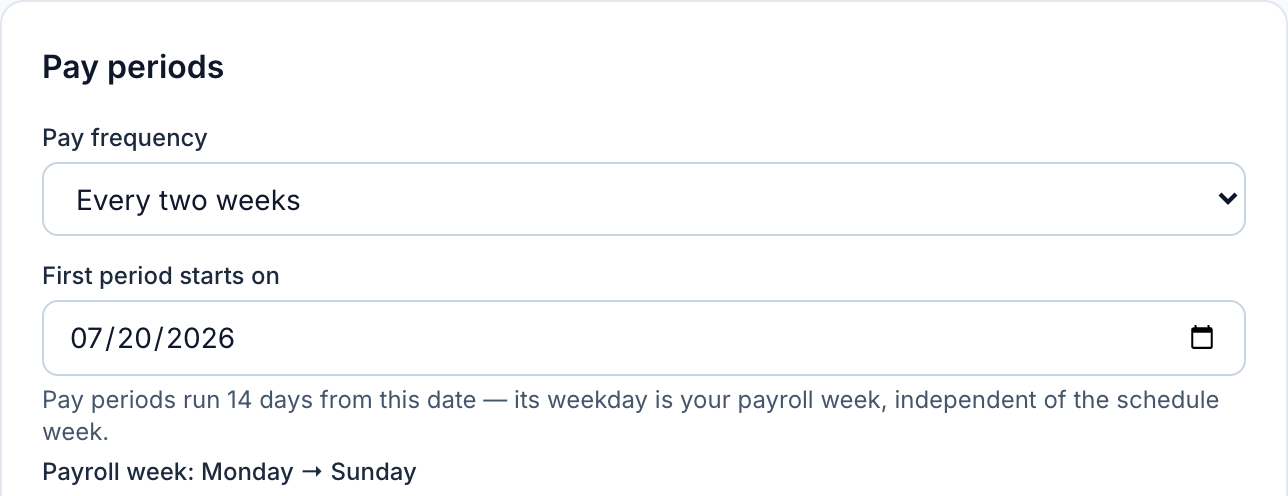
- Pay periods that match the law. Under Scheduling → Settings → Pay periods, choose weekly or every two weeks and the date the first period starts; timesheets, the pay summary and the payroll exports all follow it.
- Keep the kitchen out of the pool, tip credit or not. Under Who receives, pick only positions that serve customers, like servers, bartenders and bussers, and leave out cooks, dishwashers and anyone with managerial duties that day.
Sources
Every figure on this page comes from these official pages, as they read on the date shown.
- Massachusetts Department of Labor Standards, 454 CMR 27.00 (minimum wage regulation), checked September 24, 2026
- Massachusetts Attorney General, pay and recordkeeping, checked September 24, 2026
- Secretary of the Commonwealth, 2024 Question 5 (tipped minimum wage), checked September 24, 2026
- Mass.gov, Massachusetts law about minimum wage, checked September 24, 2026
- US Department of Labor, minimum wages for tipped employees by state, checked September 24, 2026
- US Department of Labor, overtime pay, checked September 24, 2026
- US Department of Labor, Fact Sheet #15: tipped employees under the FLSA, checked September 24, 2026
- Secretary of the Commonwealth, 2024 ballot question results, checked September 24, 2026
- Massachusetts General Laws, chapter 149, § 152A, checked September 24, 2026
- US Department of Labor, tips under the FLSA, checked September 24, 2026
- Massachusetts Attorney General, advisory on the Tips Act, checked September 24, 2026
- Massachusetts General Laws, chapter 151, § 1A, checked September 24, 2026
- Massachusetts Attorney General, working on Sundays and holidays, checked September 24, 2026
- Massachusetts Attorney General, breaks and time off, checked September 24, 2026
- US Department of Labor, breaks and meal periods, checked September 24, 2026
- US Department of Labor, state rest period requirements, checked September 24, 2026
- Massachusetts General Laws, chapter 149, § 67, checked September 24, 2026
- Mass.gov, earned sick time, checked September 24, 2026
- Massachusetts DPH, food allergen awareness guidance (2024), checked September 24, 2026
- Massachusetts Attorney General, earned sick time regulations (940 CMR 33.00), checked September 24, 2026
- Massachusetts General Laws, chapter 149, § 148C, checked September 24, 2026
- Massachusetts DFML, PFML employer contribution rates, checked September 24, 2026
- Massachusetts General Laws, chapter 149, § 148, checked September 24, 2026
This page is general information, not legal advice. Laws change, and coverage rules (your business's size, whether federal law covers you) decide which of them apply. Check the pages above, and ask an employment lawyer or accountant about your situation.
Run Massachusetts payroll on the right numbers
Set each position's wage, turn on the tip pool with managers left out, and let the time clock count overtime by the workweek. Then payroll is an export, not an evening.
Start your free trial: 30 days, every module, no card needed. Setting up a tip pool? Read Tip pooling for new restaurant owners.